

Thesify.ai
Thesify · Writing · Leaning
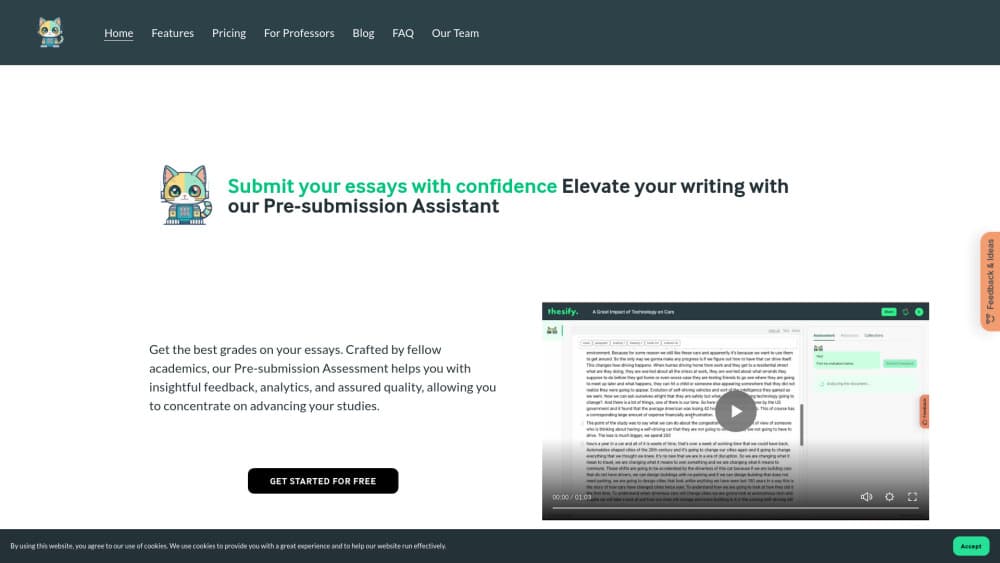
Thesify is an academic AI writing assistant for researchers. It reviews drafts against scholarly rubrics, points to real citations, and matches manuscripts to journals.
About Thesify.ai
What Is Thesify
Thesify is a web platform for people who write papers, theses, and dissertations. You upload a draft, say what kind of document it is, and get a structured report on argument strength, evidence, structure, and clarity. The output reads like a reviewer's notes, not a rewrite of your prose.
Two products share one account. Reviewer runs pre-submission checks on work you've already written. Coauthor is a writing workspace where agents search literature, read your PDFs, and propose edits as suggestions you accept or reject. The company says more than 30,000 academics use it and that 48,000 manuscripts have gone through the reviewer.
Scope is the main limit. Thesify doesn't write the paper for you, and it doesn't run plagiarism or AI-detection checks. Theses cap at 100 pages and uploads at 50 MB, so a journal article or a dissertation chapter fits, while a book-length monograph doesn't.
Getting Started
- Create an account at thesify.ai with email or Google sign-in.
- Choose Reviewer or Coauthor. Reviewer sells one-time credits, Coauthor runs a 7-day trial for €4.95 that returns as AI credits.
- Upload a Word or PDF draft, then set the document type and any instructions such as word count or analysis focus.
- Read the report. Findings are graded by severity, so you start with whatever blocks acceptance.
- Revise, upload the new version, and export the PDF report to send to a supervisor or co-author.
Product Information
A quick look at Thesify.ai's pricing, supported platforms, and performance.
Best for
The users, tasks, and scenarios where this tool fits best.
Users
- Graduate students finishing a master's thesis
- PhD candidates polishing a dissertation
- Early-career researchers preparing a journal submission
- Non-native English speakers
Tasks
- Pre-submission manuscript review
- Dissertation feedback before a defense
- Journal selection
- Citation hunting
Scenarios
- A supervisor who takes three weeks to reply
- A resubmission with two weeks on the clock
- A lab writing a paper together
Key features
Pre-Submission Review That Reads Like a Referee
The reviewer reads your draft the way a referee would and reports on argument, methodology, evidence, structure, and clarity. Each finding carries a severity grade, so a broken method section surfaces above a clumsy transition. You get the full report as a PDF you can annotate and file with your submission materials.
Feedback Chat That Explains the Why
A chat panel sits beside the report and breaks vague comments into concrete steps. Ask why a paragraph was flagged and you get the reasoning plus a direction to fix it, which matters more for a first-time author than a grade alone. It's closer to office hours than to a grammar checker.
Journal Recommender Ranked by Fit
The journal recommender ranks venues against your manuscript by topical fit, impact factor, and selectivity. Each entry carries the details you need to judge whether a desk rejection is likely, including scope notes and review timelines where available. You stop working from a list of journal names copied off a colleague's whiteboard.
Citation Finder Built on Real Papers
Highlight a sentence and the AI citation finder searches an index of 200 million peer-reviewed articles, then shows the full record so you can confirm the source exists before citing it. That fixes the worst failure mode of general chatbots, which invent plausible-looking references that collapse under an editor's check.
Coauthor Agents That Work Inside Your Draft
Coauthor runs guided agents for literature search, outlining, and revision, which covers most of the AI research writing loop. The agents read the PDFs you upload, so suggestions come from your sources rather than from generic training data. Every change arrives as a tracked suggestion, and a rich-text or LaTeX editor handles the writing itself.
Provenance Tracking and Version History
Each passage records whether a person or an agent produced it, and you can export an AI disclosure report matched to your target venue's policy. Snapshots save automatically and again before a large agent edit, so a bad revision is one click away from being undone. For labs worried about integrity rules, this is the feature that makes the rest usable.
Pros and cons
Pros
- Structured feedback in minutes instead of waiting weeks for a reader.
- Citations come from a live index of real papers, which removes the invented-reference risk that plagues general chatbots.
- Severity grading tells you what to fix first, and the PDF export is easy to share with a supervisor.
- Coauthor tracks AI versus human text, which helps with journal disclosure requirements.
Cons
- No free tier. You pay €14.95 for a single review before you know whether the feedback suits your field.
- Subject coverage varies. A humanities thesis and a clinical trial report don't get the same depth from a rubric-based system.
- It won't fix your writing for you, so a draft with serious structural problems still needs your own rewrite.
- No public API, which rules it out for teams that want to plug review into an internal submission pipeline.
Frequently asked questions
It reads a draft you've already written and returns a structured critique on argument, evidence, method, structure, and clarity, plus journal suggestions and real citations. It doesn't generate a paper from a prompt.
Related content
Explore related tools, skills, and articles for Thesify.ai.
Thesify.ai Alternatives

Google EmbeddingGemma 2
Google DeepMind · Writing · Image · CodingGoogle EmbeddingGemma 2 is a 740M-parameter open model that turns text, code, images, audio, and video frames into vectors in one 768-dimension space, running on phones and laptops.

MePersona
MePersona, Inc. · Writing · Productivity · MarketingMePersona is an AI unified inbox for creators. It learns your voice, drafts replies to fan messages from 12 platforms, and sends only what you approve.

Fluence
Yay Software (Yannick Huchard) · Writing · Voice & Language · ProductivityFluence is an Android app that reads PDFs, EPUBs, Word files and web articles aloud, follows each sentence as it speaks, and answers questions about the text on the phone itself.