

Thumos Care
Thumos Care, Inc. · Marketing · AI Assistant
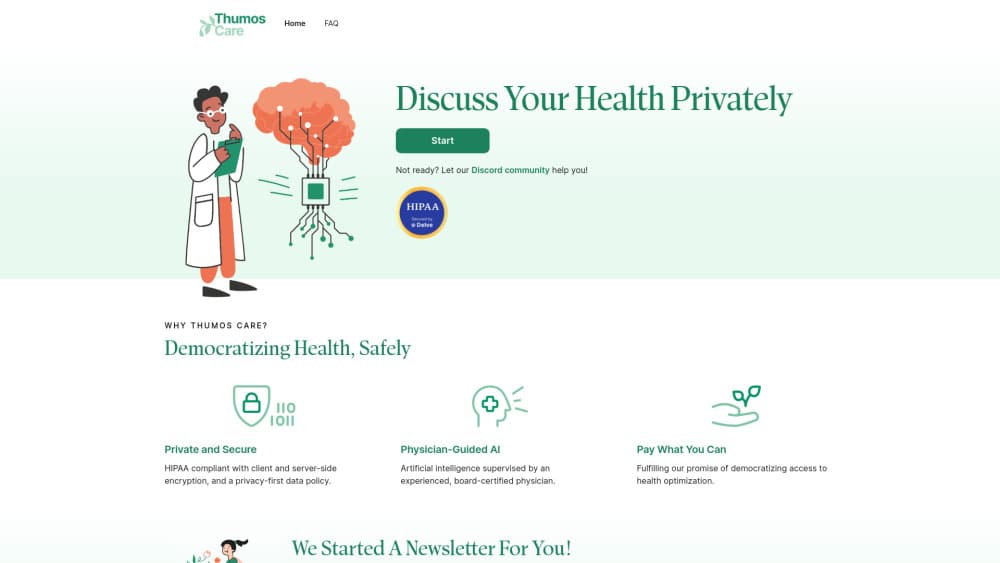
Thumos Care is a web app that turns blood test results into a body-system health report, tracks biomarker trends over time, and answers follow-up questions in chat.
About Thumos Care
What Is Thumos Care
Thumos Care is a web app for people who leave a lab appointment holding a page of numbers and a reference range that explains almost nothing. It is a health data app built around one job: lab results explained in plain terms. You upload the results and the app maps each biomarker across major body systems: cardiovascular, metabolic, hormonal, immune, and a few more. Every system gets a status, so the report points at what needs attention instead of listing forty values in a row. The company calls this AI blood test analysis, and the framing is why the output reads like a summary rather than a spreadsheet.
What separates it from a patient portal is the context it collects first. The intake covers medical history, family history, lifestyle, medications, supplements, symptoms, and goals. Analysis then runs against a medical knowledge graph with more than 130,000 biomedical relationships and scores function rather than flagging single out-of-range values. The company calls the approach physician-guided AI, and board-certified oversight is part of the pitch. You can ask follow-up questions by text or voice, and the answers use your own profile instead of generic advice.
The limits are worth knowing before you sign up. Thumos Care doesn't diagnose conditions and doesn't write prescriptions, and the site describes its output as informational rather than medical advice. It also can't order labs for you, so you need results from your own doctor or a lab you already use. The company states that the service is HIPAA compliant, third-party verified, and end-to-end encrypted, and it publishes no price list beyond "free to start."
Getting Started
- Create an account at app.thumoscare.com. The free tier needs no credit card.
- Fill in the intake: conditions, medications, supplements, lifestyle, symptoms, and what you want to improve.
- Upload blood tests, a DEXA scan, or other health records as PDF, Excel, or by typing values in by hand.
- Read the body-system breakdown, then open the recommendation list sorted by urgency.
- Chat with the health advisor about anything unclear, or invite your physician to view the profile and add clinical notes.
Product Information
A quick look at Thumos Care's pricing, supported platforms, and performance.
Best for
The users, tasks, and scenarios where this tool fits best.
Users
- Adults with a recent blood panel and no clear explanation
- Self-trackers who retest every few months
- Primary care clinicians who want evidence at the point of care
Tasks
- Making sense of an annual physical report
- Checking whether a change worked
- Preparing for a doctor appointment
- Finding guideline-backed evidence on a clinical question
Scenarios
- A physical turns up a flagged marker and the printed range tells you nothing about what to do next.
- You start a new medication and want to see how lipids or liver enzymes move over the following months.
- A small clinic has no research librarian, and the doctor needs a guideline citation during a fifteen minute appointment.
Key features
Body System Breakdown
Instead of sorting results by lab panel, Thumos Care groups biomarkers by the system they belong to: cardiovascular, metabolic, hormonal, immune. Each system shows a status so you can see where the picture looks off. This is the part that makes the bloodwork analysis readable at a glance. That framing helps when a single number sits inside the reference range but the surrounding pattern does not.
Trend Tracking Across Retests
Biomarker tracking starts with a log of lifestyle changes, medications, supplements, and symptoms, then compares every measurement against earlier uploads. Trend arrows and historical charts do the work that a stack of PDFs can't. The value compounds with each retest, and it stays flat if you only ever upload once.
Context Intake Before Analysis
The intake asks for medical history, family history, medications, supplements, symptoms, and goals. Recommendations then reflect the person, not just the panel. Someone with a family history of heart disease gets a different read on an LDL value than a 25 year old with no risk factors.
Text and Voice Health Chat
An AI health advisor answers questions using your biomarkers, history, medications, lifestyle, and trends. You can type or talk, which matters when you're reading a report on a phone at night. Answers reference your own data, and the app avoids blanket advice that ignores your context.
Recommendations Sorted by Urgency
Guidance is organized into supplements, lifestyle, diet, and follow-up testing, then ordered by how soon it matters. Every item links back to the body system that triggered it. You get a plan of action rather than a list of abnormal values with no ranking.
Clinician Workspace With Evidence Search
Doctors get a separate view: patient dashboard, clinical notes tagged by body system, and a search tool covering PubMed, Cochrane, and guidelines from USPSTF, AHA/ACC, ADA, CDC, NICE, and ESC. Results come with inline citations and collapsible references, and clinicians can generate patient handouts from the same search.
Pros and cons
Pros
- Explains results system by system, which is closer to how a doctor thinks than a panel-by-panel list.
- Keeps a running history, so the second and third uploads are more useful than the first.
- The chat knows your medications and history, so answers don't read like a search engine result.
- Free tier with no credit card lowers the cost of trying it on one lab report.
- Clinicians can add notes that feed into the patient's analysis, which keeps both parties on the same page.
Cons
- No diagnosis and no prescriptions, so it can't replace a visit for anything that needs treatment.
- Paid tiers exist behind the free start, but the company publishes no price list, which makes budgeting guesswork.
- It doesn't order labs, and people without recent results have nothing to upload.
- Web only, with no mobile app and no public API for developers.
Frequently asked questions
It extracts the values, maps each biomarker to a body system, and scores how that system looks given your history and goals. You get a status per system plus recommendations grouped by supplements, lifestyle, diet, and follow-up testing, ordered by urgency.
Related content
Explore related tools, skills, and articles for Thumos Care.
Thumos Care Alternatives

ngram 2.0
ngram · Video · Marketingngram 2.0 is an AI video generator for teams. It turns a prompt, a screen recording, or a product URL into a narrated explainer, product demo, or AI avatar video, and every scene stays editable.

shippedit.me
Krawlup · Marketing · Businessshippedit.me now redirects to Krawlup, a web platform that audits SEO, AEO and page speed every week, then hands the fixes to AI coding agents over MCP.

MePersona
MePersona, Inc. · Writing · Productivity · MarketingMePersona is an AI unified inbox for creators. It learns your voice, drafts replies to fan messages from 12 platforms, and sends only what you approve.