

Tilores
Tilores · Coding · Leaning
Tilores is a real-time entity resolution platform that links duplicate, conflicting records across your systems into one resolved entity for fraud, KYC, and AI teams.
About Tilores
What Is Tilores
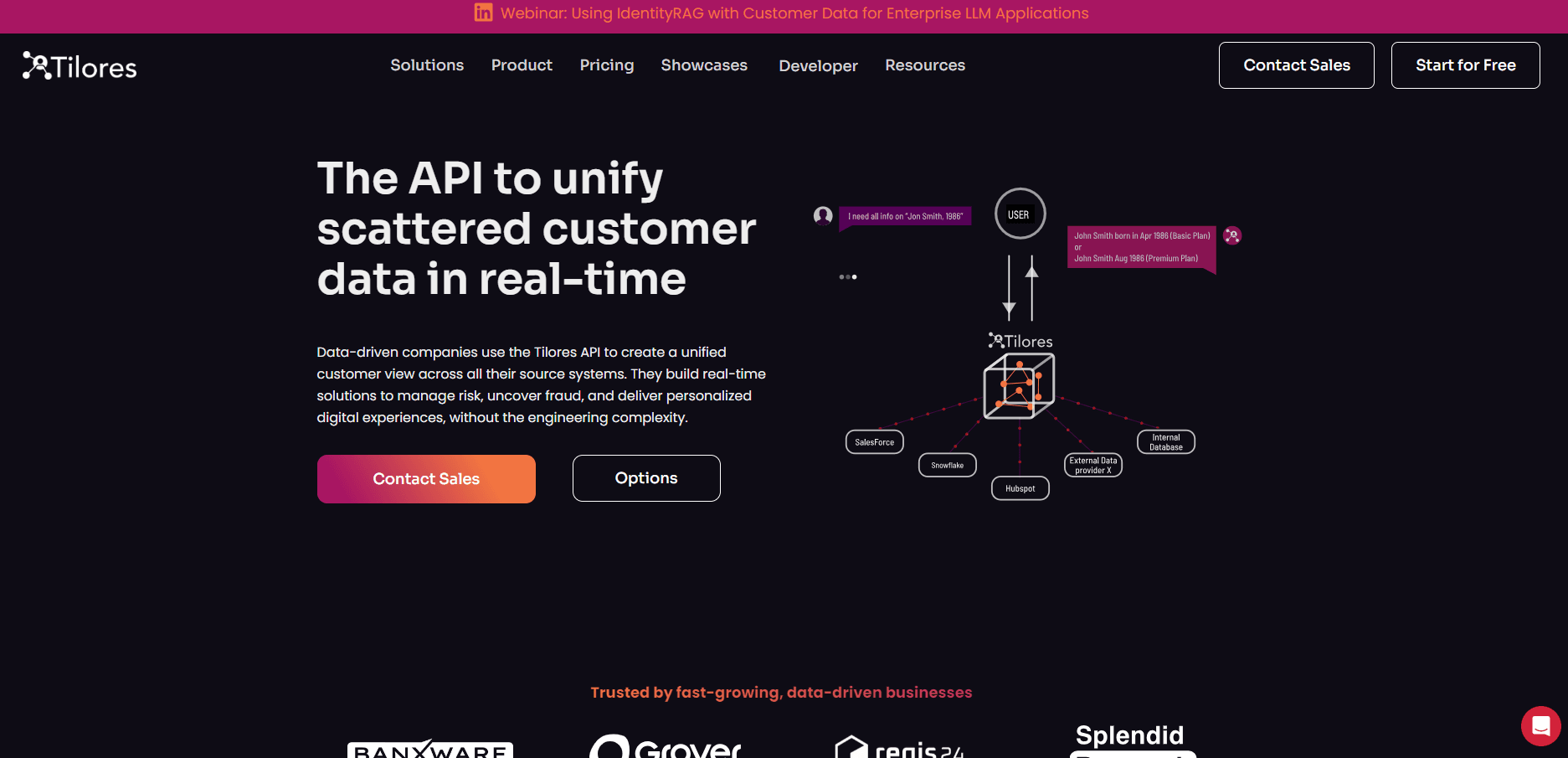
Tilores is entity resolution infrastructure for developers. It takes the same person or company showing up under different spellings across your CRM, support tool, and warehouse, then links those records into one entity your whole stack can read from.
The company started in 2021, spun out of Regis24, a German consumer credit bureau. The founding team ran the technology there and needed to fuzzy-match hundreds of millions of records about tens of millions of people. Traditional databases couldn't match at that scale, graph databases were too slow, and batch systems added delays they couldn't accept. Tilores is the engine they built instead.
Tilores competes with general identity resolution platforms, but it's built for a narrower job: serving a live application a resolved entity at query time, not cleaning data in a nightly sweep. The product sits as a layer in your stack, not a platform you rebuild around. Data flows in through a GraphQL API or prebuilt connectors, records get matched as they arrive, and resolved entity events flow back out to your warehouse, fraud platform, or AI application. Two limits are worth knowing up front. Pricing is enterprise only, so there's no public plan to compare. And the free evaluation build, Tilores Studio, caps at 100,000 records on your own machine.
Getting Started
- Download Tilores Studio, the free desktop app for macOS, Windows, or Linux, and load a sample dataset or your own records. No account or licence key is required.
- Configure a matching profile. Studio ships with person matching and company matching sets up, so you can see how fuzzy rules behave before writing your own.
- Inspect the resolved entities and the match explanations, which show exactly which rules linked two records.
- Connect the same Studio to a cloud deployment when you're ready for production. Matching rules carry over, so there's no migration.
- Push records in through the GraphQL API or a connector like Salesforce, HubSpot, or Snowflake, and query resolved entities from your own applications.
Product Information
A quick look at Tilores's pricing, supported platforms, and performance.
Best for
The users, tasks, and scenarios where this tool fits best.
Users
- Developers building identity features
- Fraud and risk teams
- Compliance and KYC teams
- Data teams running Customer 360
- AI and data science teams
Tasks
- Deduplicating customer records
- Matching records in real time
- Sanctions and KYC screening
- Grounding LLM responses
- Building an audit trail
Scenarios
- A fraud team spots a repeat signup
- A bank prepares for a KYC review
- A support agent opens a ticket
- An AI assistant answers an account question
Key features
Real-time resolution, not batch
Tilores matches records as they arrive instead of running an overnight job. Ingestion takes under 300ms on AWS, and queries return in about 150ms; self-hosted deployments run closer to 1ms. That matters when a stale match carries risk, like identifying a sanctioned entity during onboarding. There's no Tuesday morning snapshot to wait for.
Explainable matching rules
Every link between two records comes with a reason. You can see which rule fired, such as a matching phone plus postal code, and tune precision and recall to fit your case. Tilores positions this against black-box matching, because KYC and AML work often needs a defensible answer. The audit trail follows each field back to the source record it came from.
IdentityRAG for LLMs
IdentityRAG connects Tilores to LangChain and Amazon Bedrock. Before an LLM answers, it retrieves a deduplicated customer 360 across every source system, so the model isn't guessing from a single table. It works with any LLM through the LangChain integration, and Tilores calls it persistent entity memory for AI agents.
Flexible deployment
The same engine runs four ways. Managed Cloud is fully serverless in Tilores' AWS account and available on AWS Marketplace. You can also deploy into your own AWS account, another cloud, or on-premise, including air-gapped environments. Tilores needs a key-value store, a queue, and file storage, which on AWS are DynamoDB, SQS, and S3.
GraphQL API and connectors
Everything runs over one real-time GraphQL API, which also supports SQL access. You fetch an entity by any record, run fuzzy searches ranked by hit score, and aggregate across sources. Prebuilt connectors cover Salesforce, HubSpot, and Snowflake, and webhooks stream resolved entity events into your existing stack.
Tilores Studio for evaluation
Studio is a free desktop app for macOS, Windows, and Linux that runs entity resolution locally on up to 100,000 records. Your data never leaves your machine, and there's no signup. It includes person and company matching plus sample datasets, so a first matched entity can appear in under ten minutes. The same window then connects to production.
Pros and cons
Pros
- Real-time matching avoids the delay of overnight batch jobs, which matters for fraud and KYC.
- Match explanations and an audit trail make results defensible to regulators, not just accurate.
- It runs where your data already lives, including your own cloud, on-premise, or air-gapped setups.
- IdentityRAG grounds LLM answers in one resolved customer profile rather than fragments.
- The free Studio build lets teams test matching on real data before any sales conversation.
Cons
- Pricing isn't public, so you can't compare costs without booking a demo.
- Studio's 100,000-record limit is fine for a proof of concept but too small for production volumes.
- It's aimed at teams with engineering resources, since setup runs through a GraphQL API and connectors.
- There's no per-seat or self-serve plan, which puts small teams on an enterprise sales path.
Frequently asked questions
Tilores is entity resolution software that links duplicate and conflicting records about the same person or company into one resolved entity. Fraud, compliance, Customer 360, and AI teams then query that single view.
Related content
Explore related tools, skills, and articles for Tilores.
Tilores Alternatives

Base Code
Base44 (Wix) · Coding · ProductivityBase Code is a shared cloud development environment from Base44. Teammates describe changes to an existing GitHub codebase in chat, preview them live and send them back as pull requests.

Google EmbeddingGemma 2
Google DeepMind · Writing · Image · CodingGoogle EmbeddingGemma 2 is a 740M-parameter open model that turns text, code, images, audio, and video frames into vectors in one 768-dimension space, running on phones and laptops.

GitGlow
GitGlow · Coding · ProductivityGitGlow is a local-first desktop Git client that lets independent developers review their own code and their AI agents' changes in one place before shipping.