

TLDL - Too Long; Don't Listen
TLDL · Writing · Voice & Language · Productivity
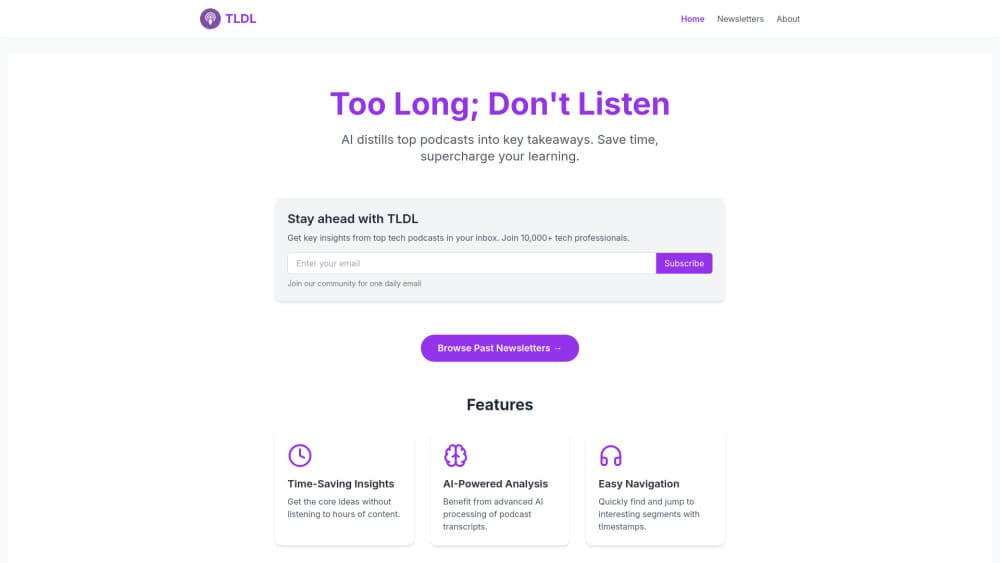
TLDL (Too Long; Don't Listen) turns long AI and tech podcasts into short written digests with key takeaways, quotes and timestamps. It's free to read on the web, with an RSS feed and newsletter.
About TLDL - Too Long; Don't Listen
What Is TLDL - Too Long; Don't Listen
TLDL is a free web service that condenses long AI and tech podcast episodes into short written digests. The name answers the obvious complaint: a two-hour conversation holds twenty minutes of substance, and most people never get to it. TLDL reads the episode for you and publishes the parts worth keeping.
Every issue follows the same structure. You get a concise summary of the episode, a numbered list of takeaways you can act on, notable quotes with timestamps, and a Q&A breakdown that turns a messy conversation into questions and answers you can scan. The digests cover shows like Lightcone (YC), Lex Fridman, All-In, a16z Podcast, Latent Space, Acquired, No Priors and The Gradient, with more shows added weekly.
Beyond the digests, the site runs a wider resource library. There are LLM pricing comparisons, a directory of more than 2,000 AI companies, guides to AI coding tools, market maps and job resources. The catch is that everything TLDL publishes is only as good as the transcript underneath it, and it's a reading product rather than a listening one. If you want audio on your commute, this isn't that.
Getting Started
- Open the TLDL website and browse the latest issues or the full archive.
- Subscribe by RSS feed or email newsletter if you want new digests without checking back.
- Read an issue: summary first, then numbered takeaways, quotes and the Q&A section.
- Follow a topic or a show to narrow future issues to what you care about.
- Use the resource pages, like the LLM pricing guide or the AI companies directory, when you need reference material.
Product Information
A quick look at TLDL - Too Long; Don't Listen's pricing, supported platforms, and performance.
Best for
The users, tasks, and scenarios where this tool fits best.
Users
- Engineers tracking AI
- Founders and product people
- Investors
- Students and self-learners
Tasks
- Catching up on a backlog
- Pulling quotes for writing
- Comparing API costs
- Building an AI reading list
- Onboarding a team
Scenarios
- A packed week with no listening time
- Researching a specific claim
- Preparing for a meeting
Key features
Structured Episode Digests
Each issue turns one or more podcast episodes into a fixed structure: a short summary, numbered takeaways, notable quotes with timestamps and a Q&A breakdown. You scan in a couple of minutes what would have taken an hour to hear. The format stays consistent across issues, so you always know where to look for a given part.
Concise Summaries and Actionable Takeaways
The summary states the episode's main arguments, and the takeaways list the individual points worth remembering. TLDL keeps the technical detail rather than flattening a conversation into vague advice. If a guest makes a specific claim about a model, a market or a decision, it usually survives into the digest.
Notable Quotes with Timestamps
Quotes pull the exact wording from founders, researchers and investors, with timestamps pointing back to the source. That lets you check the original context instead of trusting a paraphrase. It's the feature that makes a digest usable for writing or for a meeting, where the exact phrasing matters.
Topic and Show Navigation
Issues are indexed by topic and by show. Topics span AI and machine learning, startups and venture, and engineering and infrastructure, among others. You can follow the shows you already trust, or browse a topic when you want to see how several shows treated the same question.
Podcast Coverage That Keeps Growing
TLDL tracks the shows technical audiences actually follow, including Lightcone (YC), Lex Fridman, All-In, a16z Podcast, Latent Space, Acquired, No Priors and The Gradient. New shows are added weekly rather than in one fixed list. Coverage stays focused on AI and tech, so niche or non-English podcasts rarely appear.
AI Resource Library
Alongside the digests, the site collects reference pages: LLM API pricing comparisons, a directory of more than 2,000 AI companies, AI coding tool comparisons, market maps and job guides. These pages answer the practical questions that come up while you're working, not just while you're catching up on audio. They're free to browse and updated over time.
RSS and Newsletter Delivery
You can read TLDL on the website, follow an RSS feed, or get issues by email. The RSS route keeps updates out of your inbox, while the newsletter puts a digest in front of you when a new issue lands. Both are free, and neither requires a paid tier.
Pros and cons
Pros
- It's free to read, with no account and no paywall between you and the digests.
- The fixed structure, with summary, takeaways, quotes and Q&A, makes issues quick to scan for a specific part.
- Quotes carry timestamps, so you can trace a claim back to the source episode instead of trusting a paraphrase.
- The resource library extends past podcasts into LLM pricing, AI company and tool comparisons.
Cons
- It's text only. There's no audio version, so it doesn't replace listening on a commute or at the gym.
- Coverage leans toward a limited set of English-language tech shows, so niche or non-English podcasts are mostly left out.
- Summaries are a starting point and can miss nuance, so anything you plan to act on is worth checking against the original episode.
- It's a website and feed rather than a mobile app with search and offline reading, which limits how you use it on the move.
Frequently asked questions
TLDL is used to turn long AI and tech podcast episodes into short written digests. Each issue gives you a summary, numbered takeaways, quotes with timestamps and a Q&A breakdown, so you can follow the shows worth hearing without committing the listening time.
Related content
Explore related tools, skills, and articles for TLDL - Too Long; Don't Listen.
TLDL - Too Long; Don't Listen Alternatives

Google EmbeddingGemma 2
Google DeepMind · Writing · Image · CodingGoogle EmbeddingGemma 2 is a 740M-parameter open model that turns text, code, images, audio, and video frames into vectors in one 768-dimension space, running on phones and laptops.

MePersona
MePersona, Inc. · Writing · Productivity · MarketingMePersona is an AI unified inbox for creators. It learns your voice, drafts replies to fan messages from 12 platforms, and sends only what you approve.

Fluence
Yay Software (Yannick Huchard) · Writing · Voice & Language · ProductivityFluence is an Android app that reads PDFs, EPUBs, Word files and web articles aloud, follows each sentence as it speaks, and answers questions about the text on the phone itself.