

Tokenomy.ai
Tokenomy.ai · Coding · Business
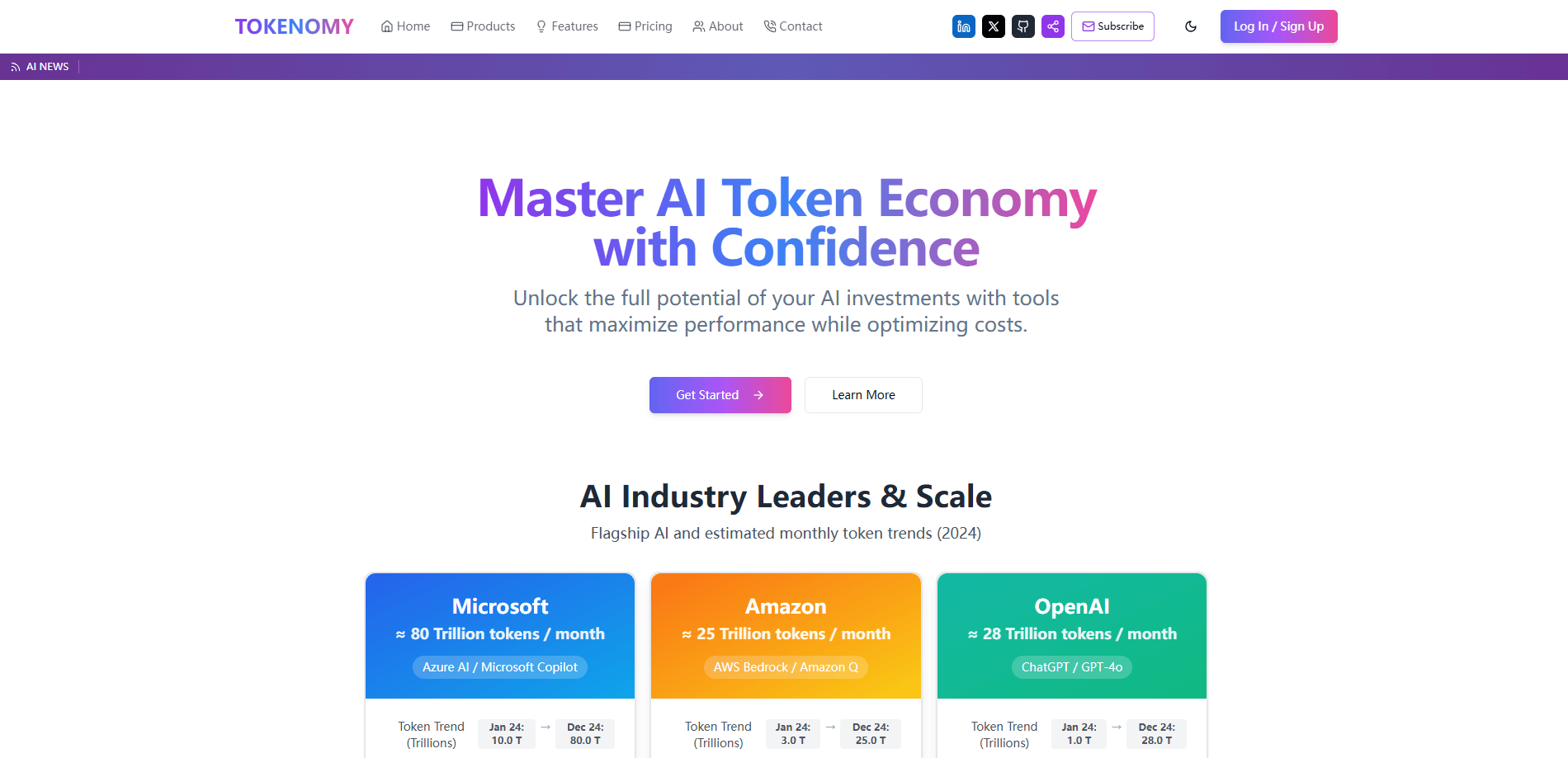
Tokenomy.ai is a runtime FinOps platform for LLMs and agents. It meters every call, caps spend inside the request path, and routes work to the cheapest model that meets your quality bar.
About Tokenomy.ai
What Is Tokenomy.ai
Tokenomy.ai is an AI cost management platform built for teams that run language models in production. It sits between an application and the model providers as a proxy, so every request passes through its ledger before it reaches a paid endpoint. That position is the whole point: a tool that reads last month's invoice can describe the problem, but only something inside the request path can stop the spend.
The product splits into two halves. The runtime side handles metering, budget enforcement, routing and attribution for live traffic. The free side is a set of calculators, simulators and price data that anyone can use without an account, including a token calculator, a memory estimator and a live pricing catalog for over 40 models.
The catch is that value depends on adoption. Attribution only reaches the agent, step or customer level if requests actually route through the proxy, which means an engineering change to the base URL, not just a finance report. Teams that only want to read historical spend are better served by tools that ingest provider invoices directly.
Getting Started
- Create a workspace at tokenomy.ai and grab a Tokenomy API key from the dashboard.
- Point your SDK at the OpenAI-compatible base URL so calls land in the metering proxy.
- Connect your own provider keys (BYOK) for OpenAI, Anthropic, Google, xAI or open-weight endpoints.
- Set budgets with hard and soft caps, then add routing policies for quality, latency and cost.
- Watch the Cost Explorer for attribution by agent and customer, and export chargeback reports.
Product Information
A quick look at Tokenomy.ai's pricing, supported platforms, and performance.
Best for
The users, tasks, and scenarios where this tool fits best.
Users
- Platform and infra engineers
- Finance and FP&A teams
- Product teams guarding gross margin
Tasks
- LLM cost optimization
- Token metering and AI spend attribution
- Budget enforcement with an AI budget guard
Scenarios
- A bill that tripled without a clear cause
- Preparing an AI margin review
- Comparing models before a migration
Key features
BYOK metering proxy
Tokenomy.ai runs an OpenAI-compatible proxy that teams reach by swapping one base URL. With bring-your-own-keys, provider spend stays on the customer's own accounts, so there's no migration and no reseller markup on top. Every request lands in a real ledger rather than a sampled estimate.
Budget guard in the request path
Budgets are declarative, with hard and soft caps plus anomaly detection on a z-score basis. When a quota is hit, the proxy returns an HTTP 402 instead of forwarding the call. Circuit breakers are wired the same way, which is how an unexpected agent loop gets stopped mid-run rather than discovered at month end.
Smart router and right-sizing
The router applies quality and latency thresholds that the user defines, then picks the cheapest model that still passes. Response caching with measured hit ROI sits beside it, and the Model Right-Sizing Lab sweeps an actual workload across models to find the lowest-cost plan that keeps its quality bar.
Agent-level cost attribution
Attribution reaches agent, step, tool call, product, customer and environment, and even a request hash. That granularity comes from sitting in the request path, because the context that ties spend to a specific agent never leaves the application otherwise. Per-run breakdowns show which retry policy or context payload is doing the damage.
Effective-dated price records
Model prices move without notice, and Tokenomy.ai keeps a dated row per model per day. Margin, forecast and chargeback figures stay reproducible because the rate used on any given day can be looked up on demand, rather than relying on a current-price lookup that changes underneath the report.
Chargeback and margin reporting
The platform turns metered cost into finance-ready output: margin per customer, forecast bands, commit burn-down and chargeback exports in CSV and PDF. Executive PDF reporting and scheduled digests are built in, which is what lets a platform team hand FP&A a number it can stand behind.
Pros and cons
Pros
- Enforcement happens before spend, not after, so budgets can stop a runaway agent loop instead of just reporting it.
- BYOK design keeps provider spend on the customer's accounts, which removes migration friction and cuts out reseller markup.
- Attribution reaches the agent, step and customer level, a granularity that invoice-reading tools structurally can't match.
- Free tier covers real usage up to $2,500 per month of routed spend, plus the full calculator suite at no cost.
- Dated price records make historical margin and chargeback numbers reproducible on demand.
Cons
- Agent-level value requires routing live traffic through the proxy, which is a code change teams have to ship.
- Pricing is a percentage of spend under management, so the bill scales with volume and needs forecasting of its own.
- The self-serve tiers stop at $1,999 per month, and larger deployments move to a sales-led enterprise plan.
- Teams that only need a static price list will find the free catalog sufficient and the runtime rails unnecessary.
Frequently asked questions
It's an AI cost management platform that meters every LLM and agent call, enforces budgets inside the request path, and routes each request to the cheapest model that still passes a quality bar. It also attributes spend down to the agent and customer level.
Related content
Explore related tools, skills, and articles for Tokenomy.ai.
Tokenomy.ai Alternatives

Base Code
Base44 (Wix) · Coding · ProductivityBase Code is a shared cloud development environment from Base44. Teammates describe changes to an existing GitHub codebase in chat, preview them live and send them back as pull requests.

Google EmbeddingGemma 2
Google DeepMind · Writing · Image · CodingGoogle EmbeddingGemma 2 is a 740M-parameter open model that turns text, code, images, audio, and video frames into vectors in one 768-dimension space, running on phones and laptops.

GitGlow
GitGlow · Coding · ProductivityGitGlow is a local-first desktop Git client that lets independent developers review their own code and their AI agents' changes in one place before shipping.