

TraceRoot.AI
TraceRoot AI · Coding
TraceRoot is an open-source observability and self-improving layer for AI agents. It turns production traces into detectors, improvement signals, and evals your coding agent can act on.
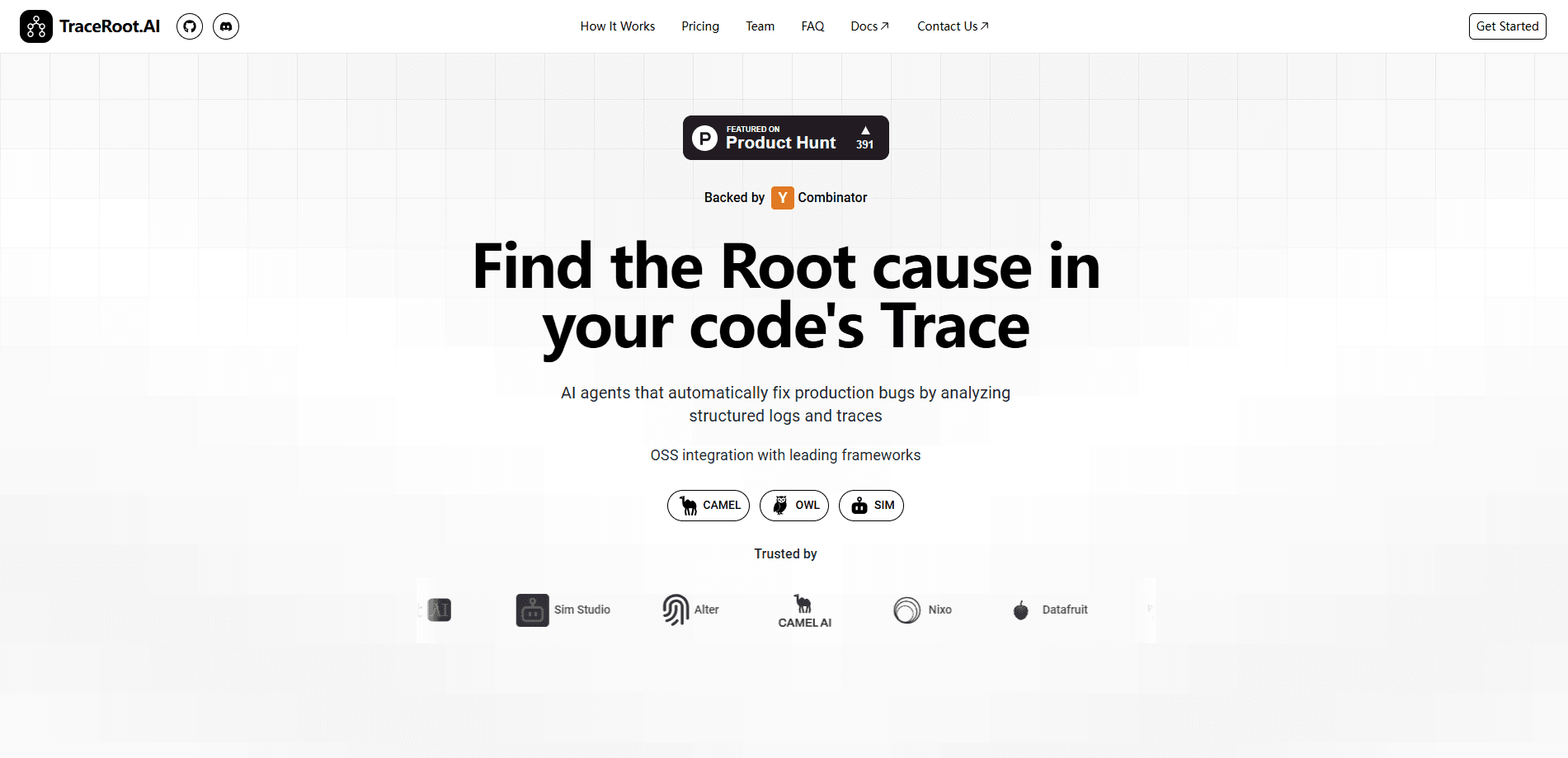
About TraceRoot.AI
What Is TraceRoot
TraceRoot is a platform for teams shipping AI agents into production. It records every model call, tool call, and agent decision, then runs detectors that flag failures, hallucinations, and drift the moment they happen. The pitch is simple: your agent passed the tests, but production still finds the gaps.
Most agent bugs stay invisible until a customer hits them. A wrong answer can look like a successful run. Tool loops quietly burn time and tokens. A prompt tweak that fixes one case breaks three others, and manual spot checks never catch it. TraceRoot exists to turn those silent failures into concrete fixes you can test and ship.
The tool is open source under Apache 2.0 for everything outside directories named ee, so you can self-host it with Docker or use TraceRoot Cloud. The catch is that the full loop rewards teams who already run a coding agent, since investigation and fix generation happen through that agent. Solo developers on a tight budget also hit the free plan's 50k event ceiling fast once traffic picks up.
Getting Started
- Sign up at app.traceroot.ai or self-host the platform with Docker Compose and run it locally.
- Create a project in your dashboard, then copy the project API key it generates.
- Instrument your app. Install the CLI with
npm install -g traceroot-cli, runtraceroot login, and ask your coding agent to set up tracing. Or wire the Python or TypeScript SDK by hand. - Send a trace to confirm data is flowing, then open the Traces page to inspect the run.
- Add detectors and datasets so TraceRoot can flag failures and score changes as you iterate.
Product Information
A quick look at TraceRoot.AI's pricing, supported platforms, and performance.
Best for
The users, tasks, and scenarios where this tool fits best.
Users
- AI engineering teams shipping agents to production
- Developers debugging flaky agent behavior
- Small startups without a dedicated observability stack
Tasks
- Diagnosing why an agent gives wrong answers that still passed automated tests
- Catching regressions after a prompt or model change
- Closing the improvement loop with a coding agent
Scenarios
- A customer support agent that loops on tool calls and wastes tokens
- A RAG pipeline that silently retrieves stale documents
- A team running nightly prompt experiments
Key features
OpenTelemetry-Based Tracing
TraceRoot captures every LLM call, tool invocation, and agent step with inputs, outputs, latency, and cost attached. It ships native Python and JavaScript/TypeScript SDKs plus a full OpenTelemetry path, so the data comes through the format you already use.
Detectors for Live Failure Detection
Detectors run online evaluation on production traces and flag runs that miss the mark. You define what good behavior looks like once, and TraceRoot checks every new trace against that standard the moment it arrives.
Improvement Signals from Clustered Judge Outputs
Related judge outputs get grouped into improvement signals, so you see recurring patterns instead of thousands of scattered failures. A background coding agent then investigates those signals alongside your connected GitHub code in a sandbox.
Offline Evals and Regression Checks
You run evals against your datasets and compare versions to measure what improved and what broke. This is the part that catches the regressions a quick spot check would miss, and it keeps the loop honest.
Agent-Native CLI
The TraceRoot CLI gives your coding agent read and write access to traces, signals, datasets, evals, dashboards, and alerts. Install it with npm install -g traceroot-cli, run traceroot login, and your agent can pull production context and push changes without you relaying data by hand.
Broad Framework and Provider Support
TraceRoot connects to LangGraph, CrewAI, Vercel AI SDK, LlamaIndex, OpenAI Agents SDK, and other common frameworks, plus model providers like OpenAI, Anthropic, Gemini, Mistral, and OpenRouter. Over 40 integrations cover most stacks without custom glue code.
Pros and cons
Pros
- Open source under Apache 2.0, so you can self-host with Docker or start on the cloud without committing.
- Free plan needs no credit card and includes 2 seats, 50k events per month, and Slack alerts for detectors.
- Detectors, signals, and evals form a genuine loop, not just a dashboard that shows you problems and stops.
- The CLI lets a coding agent read production context and write fixes, which removes the manual copy-and-paste step.
- Bring-your-own-key support runs on every plan, so you can keep model costs and data under your own accounts.
Cons
- The full self-improving loop assumes you already use a coding agent, so teams without one get less value from the fix-generation side.
- The free plan caps at 50k events per month and keeps only 15 days of retention, which runs out fast for busy production agents.
- Paid plans jump from $30 to $200 per month, and the Pro tier mainly adds retention and rate limits rather than new features.
Frequently asked questions
TraceRoot records and evaluates AI agent runs in production. It traces every model and tool call, detects failures with live evaluation, groups recurring problems into signals, and verifies fixes with offline evals.
Related content
Explore related tools, skills, and articles for TraceRoot.AI.
TraceRoot.AI Alternatives

Base Code
Base44 (Wix) · Coding · ProductivityBase Code is a shared cloud development environment from Base44. Teammates describe changes to an existing GitHub codebase in chat, preview them live and send them back as pull requests.

Google EmbeddingGemma 2
Google DeepMind · Writing · Image · CodingGoogle EmbeddingGemma 2 is a 740M-parameter open model that turns text, code, images, audio, and video frames into vectors in one 768-dimension space, running on phones and laptops.

GitGlow
GitGlow · Coding · ProductivityGitGlow is a local-first desktop Git client that lets independent developers review their own code and their AI agents' changes in one place before shipping.