
Tredence
Tredence Inc. · Other
Tredence is an enterprise AI and analytics consulting firm that builds data platforms, agentic AI systems and industry-specific analytics for large companies.
About Tredence
What Is Tredence
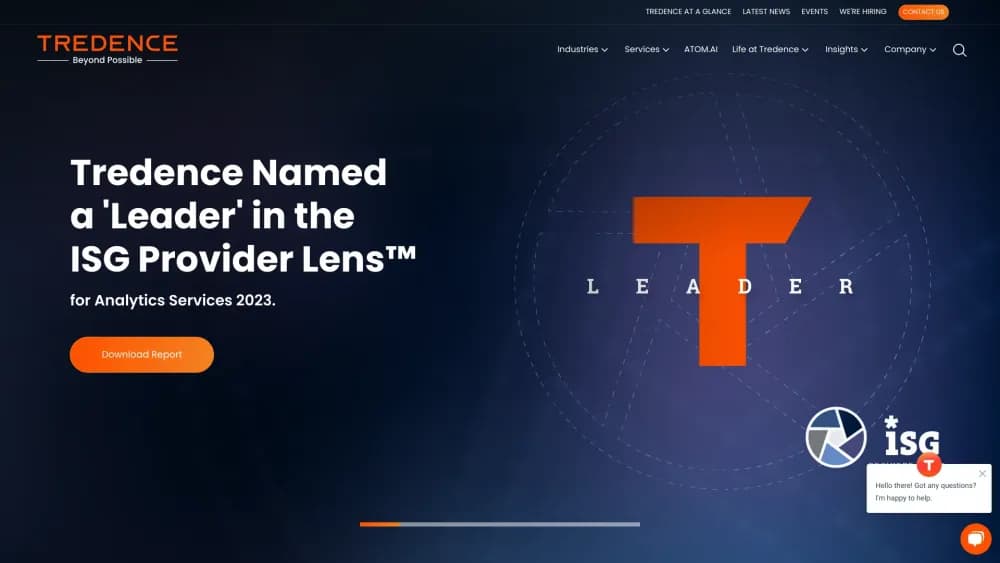
Tredence Inc. is an enterprise AI and analytics company, and it works as a consulting firm rather than as a self-serve product. Founded in 2013 and based in San Jose, California, it works with large companies on the unglamorous part of AI: getting data clean enough, models reliable enough and workflows embedded deep enough that decisions actually change. The company calls this "last-mile adoption," and it's the phrase that shows up in almost everything it publishes.
Clients come mostly from retail, consumer packaged goods, healthcare, life sciences, banking, insurance, telecom and industrials. Work usually starts with a data platform project, then expands into AI and analytics applications on top of it. Tredence sells through Databricks, Snowflake, Google Cloud, Microsoft, AWS and OpenAI. Much of what it builds sits inside those stacks rather than on its own infrastructure.
The limits are worth knowing before you call. There's no listed pricing, no free tier and no public self-serve signup. Engagement starts with a sales conversation, and the smallest projects typically still run for months with a dedicated team. If you're a startup or a single department looking for a tool you can test this afternoon, this isn't it.
Getting Started
- Reach out through the contact form or the sales line at +1-408-819-2336 to describe the problem you're trying to solve.
- Run a scoping conversation with the practice team for your industry. Expect questions about current systems, data quality and who will own the output after handover.
- Agree on a pilot or discovery phase. Tredence commonly prototypes with its prebuilt accelerators before committing to a full build.
- Stand up the production system with the delivery team, usually on your existing cloud and data stack.
- Take over operations with runbooks, dashboards and the option of ongoing managed support for models and agents.
Product Information
A quick look at Tredence's pricing, supported platforms, and performance.
Best for
The users, tasks, and scenarios where this tool fits best.
Users
- Data and analytics leaders at large enterprises
- Retail and CPG teams
- Healthcare and life sciences organizations
- Engineering leaders adopting agentic AI
Tasks
- Consolidating data across disconnected systems
- Moving AI pilots into production
- Building decision support for supply chains
- Designing a generative AI strategy
Scenarios
- A retailer wants to cut stockouts across thousands of stores
- A distributor needs to recover rebate income it's leaving on the table
- A hospital group runs seven practice management systems
- An enterprise has a board mandate on AI but no production system
Key features
Agentic AI Design and Orchestration
Tredence builds multi-agent systems that carry out work across sales, operations, finance and supply chain rather than just answering questions. Agents get memory and planning tools, plus coordination across several agents, so they can handle multi-step workflows. The same agents connect to CRM and ERP systems, where they trigger actions and close loops inside live processes. The firm positions this as moving from tools to teammates, and the delivery model includes monitoring and retraining so agents keep matching the outcomes they were built for.
Industry Accelerators and Prebuilt Solutions
Rather than starting every engagement from a blank page, Tredence ships more than 150 data science, generative AI and prescriptive analytics assets that can be adapted to a client's data. Named solutions include the Supply Chain Control Tower, the Test and Learn Platform, On-shelf Availability, Customer Cosmos, Revenue Growth Management and Sancus for AI-led data quality. The practical effect is a shorter path to a working prototype. Stakeholders usually want to see something working before they approve budget.
Data Engineering and Modernization
The data practice covers ingestion, pipelines, warehouse and lakehouse design, plus migration off legacy systems. For healthcare clients, that has meant merging clinical, practice, accounting and marketing records across more than 50 clinics and seven practice management systems into one platform with real-time refresh. Data quality management runs alongside it, since a model is only as good as the records feeding it.
MLOps and LLMOps
MLOps services are treated as a standing practice, not a handover after the build. The team handles deployment and retraining for both conventional machine learning models and large language model applications, and it keeps a close eye on how they perform. Governance sits with the same team. For LLM work, that includes evaluating output quality, reducing hallucinations and controlling inference cost. Those three decide whether a generative feature survives its first quarter in production.
Generative AI Advisory and Center of Excellence
Generative AI consulting engagements assess AI maturity, prioritize use cases, design architecture and set governance before any code is written. A center of excellence model then supplies talent and shared assets, plus training for the client's own staff. Internal teams can run the capability themselves over time. Tredence frames the goal as reducing dependency on outside consultants. That's an unusual thing for a consultancy to promise out loud.
Partner-Native Delivery
Tredence holds partner status with Databricks, Snowflake, Google Cloud, Microsoft, AWS and OpenAI, and has collected partner-of-the-year awards from several of them. Practically, that means projects are built on the platform you already pay for, with access to vendor engineering support when something breaks. It also means architecture decisions tend to follow the strengths of the partner stack rather than being vendor neutral.
Rebate and Healthcare Vertical Products
Two packaged products sit outside the general consulting practice. Rebate.AI targets buying groups and distributors that leave rebate money unclaimed because deal terms are spread across spreadsheets and supplier portals. HealthEM.AI handles the healthcare data lifecycle from ingestion through quality checks and into analytics. Both are narrower than the consulting work, so they're easier to evaluate up front.
Pros and cons
Pros
- Industry-specific accelerators shorten the path from kickoff to a working prototype. That matters when you need stakeholder buy-in fast.
- One vendor can cover data engineering, models, agent orchestration and change management, so fewer handoffs between teams.
- Deep partner status with Databricks, Snowflake, Google Cloud, Microsoft, AWS and OpenAI gives you vendor engineering escalation paths.
- The healthcare and rebate products address concrete, measurable problems rather than general AI ambition.
- The center of excellence model is designed to leave your own team able to run the systems, not permanently dependent on the vendor.
Cons
- No published pricing, no free trial and no self-serve signup. Budgeting starts with a sales conversation and can take weeks before you have a number.
- Every engagement is bespoke. If you want a tool you can install and test alone this week, you'll be frustrated by the scoping process.
- Delivery quality depends heavily on the assigned team, so ask for references from projects similar to yours before signing.
- Architecture leans toward the partner platforms Tredence is certified on. Options get narrower if your stack runs elsewhere.
Frequently asked questions
Tredence is a consulting firm that helps large companies build data platforms and put AI into production. Its work spans data engineering, analytics, generative AI, agentic AI, MLOps and LLMOps, organized by industry. Clients typically start with a data project and expand into AI applications built on top of it.
Related content
Explore related tools, skills, and articles for Tredence.
Tredence Alternatives

Odyssey 3
Odyssey · OtherOdyssey-3 is Odyssey's foundation world model. It simulates physics in real time, turns a prompt into an interactive environment, and adapts to robots, cars and games.

JarvisCore
Prescott Data · Coding · Productivity · OtherJarvisCore is an open source Python runtime where AI agents work as equal peers on an agent mesh, claim tasks from a shared ledger, and reach external services through a zero-trust broker.
Clef
Cloudflare · Business · OtherClef is Cloudflare's open-source decision model for Workers AI. It returns calibrated probabilities for typed questions, not generated text, so agents can classify, route, and act fast.