

Trend Seeker
Trend Seeker · Business
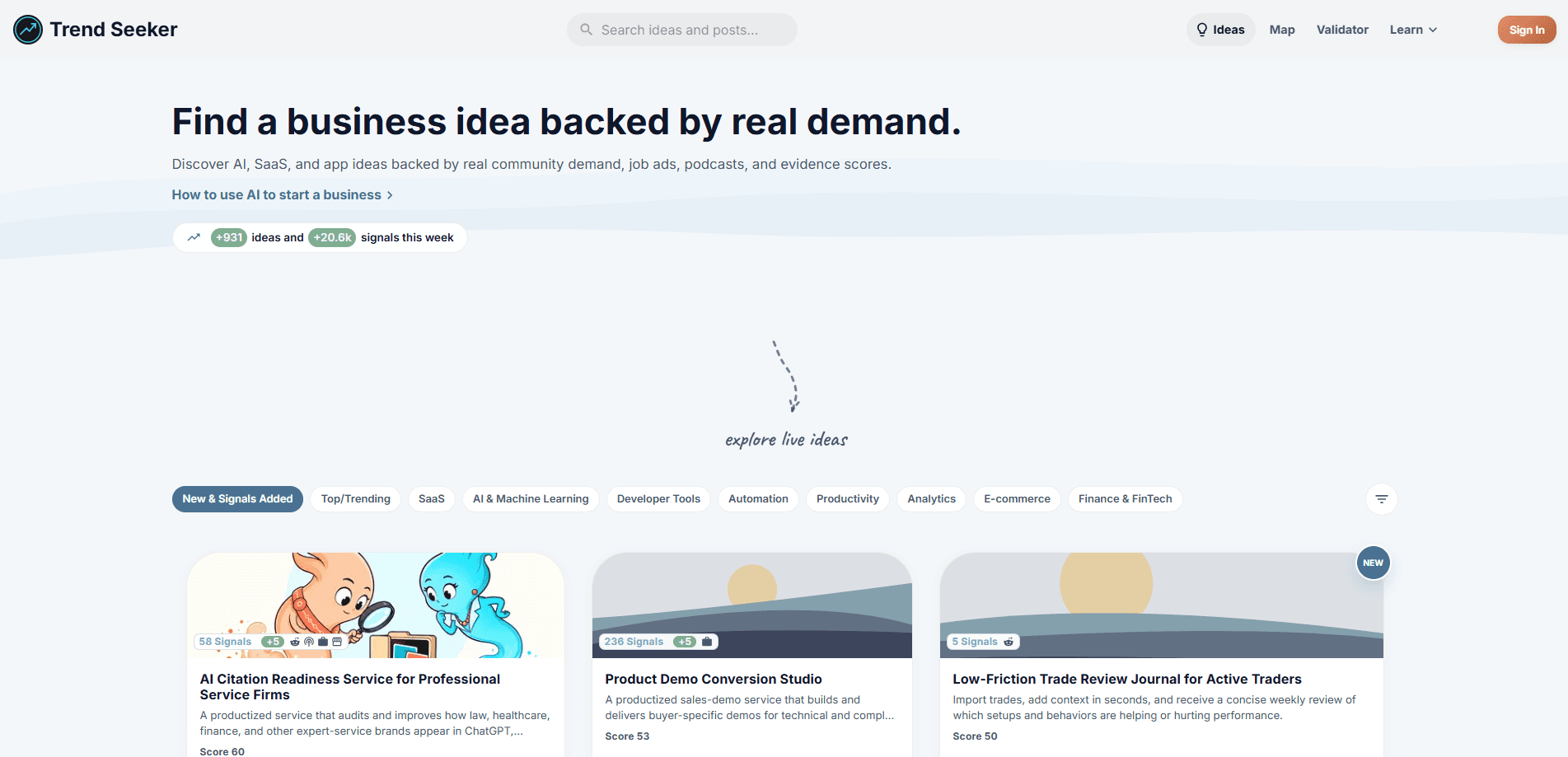
Trend Seeker is a market intelligence platform for founders who want proof before they build. It scans public sources like Reddit, job ads, podcast transcripts, and app reviews, then groups repeated problems into business ideas and ranks each one with an evidence score. Instead of trusting a single AI opinion, you get the raw posts, links, and competition data behind every score.
About Trend Seeker
What Is Trend Seeker
Trend Seeker is a web-based market research platform that helps you find business ideas backed by real demand. It pulls signals from Reddit, X, job listings, podcasts, app reviews, search trends, and product launches, then filters out the pitchy noise to keep only genuine problems people are complaining about.
The core promise is evidence over opinions. Most AI idea validators hand you a confident verdict with no way to check the math. Trend Seeker does the opposite: it shows the community posts, the source diversity, and the competitor activity behind each score, so you can judge the demand yourself before spending months building.
The main catch? A high score is still a research shortcut, not a guarantee. The platform says so on its own validator page. Sources are public and English-heavy, so niches that live in private forums or non-English communities may show weaker signals than they deserve.
Getting Started
- Go to the Trend Seeker site and open the ideas explorer to browse live business ideas by score and category.
- Pick a niche you care about, or head to the idea validator and describe your own concept in plain language.
- Run the validator to match your idea against hundreds of thousands of market signals.
- Open the matched signals and read the actual Reddit threads, podcast clips, and reviews, checking the demand yourself.
- Compare related ideas by score, competition, and trend momentum, then decide whether the opportunity is worth pursuing.
Product Information
A quick look at Trend Seeker's pricing, supported platforms, and performance.
Best for
The users, tasks, and scenarios where this tool fits best.
Users
- Solo founders and indie hackers
- Product managers and small teams
- Market researchers and analysts
Tasks
- Validating a startup idea
- Finding business ideas
- Gauging competition
- Sourcing customer problems
Scenarios
- The weekend before you start building
- Early project research
- Picking a niche for a side project
- Pre-investment homework
Key features
Evidence Scores, Not Just Opinions
Every idea carries a score built from observed demand, search trends, and competitor records, not a one-off AI judgment. The scoring blends signal quality, competition, evidence depth, trend momentum, and source breadth into a single number that updates as new data arrives. You can drill into the underlying signals and decide for yourself whether the score holds up. That matters.
Multi-Source Demand Signals
Trend Seeker collects from many public sources: Reddit, X, job ads, podcast transcripts, app reviews, search trends, and product launches. More feeds means fewer blind spots. On its homepage it reports matching thousands of signals per day. Pulling from so many feeds means one loud complaint doesn't dominate, and repeated problems across different communities carry more weight. No single source runs the show.
Idea Validator
The idea validator lets you describe your own startup concept and match it by meaning against a large pool of market signals. It separates Reddit, podcast, and other request types so you can inspect demand channel by channel. The score splits into post volume and idea similarity, and a high post volume with low similarity points to an underserved gap.
Demand Map
The demand map shows where customer problems cluster and lets you compare nearby ideas by fresh activity, source, and score. That visual layer helps you spot crowded neighborhoods versus open lanes without reading every thread. It's a fast way to scan a market's shape before you commit to a focus. Handy for early scoping.
Transparent Source Links
Every score connects back to the original posts, transcripts, and reviews behind it. You can read the community discussion, check who said it, and see how independent the sources really are. That transparency is the main difference from validators that only show a verdict.
Trend and Competition Tracking
Trend momentum compares recent search interest against a baseline, while competition tracking flags how many active players already validate the demand. Crowded markets score lower on the competition axis, which nudges you toward less saturated ideas. Both signals refresh as new evidence comes in.
A Public-Source Research Shortcut
The platform bundles demand, competition, and trend data that would otherwise take a dozen open tabs and several hours of manual digging to assemble, which is exactly the kind of grunt work most founders skip and then regret.
Pros and cons
Pros
- Shows the raw evidence behind every score, so you can verify demand instead of trusting a black box.
- Pulls from many independent sources, which makes recurring problems easier to separate from one-off complaints.
- Combines demand, competition, and trend data in one dashboard, cutting down on manual research.
- Has a free tier and a low entry price, so testing a few ideas costs little.
Cons
- No public API, so you can't pull signals into your own tools or automate research workflows.
- Signals lean toward English-language public sources like Reddit and podcasts, which means some regional or private communities show up weaker than they might deserve.
- A high score is a research shortcut, not proof, and the platform says as much, so you still have to read the evidence yourself.
Frequently asked questions
It scans public sources like Reddit, job ads, podcasts, and app reviews, groups repeated problems into business ideas, and ranks each idea with an evidence score plus source links. You use it to check whether real demand exists for an idea before you build.
Related content
Explore related tools, skills, and articles for Trend Seeker.
Trend Seeker Alternatives

Knocket
Knocket (Tencent RTC team) · Productivity · Business · ChatbotKnocket is a free live chat and contact page tool that lets visitors message you from your website, app, or a shareable link, with every reply handled from Telegram or one inbox.

shippedit.me
Krawlup · Marketing · Businessshippedit.me now redirects to Krawlup, a web platform that audits SEO, AEO and page speed every week, then hands the fixes to AI coding agents over MCP.

Ayven
Alknoma · Productivity · BusinessAyven is an AI control centre by Alknoma that turns a plain-language goal into a dated plan, hands the work to your people and AI agents, and asks for your approval only when the call is yours.