

Treyci
Helix Apps LLC · Marketing · Business
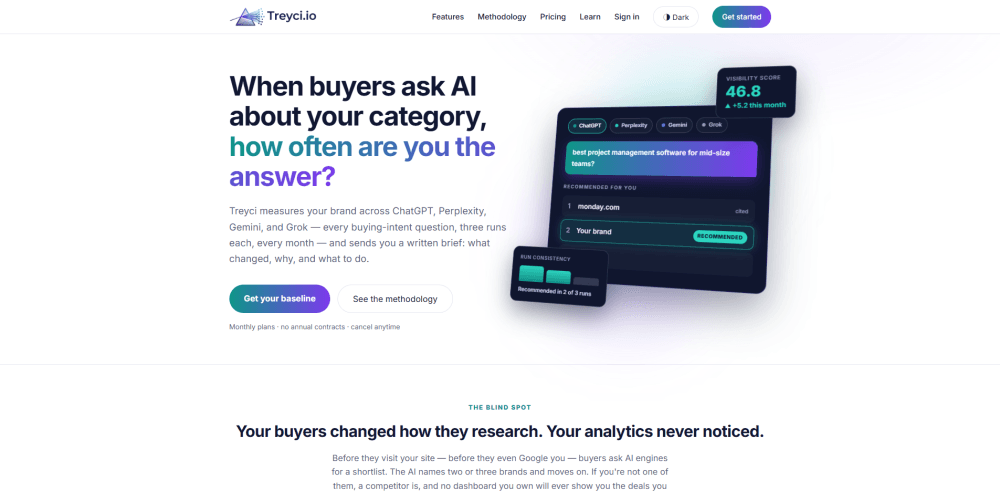
Treyci is an AI visibility tool for teams that want to know how often AI search engines recommend their brand. It runs roughly 100 buying-intent prompts across ChatGPT, Perplexity, Gemini, and Grok three times each per month, scores every mention, and delivers a written monthly brief instead of yet another dashboard. Think of it as AI search tracking with a thin layer of judgment on top. The product is built for marketers and executives who need a clear read on where they stand in AI answers, not a full-time analytics job.
About Treyci
What Is Treyci
Treyci tracks how your brand shows up when buyers ask AI chatbots about your category. It measures four engines, stores the verbatim answers behind every number, and turns the results into a short monthly memo you can forward to a CEO. The whole product is deliberately narrow. Two tabs on the surface, five working screens underneath.
AI answers shift from run to run, and most trackers report that randomness as if it were a trend. Treyci's answer is repetition: the same prompts, three separate runs each, aggregated so "recommended in 2 of 3" is something you can actually trust. That's the whole trick. Simple, but it changes what the score means.
The limit is scope. Treyci measures and reports. It doesn't rewrite your pages or auto-publish content, and it runs monthly rather than continuously, so it won't catch a shift mid-week.
Why does that matter for a generative engine optimization (GEO) workflow? Because GEO lives or dies on whether AI engines keep naming you. Treyci shows that. It doesn't do the fixing.
Getting Started
- Pick a plan on the pricing page and check out. Treyci provisions your workspace automatically, so there's nothing to install or configure.
- The team builds a prompt set from your category, around 100 buying-intent questions that cover comparisons, best-of queries, pricing, and alternatives.
- Your first monthly run establishes the baseline: a visibility score, a rank, and a per-engine breakdown of what you win and lose today.
- Read the monthly brief in your inbox, or open the Marketers screens to drill into prompts, engines, citations, and stored answers.
- Add your own custom prompts on Growth and above to track questions specific to your market.
Product Information
A quick look at Treyci's pricing, supported platforms, and performance.
Best for
The users, tasks, and scenarios where this tool fits best.
Users
- B2B marketing teams
- Founders and executives
- SEO and GEO specialists
Tasks
- Measuring brand visibility in AI
- AI search tracking
- Tracking competitor mentions
- Reporting AI search performance
Scenarios
- A buying committee asks an AI for a shortlist and you're not on it
- Quarterly planning
- Agencies running AI visibility for clients
Key features
Multi-Engine Coverage
Treyci tracks four AI search engines: ChatGPT, Perplexity, Gemini, and Grok. Each one builds answers from a different set of trusted sources, so a brand often dominates on one engine and disappears on another. The Engines screen lays this out as a brand-by-engine matrix, with mention rates for you and every competitor side by side. That matters because the engine where you're weakest is often the one with the most buyers.
Three Runs Per Prompt
AI answers are stochastic, meaning the same question can return a different brand list each time. Most tools run a prompt once and treat a lucky result as a trend. Treyci asks every question three separate times each month and aggregates the results, so "recommended in 2 of 3 runs" is a measurement you can reproduce. It also publishes a consistency score showing how often all three runs agreed. Fair enough.
Weighted Visibility Score
Every answer is parsed for every tracked brand and coded three ways: recommended, mentioned, or cited in the sources. Those levels are weighted to reflect how buying actually works, roughly 50% for a recommendation, 30% for a mention, and 20% for a citation, giving a single score out of 100. You see both your position and the reasoning behind it, not a black-box number.
Two Tabs, Five Screens
The product is built for people with five minutes, not a full-time analytics role. The Executive view is one screen with zero setup: your score, your rank, a trend line, and a three-sentence brief that arrives by email even if nobody logs in. The Marketers side opens five screens for Trends, Prompts, Engines, Citations, and Answers, so you can move from a summary to the underlying detail without switching tools.
Verbatim Answer Archive
Every number in Treyci is traceable to the actual words an AI wrote. The tool stores the engines' answers and their citation lists, so any stat can be clicked down to the sentence that produced it and the sources the engine used. Nothing in the dashboard is Treyci's opinion of what AI thinks. It's a record of what AI said. That makes the brief defensible in a meeting.
Monthly Written Brief
Instead of a dashboard to interpret, Treyci sends a short memo each month covering what changed, why it likely changed, and what to do next. On the Authority plan and above, a human analyst reviews the brief before it reaches your inbox, and you get a quarterly strategy call. It's a leaner cadence than daily tracking, but the trade-off is a report you can act on rather than a stream of alerts.
Custom Prompts and Alerts
Growth plans and above let you add your own prompts, about 15 per month, and set up alerts for changes worth knowing about. You can also export data as CSV or PNG. This is where teams move beyond the standard category questions and track the specific comparisons their buyers ask, like "your brand vs a named competitor for a mid-size team." No GEO tool replaces the work of fixing the gaps. Treyci just tells you where they're hiding.
Pros and cons
Pros
- Repeated runs per prompt make the visibility score reproducible instead of a single lucky answer.
- Written monthly brief targets busy teams that won't live inside a dashboard.
- Every stat links back to the verbatim AI answer and its cited sources.
- Covers four engines, including Grok, at a lower entry price than several enterprise competitors.
- Executive view needs no configuration and can be forwarded to leadership as-is.
Cons
- Paid plans start at $99/mo and there's no free tier, so small budgets can't test it first.
- Monthly cadence means you won't catch a shift that happens mid-week.
- It measures and reports only. Fixing the underlying content isn't part of the product.
- Prompt sets are built around category questions, so niche or non-commercial queries need custom prompts on higher plans.
Frequently asked questions
It measures how often your brand is mentioned, recommended, or cited when AI search engines answer buying-intent questions in your category. Results are aggregated into a visibility score out of 100 and tracked across four engines.
Related content
Explore related tools, skills, and articles for Treyci.
Treyci Alternatives

Emailwritr
Emailwritr · Writing · MarketingEmailwritr is an AI email copywriting tool built for affiliates, course creators, and online businesses that want more revenue from the list they already own. Instead of blank pages or generic chatbot prompts, this AI email writer generates welcome sequences, launch campaigns, cart recovery emails, and promo series from frameworks modeled on well-known direct-response copywriters. You connect your autoresponder, answer a few questions about your offer, and it writes the copy for you.

Prosp
Prosp · Writing · Voice & Language · MarketingProsp is an AI LinkedIn outreach tool built for agencies and sales teams, and it writes the message and the voice note in your own voice for each prospect so they actually reply. You connect your accounts, find leads, and let the AI draft and send personalized messages at scale, all from one inbox. It's built for people running outbound at volume. That's the whole pitch. Every touchpoint still has to feel human.

On Model
On Model · Image · MarketingOn Model is an AI fashion model tool that places your clothing on virtual models so online stores can get on-model product photos without booking a photoshoot. It runs as a Shopify app, letting you swap the model in an existing image, change backgrounds, and generate faces for cropped or headless shots. The goal is simple: match your product photos to your customers and stand out from competitors using the same supplier images.