

TrueAccord
TrueAccord Corp. · Marketing
TrueAccord is a digital-first debt collection agency. Its AI platform handles first- and third-party collections with self-service payment plans, omnichannel outreach and compliance built in.
About TrueAccord
What Is TrueAccord
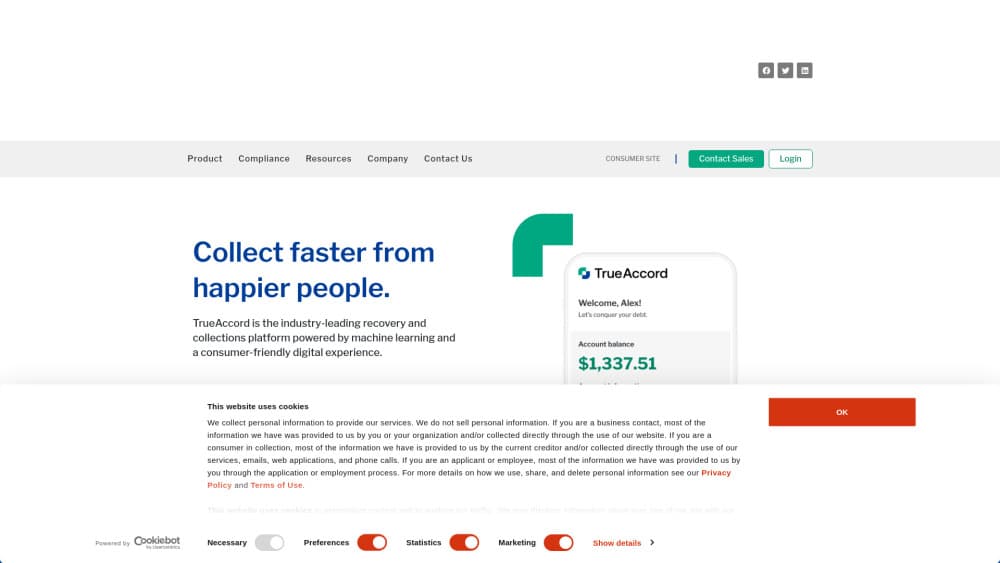
TrueAccord is a collections agency that runs on software rather than a phone room. Creditors hand it delinquent accounts, and the platform decides how to contact each person, what to offer, and when to step back. Consumers get emails, texts, letters and payment links instead of a stream of calls from unknown numbers.
The company started in 2013 after CEO Ohad Samet spent weeks dodging collectors over a small store card balance. The founding bet was simple. Most people who owe money will pay if you make it easy and stop treating them like a suspect. TrueAccord says it has worked with more than 20 million consumers for banks, issuers, eCommerce companies and direct lenders, and that its platform reaches over 24 million consumers a year.
Two things decide whether it fits. It's an agency engagement, not a signup form, so you're buying recovery work and a servicing platform together. And it's built for US consumer receivables, which means state licensing, collections compliance and Reg F style rules are part of every conversation.
Getting Started
- Talk to sales through trueaccord.com. The team scopes the portfolio type, whether you need first-party or third-party collections, and which systems hold your account data.
- Connect the account source. Files or API feeds carry balances, contact details and account status into the ingestion engine, and the client portal at trueaccord.com/app becomes your view of the book.
- Approve the treatment rules. Branding, contact cadence, settlement bands and escalation paths get set before anything goes live, with legal review on both sides.
- Launch on a segment. Most clients start with one portfolio or delinquency bucket, watch recovery and complaint rates for a cycle, then widen the scope.
- Read the reporting and adjust. Offer levels, channel mix and payment plan terms are tuned from results rather than guesswork.
Product Information
A quick look at TrueAccord's pricing, supported platforms, and performance.
Best for
The users, tasks, and scenarios where this tool fits best.
Users
- Credit card issuers and banks
- Fintech lenders and buy-now-pay-later providers
- eCommerce and subscription businesses with small balances
- Collections and recovery managers at mid-size creditors
Tasks
- Chasing late-stage charge-offs
- Setting up a payment plan at 2am
- Keeping outreach inside the rules
- Onboarding a new portfolio in weeks
- Measuring what actually recovers money
Scenarios
- A lender with a growing charge-off book and a collections team of six
- A brand that can't afford an angry consumer on social media
- A company testing whether to insource or outsource recovery
- A quarterly compliance review
Key features
Patented AI Account Treatment
Every account gets its own treatment plan. The system weighs balance size, payment history, prior contact and response behavior, then decides which channel to use, how often to reach out and what settlement to offer. The company holds patents on this approach to digital collections, and it's the part that separates the product from a bulk email blast with a payment link.
Digital-First Omnichannel Outreach
Email, text, letters and voice sit in one sequence, and the sequence shifts based on what the consumer does. Someone who opens an email but ignores a text gets a different next step than someone who never responds. Voice and mail still exist as options, which matters for older account holders who won't pay through a link.
Self-Service Payment Portal and Payment Plans
The consumer side is a mobile-optimized payment plan portal, open around the clock. People see the balance, pick an installment amount, choose a payment date and finish in a few screens. No account creation gauntlet, no hold music. TrueAccord says hundreds of thousands of consumers have resolved debts this way, and consumer reviews on its site keep returning to the same point: being able to set the terms themselves is why they followed through.
Dynamic Settlement Optimization
Discounts aren't static. The platform tests settlement levels against real response and adjusts what it offers, aiming to hit the moment when someone is ready to pay. For a creditor that means recovering something from accounts that would otherwise sit until they age out. For a consumer it means an offer that arrives when it can actually be accepted.
First-Party White-Label Servicing
Early-stage delinquency gets a different product. TrueAccord's team works under your brand, inside your CRM or its own stack, with scripts and tone that match your customer service. The goal is to cure the account before it ever reaches third-party collections, which protects the relationship and the future lifetime value.
Portfolio Onboarding and API Integration
Accounts arrive through a flexible ingestion engine, with documented APIs for teams that want to push data programmatically. Placement files, balance updates, payments and recalls move between systems without manual rekeying. Implementation still takes real work on the client side, but it's integration rather than a custom build.
Pros and cons
Pros
- The digital-first model reaches people who screen calls, which is most people under 40 with a past-due balance.
- Self-service payment plans produce commitments consumers actually keep, because they choose the amount and the date.
- Compliance work is in-house and ongoing, with licensing, disclosures and contact logs handled by people who do it daily.
- One platform covers both early-stage first-party collections and late-stage third-party work, so you don't need two vendors.
- Reporting ties contact activity to dollars recovered, which makes channel decisions defensible.
Cons
- No published pricing. You can't estimate cost per account without a sales conversation, and the contingency model means fees scale with what you recover.
- Onboarding requires clean account data and engineering time for the API path. Messy placements slow the launch.
- The model is built around US consumer receivables and state licensing. Creditors outside that framework will find little here.
- It's a managed service, not self-serve AI debt collection software. A team that wants to run collections internally on its own tooling won't get the software alone.
Frequently asked questions
TrueAccord is a debt collection agency that works digitally. Creditors place delinquent accounts with it, and its platform handles outreach by email, text, letter and voice, plus a self-service payment portal where consumers set up their own plans. It runs both first-party collections under a client's brand and third-party contingency collections.
Related content
Explore related tools, skills, and articles for TrueAccord.
TrueAccord Alternatives

ngram 2.0
ngram · Video · Marketingngram 2.0 is an AI video generator for teams. It turns a prompt, a screen recording, or a product URL into a narrated explainer, product demo, or AI avatar video, and every scene stays editable.

shippedit.me
Krawlup · Marketing · Businessshippedit.me now redirects to Krawlup, a web platform that audits SEO, AEO and page speed every week, then hands the fixes to AI coding agents over MCP.

MePersona
MePersona, Inc. · Writing · Productivity · MarketingMePersona is an AI unified inbox for creators. It learns your voice, drafts replies to fan messages from 12 platforms, and sends only what you approve.