

TrueClaim
TrueClaim Technologies, Inc. · Other
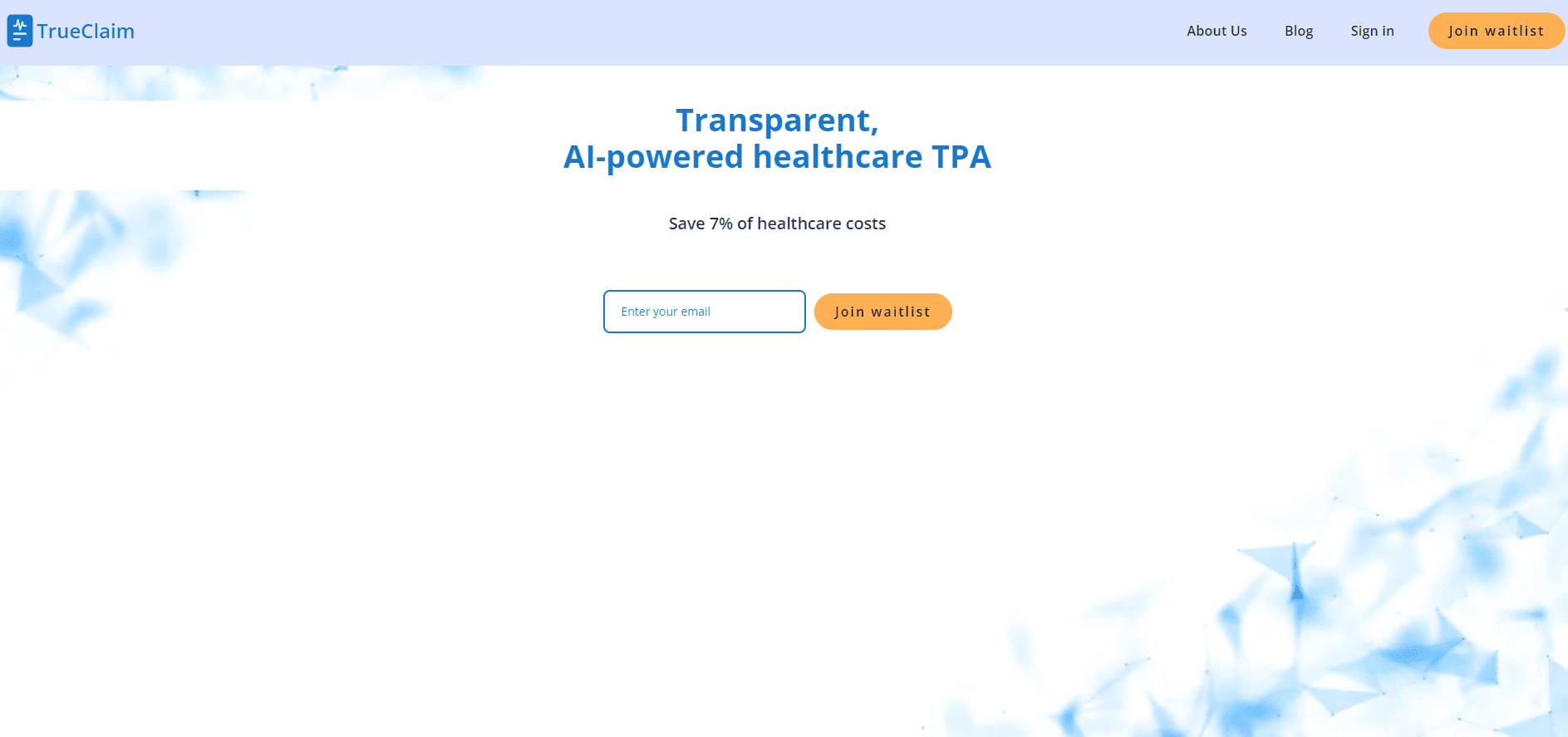
TrueClaim is an AI healthcare TPA for self-funded employers. Its engine adjudicates and reviews every claim before payment, aiming at roughly 7% lower plan costs without changing benefits.
About TrueClaim
What Is TrueClaim
TrueClaim is a third party administrator that runs a self-funded health plan on software it built, instead of bolting new tools onto a legacy claims system. It sits between providers and the employer who funds the plan, and it reads each claim as the claim moves toward payment.
The company formed in 2023 in San Francisco. Co-founder Barbora Howell needed surgery for her newborn, and the insurer wrongly treated the plan as inactive, which put her family on the hook for a bill that should never have existed. TrueClaim exists to catch that class of failure: billing errors, wrong adjudication outcomes, and care gaps, all before money leaves the employer's account. The team went through Y Combinator's Winter 2024 batch and has raised about $4.1 million, per Y Combinator and press coverage.
One thing worth getting straight up front: TrueClaim is not an insurer. The employer still funds claims and carries the risk. What changes is the administration layer, which covers plan setup, claims processing, member support, and spend reporting.
Getting Started
- Book an intro call through the site or email the founders directly.
- Send over plan documents, your current TPA agreement, and the vendor stack you already use for pharmacy, network access, and stop-loss coverage.
- Agree on plan design and fee structure. TrueClaim builds the plan in its platform rather than in a spreadsheet.
- Run implementation: member data gets loaded, ID cards get issued, and the provider portal goes live.
- Sign in to the admin dashboard on day one of coverage, where every member, claim, and dollar shows up in real time.
Product Information
A quick look at TrueClaim's pricing, supported platforms, and performance.
Best for
The users, tasks, and scenarios where this tool fits best.
Users
- Benefits and HR leads at self-insured employers under 1,000 employees
- Brokers and benefits consultants
- Finance and CFOs at companies that fund their own plan
Tasks
- Adjudicating medical claims
- Recovering overpayments
- Reviewing pharmacy spend
- Reporting on plan spend
Scenarios
- Replacing a legacy TPA at a January renewal
- Launching a first self-funded health plan
- Running a retrospective audit on last year's claims
Key features
Claim review on every claim, not a sample
Most TPAs audit a slice of claims after the fact. TrueClaim reviews 100% of medical claims as part of AI claims processing, then routes suspicious ones for a closer look. The company says it has processed $50 million in claims through its platform, and that the review catches billing errors, adjudication mistakes, and care gaps in the same pass.
Real-time admin dashboard
The admin side shows every member, claim, and dollar as it moves, instead of a monthly file. For a benefits lead, that means spotting a spike in a provider's billing in week one rather than quarter three. Data access is one of the main reasons employers move off a legacy administrator.
Flexible plan design
Plan rules get configured in the platform, so an employer can adjust deductibles, copays, and eligibility without filing a change request with an outside vendor. TrueClaim positions this as a way to keep your existing vendor stack and let the platform flex around it, rather than forcing a rip and replace.
Member support that does not feel like an insurer
Members get multi-channel support plus an app for finding care and checking what they owe. The company runs this as a concierge service, and employers can either use the full service or license the tools for their own team. Testimonials on the site lean heavily on speed, including one employer noting ID cards going out faster than any turnaround they had seen in 15 years.
Cost recovery with a stated return
Beyond ongoing administration, TrueClaim sells a recovery service that hunts through historical claims for money the plan should not have paid. It comes with a 3x ROI guarantee, according to the company. That structure suits finance teams that want the fee tied to results rather than to effort.
Security and employer data ownership
TrueClaim holds SOC 2 Type II certification, runs a yearly HIPAA audit, and states that employers own their claims data and that the company won't resell it. For a self-funded health plan, claims data is about as sensitive as records get, so the contractual position matters as much as the certificate.
Pros and cons
Pros
- Full-population claim review instead of post-payment sampling, which is the core reason the savings claim holds up.
- Transparent TPA pricing model: fees are quoted openly, and the company markets pass-through economics rather than a bundled rate.
- One vendor covers administration, benefits administration software, member support, and reporting, so there is no integration project between four suppliers.
- Member-facing app and fast card issuance, both of which show up in the testimonials on the site.
- SOC 2 Type II plus a yearly HIPAA audit, with a written commitment not to resell employer data.
Cons
- No published rate card. You have to get on a call to learn what a per-employee fee looks like, which makes early budgeting guesswork.
- Small vendor. Around 10 employees and $4.1 million raised means a large or complicated plan should ask hard questions about implementation capacity and backup coverage.
- No public API. If your analytics team wants claims data in its own warehouse on its own schedule, you'll depend on TrueClaim's exports and their team's turnaround.
- The 7% savings figure is vendor reported. Treat it as a target to validate against your own claims history, not a number you can bank before implementation.
Frequently asked questions
It administers self-funded health plans. That covers plan design, claims adjudication, payment, member support, and reporting. The difference from a traditional TPA is that AI reviews every claim before payment instead of auditing a sample afterward.
Related content
Explore related tools, skills, and articles for TrueClaim.
TrueClaim Alternatives

Odyssey 3
Odyssey · OtherOdyssey-3 is Odyssey's foundation world model. It simulates physics in real time, turns a prompt into an interactive environment, and adapts to robots, cars and games.

JarvisCore
Prescott Data · Coding · Productivity · OtherJarvisCore is an open source Python runtime where AI agents work as equal peers on an agent mesh, claim tasks from a shared ledger, and reach external services through a zero-trust broker.
Clef
Cloudflare · Business · OtherClef is Cloudflare's open-source decision model for Workers AI. It returns calibrated probabilities for typed questions, not generated text, so agents can classify, route, and act fast.