

TrueFoundry AI Gateway
TrueFoundry · Coding
TrueFoundry AI Gateway is an enterprise control plane that sits between your applications and your model providers. It gives teams one API to route, govern, and monitor LLM and Gen-AI traffic. The tool bundles model routing, guardrails, rate limits, token budgets, and LLM observability into a single layer, so engineers can swap providers or add new ones without rewriting application code. It's aimed at organizations running AI in production rather than solo builders testing a single model.
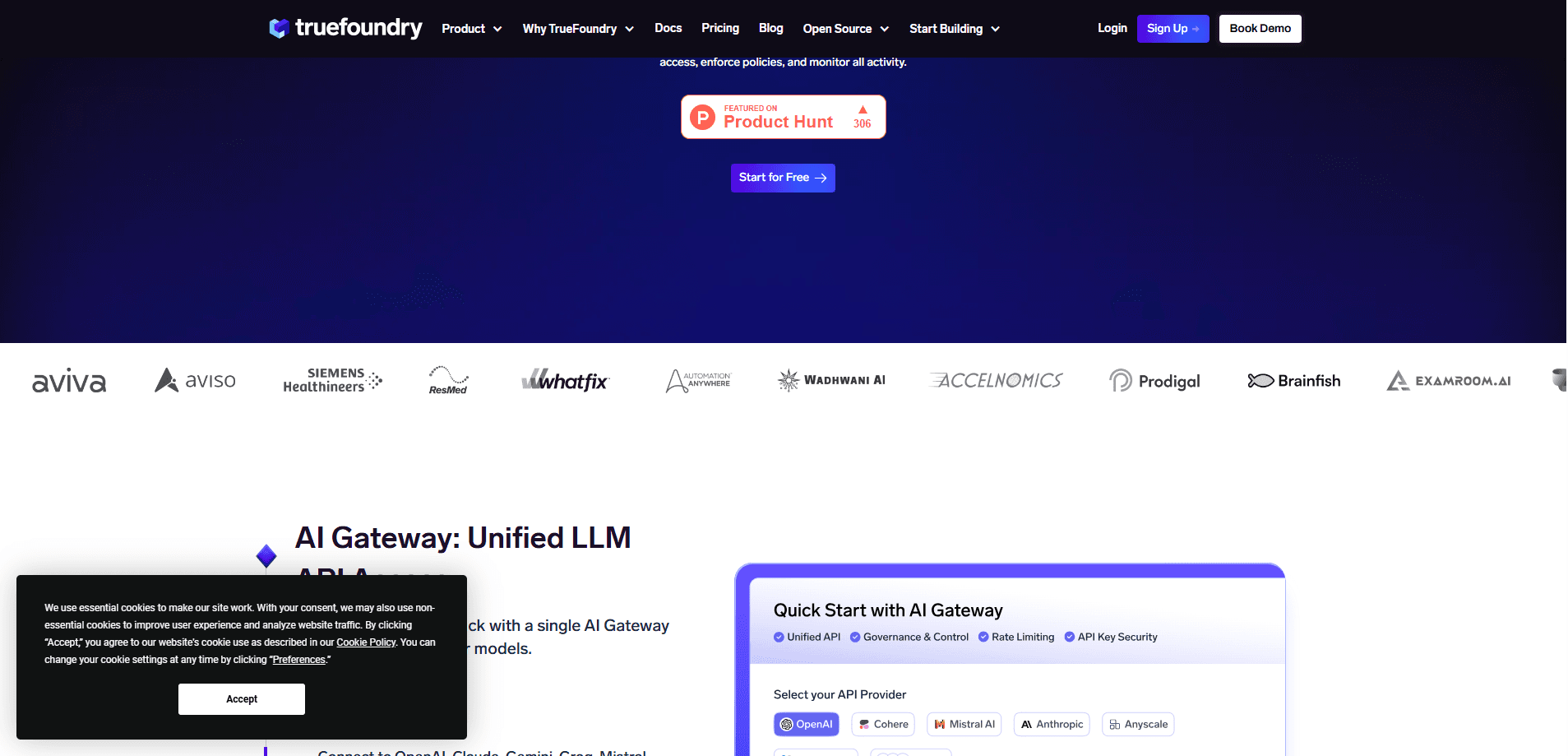
About TrueFoundry AI Gateway
What Is TrueFoundry AI Gateway
TrueFoundry AI Gateway is middleware for teams that have outgrown raw model APIs. Instead of hard-coding calls to OpenAI, Anthropic, or a self-hosted LLaMA model, you point your app at one gateway endpoint. The gateway authenticates the request, decides which model should answer, and applies your governance rules along the way. TrueFoundry describes it as a centralized control plane for the production inference path, and that framing matters: the product lives where requests actually flow, not off to the side as a reporting tool.
The main problem it solves is sprawl. Once an organization has several teams calling several providers, nobody can say with confidence who is spending what, which model is behind a given feature, or what happens when a provider goes down. The gateway pulls that mess into one place. Routing rules, fallbacks, and AI governance policies are configured centrally, and every request leaves a trace you can inspect later.
The biggest limitation is scope. This is infrastructure for people who deploy AI systems, not a chat app you can hand to a non-technical user. Setup means connecting model accounts, defining virtual models, and wiring the gateway into your own services. Small teams on the free tier hit request caps quickly, and anything past simple usage moves you toward the paid plans or a sales conversation. If you just want to try a chatbot, this is more machinery than you need.
Getting Started
- Create an account at TrueFoundry and pick the Developer plan to start testing without a credit card.
- Connect your model provider accounts, such as OpenAI, Anthropic, or a self-hosted endpoint, so the gateway can reach them.
- Set up a virtual model, which is a named target your app calls instead of a raw provider.
- Point your application at the gateway endpoint and send a test request to confirm routing works.
- Add rate limits, budget rules, and guardrails once basic traffic is flowing.
Product Information
A quick look at TrueFoundry AI Gateway's pricing, supported platforms, and performance.
Best for
The users, tasks, and scenarios where this tool fits best.
Users
- Platform and ML engineers
- Engineering leads at mid-size and large companies
- Security and compliance staff
Tasks
- Routing requests across multiple model providers
- Tracking LLM spend
- Adding guardrails to model output
- Connecting agents to tools securely
Scenarios
- A startup shifting from a prototype to a multi-tenant product
- A company facing data-residency rules
- A team comparing providers for cost and quality
Key features
Unified LLM API
One endpoint connects to OpenAI, Anthropic, self-hosted models, and others, so switching or adding a provider is a config change rather than a code change. Your app keeps calling the same URL while the gateway handles the differences between providers. That's the core promise. For teams juggling multiple vendors, it removes a lot of glue code.
Intelligent Routing and Fallbacks
The gateway picks which model should serve each request and can reroute automatically when a provider is slow or down. You set the rules once. Traffic follows them without a manual failover. For anything customer-facing, automatic fallback is the difference between a hiccup and an outage.
Rate Limiting and Token Budgets
You can cap usage by team, user, or project and track token consumption against those caps. This is how you stop one experimental script from eating the budget meant for everyone. It's the clearest form of AI cost control the product offers. Budgets also give finance a clearer picture of where AI spend actually goes.
Guardrails
Built-in guardrails check model input and output against your policies and can block or flag responses that cross the line. The free tier ships with built-in rules only. Fuller control needs a paid plan. If your app handles user-generated prompts, this is the layer that keeps bad output from going live unchecked.
Observability and Traces
Every request is logged with latency, token counts, and outcomes, and log retention runs 7 days on the free plan and 30 days on Pro. The tracing is OpenTelemetry-compatible, so it can feed Grafana, Datadog, or Prometheus instead of trapping you in a single dashboard. Being able to see the full path from prompt to model response is what turns an opaque AI feature into something you can debug.
MCP Gateway
The MCP gateway connects agents to tools and MCP servers with centralized discovery, authentication, and access control. Agents get their credentials through the gateway rather than holding keys themselves. That keeps tool access auditable. For teams building agentic workflows, it beats scattering keys across scripts.
Deployment Options
The gateway runs as SaaS, inside your VPC, on-prem, or in an air-gapped setup, and TrueFoundry says data never leaves your domain in the self-hosted paths. That flexibility is why it lands with regulated buyers. You choose the deployment model that fits your compliance rules.
Pros and cons
Pros
- One API across many providers means less integration work and easier model swaps.
- Central budgets and rate limits give a clear view of where LLM spend goes.
- Self-hosted and air-gapped options keep prompts and responses inside your own network.
- OpenTelemetry-compatible tracing plugs into the monitoring tools you already run.
- Free Developer tier for up to 3 users makes it cheap to evaluate before committing.
Cons
- It's built for engineers. Non-technical teams can't just pick it up and use it.
- The free tier caps you at 3 users and 10k requests per user, which runs out fast in real testing.
- MCP servers, model accounts, and virtual models are limited on the lower tiers, so you hit walls early.
- Enterprise pricing is quote-only. That makes budgeting harder before you talk to sales.
Frequently asked questions
It sits between your app and your model providers, handling authentication, routing, fallbacks, rate limits, and logging in one place. So what changes for you? Every request funnels through the gateway, which is where your governance rules live. That's the whole point.
Related content
Explore related tools, skills, and articles for TrueFoundry AI Gateway.
TrueFoundry AI Gateway Alternatives
Forefront
Forefront · CodingForefront is a web platform for building with open-source AI. It lets you fine-tune leading open-source language models on your own data, evaluate how they perform, and run them through an API or export them to host yourself. Developers who want the convenience of a closed-source platform but insist on owning their models and data are the target audience here.

Startkit
StartKit.AI · CodingStartkit is a boilerplate for building AI SaaS and AI wrapper products. Think of it as an AI startup boilerplate with the boring parts already wired up: authentication, Stripe and Lemon Squeezy payments, usage limits, transactional email, and an AI API starter that talks to OpenAI, Anthropic, Groq, or Llama. You clone the repo, set your price, and start on the part of your product that people actually pay for. It's Next.js under React and Tailwind, so most of the boilerplate code already feels familiar.
Testim
Tricentis · CodingTestim is an AI-powered test automation platform for building and running end-to-end tests across web, mobile, and Salesforce applications. It leans on machine learning to keep tests stable when an interface changes, so teams spend less time fixing broken selectors. Not bad for an automated testing tool you can start using today. You create tests by recording actions in a browser, then optionally add JavaScript when you need more control. It's a solid pick for busy QA teams.