

Truffle
Truffle · Marketing · Business
Truffle is an AI visibility tool that checks how ChatGPT, Gemini, Claude, Perplexity and Google AI Overviews answer buyer questions, then turns each gap into a task your team can fix.
About Truffle
What Is Truffle
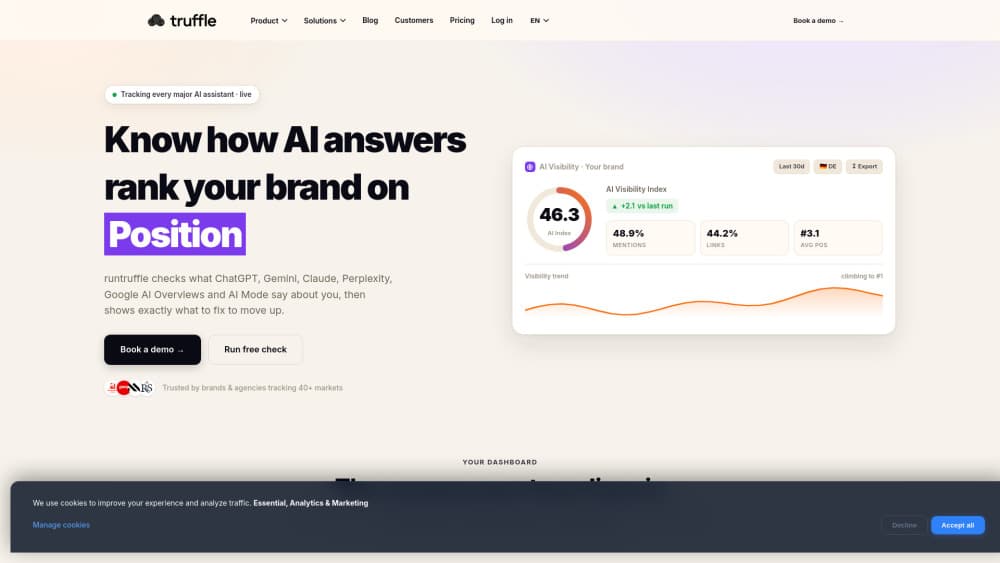
Your buyers now ask an assistant for a recommendation and accept the first answer. Truffle measures what that answer says about your brand. It runs a set of purchase-intent prompts through six AI surfaces every day and records whether you appear, in what position, with a link, and in what tone.
The company runs the product from Germany and hosts it on Hetzner servers, which explains the GDPR framing and the DPA paperwork on the site. You get a web dashboard, a 0-100 Visibility Index, per-model breakdowns and a competitor table that fills itself from the answers.
The limitation is scope of action. Truffle tells you what to change, ranked by projected impact, and it pushes that task to your Kanban board. Writing the comparison page or landing the citation is still your job. The standard subscription also covers six surfaces only, so Grok or DeepSeek tracking costs extra.
Getting Started
- Create an account at runtruffle.com and add your domain with the countries and languages you sell in.
- Build buyer personas. Truffle suggests prompts from your industry and brand, and you keep the ones that match real purchase questions.
- Wait for the first run, which takes a minute or two, then read the Visibility Index, mention rate, link rate, position and sentiment.
- Connect Google Search Console and Analytics 4, then work through the recommendation list or send tasks straight to your board.
Product Information
A quick look at Truffle's pricing, supported platforms, and performance.
Best for
The users, tasks, and scenarios where this tool fits best.
Users
- B2B marketing teams
- SEO specialists moving into GEO work
- Agencies
- SaaS and e-commerce founders
Tasks
- Auditing AI answers for purchase-intent questions
- Benchmarking against competitors
- Reporting AI search visibility to clients or executives
- Finding sources worth pitching
Scenarios
- A new brand that ranks on page three in Google and still gets cited by Perplexity, which tells you where to put effort first.
- Multi-market sellers
- An agency that needs a monthly client report without building its own dashboard.
Key features
A visibility index weighted by real reach
Truffle scores your brand from 0 to 100 across ChatGPT, Gemini, Claude, Perplexity, Google AI Overviews and Google AI Mode, plus the classic top ten results. Engines carry different weights based on their audience size, so a mention on ChatGPT moves the number more than one on Grok. Position and links count too, which means a cited mention beats a passing name-drop.
Daily prompt tracking by market and persona
Each prompt runs every day in the countries and languages you picked, and Google AI Mode refreshes weekly. The per-prompt view shows which questions you own and which ones return an answer without you, which is the daily work of brand monitoring in AI search. This is the part that turns AI search visibility into something you can manage week by week.
Competitor discovery and share of voice
You can add rivals by hand, and Truffle also pulls in the brands that show up next to you in AI answers. The share of voice chart tracks how much of the conversation you hold, and an alert fires when a competitor is close enough to overtake.
Answer to task recommendations
Every gap becomes a ticket with the original AI answer attached, a projected impact range instead of a single promised number, and a suggested owner. Categories cover technical fixes, content, expert input, digital PR and off-site work. One click sends it to your board.
Source and citation tracking
The tool lists the URLs the models cite for your prompts and checks whether those pages still load, render and stay reachable behind Cloudflare. If the page that names you breaks, you find out before the answer changes.
Reporting, API and stack connections
Google Search Console and Analytics 4 connect through OAuth, Looker Studio pulls the data, and CSV or branded PDF reports cover the rest. The Pro plan adds a REST API with an OpenAPI spec and 5,000 calls a day, which is enough to feed BigQuery or a Slack bot.
Pros and cons
Pros
- Puts Google rankings and AI answers in the same project, which most pure AI visibility trackers skip.
- Competitor discovery surfaces brands the models recommend that you would never have guessed.
- Recommendations come with a projected impact range and a source, so you can defend the priority order.
- EU hosting with GDPR and a DPA option matters for agencies working with European clients.
- The free 7-day trial includes every surface, so you can test the data before paying.
Cons
- Six surfaces are standard. Grok costs $5 to $50 a month depending on plan, and other models need a sales conversation.
- Only the top plan gets the API and unlimited seats, so smaller teams hit the $399 step quickly.
- Google AI Mode updates weekly, which leaves a gap if your category shifts inside a week.
- It diagnoses more than it delivers. Expect to spend real hours on the content and outreach work it recommends.
Frequently asked questions
It records whether your brand appears in AI answers for chosen prompts, where it sits in the answer, whether a link is included and how the model describes you. Those signals roll into one Visibility Index from 0 to 100, with a separate score for each model.
Related content
Explore related tools, skills, and articles for Truffle.
Truffle Alternatives

ngram 2.0
ngram · Video · Marketingngram 2.0 is an AI video generator for teams. It turns a prompt, a screen recording, or a product URL into a narrated explainer, product demo, or AI avatar video, and every scene stays editable.

shippedit.me
Krawlup · Marketing · Businessshippedit.me now redirects to Krawlup, a web platform that audits SEO, AEO and page speed every week, then hands the fixes to AI coding agents over MCP.

MePersona
MePersona, Inc. · Writing · Productivity · MarketingMePersona is an AI unified inbox for creators. It learns your voice, drafts replies to fan messages from 12 platforms, and sends only what you approve.