

Prism
Prism · Business
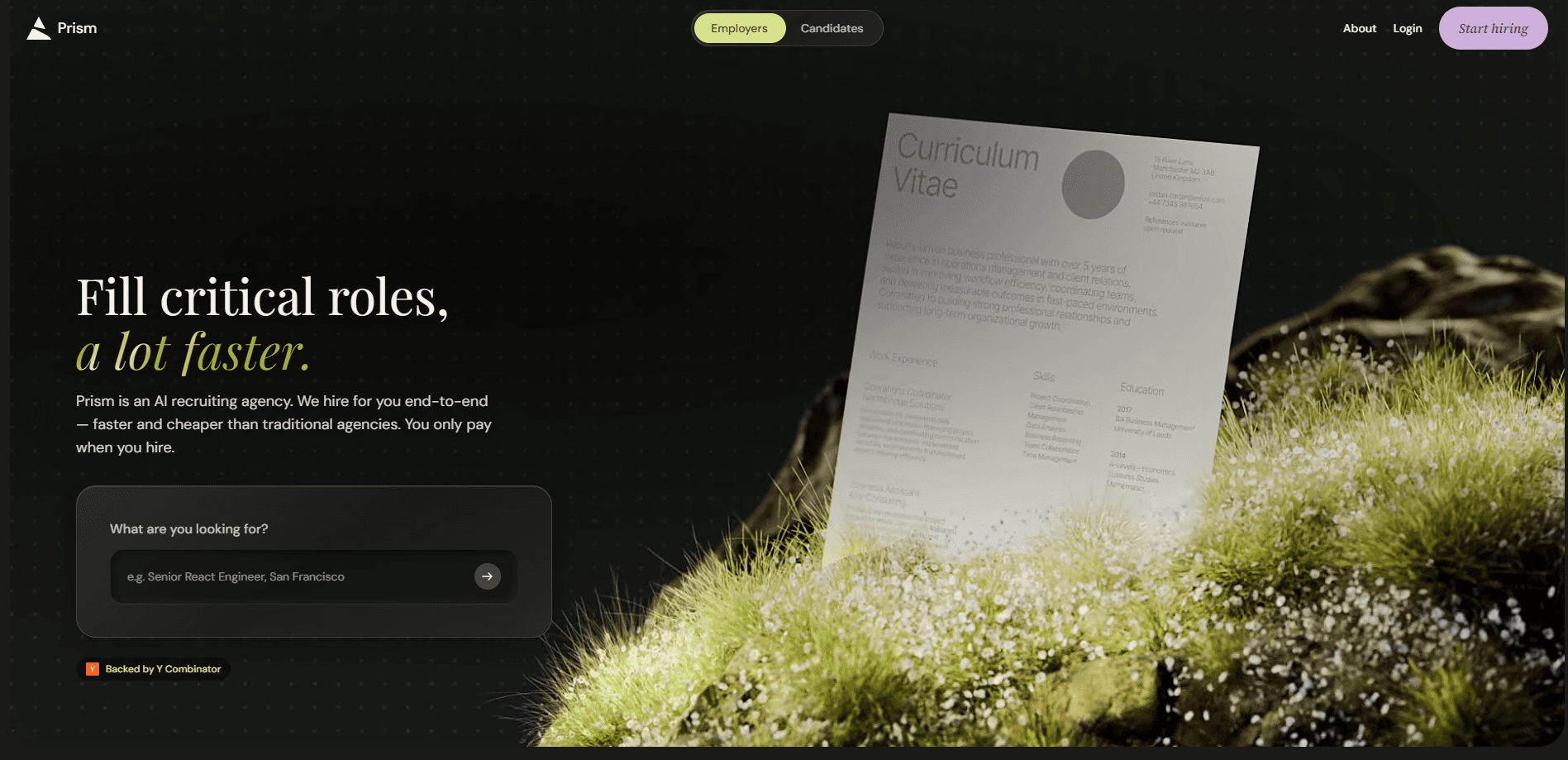
Prism is an AI recruiting agency for teams that need to fill a role without running the search themselves. You describe the job, Prism handles sourcing, screening, and outreach end-to-end, and you get a ranked shortlist of candidates who are ready to interview. Recruiting automation does the boring part. It charges 15% of first-year salary per role, plus a retainer to start, and the success fee only lands when someone signs.
About Prism
What Is Prism
Prism is a recruiting service built around AI instead of a seat-based software subscription. Traditional agencies charge 20% to 30% of first-year salary and can take months to produce a shortlist. Prism runs the same search pipeline, candidate sourcing and screening and outreach, but leans on AI for the heavy lifting to move faster and charge less. It's YC-backed and positioned as an agency, not a tool you log into and operate yourself.
The pitch is simple. You don't manage a pipeline. There are no dashboards to learn and no job slots to buy. You tell Prism about the role, it works the talent sourcing and screening, and you spend your time on interviews rather than resume triage. That matters most for small teams where the person doing the hiring is also doing five other jobs.
The main catch is that Prism is agency-priced, not software-priced. The retainer is paid up front whether or not you hire, and the 15% success fee applies to the first year of salary, so a senior role still carries a real cost. If you're filling a role you expect to keep long term, that's a normal recruiting expense. If you just want a cheap sourcing tool to poke at, this isn't that. So who benefits? Teams that treat a hire as an investment rather than a subscription line item.
Getting Started
- Tell Prism about the role: seniority, tech stack, location, and how urgent the hire is. You can start online or book a call, whichever you prefer.
- Pay the retainer to kick off the search and put your role on the front of the queue.
- Let Prism run sourcing, screening, and outreach end-to-end. There's nothing for you to configure or monitor.
- Interview the candidates Prism surfaces, then hire. The 15% success fee is due only when someone signs.
Product Information
A quick look at Prism's pricing, supported platforms, and performance.
Best for
The users, tasks, and scenarios where this tool fits best.
Users
- Startup founders and small teams
- Hiring managers filling technical roles
- Agencies and lean HR teams
Tasks
- Sourcing qualified candidates for a specific role
- Screening and shortlisting applicants
- Running candidate outreach
Scenarios
- Filling an engineering role on a tight deadline
- Hiring a senior specialist without an in-house recruiter
- Scaling a small team quickly
Key features
End-to-End Search Management
Prism runs the whole recruiting pipeline rather than a slice of it. Sourcing, screening, and outreach all sit inside the service, so you don't stitch together a sourcing tool, an ATS, and an outreach platform. That's the core difference from recruiting software, which hands you the machine and expects you to drive.
AI-Powered Sourcing and Screening
The candidate sourcing and screening work is where AI does the lifting. Prism identifies candidates against the role you described, then screens them before they reach you. You're meant to receive people who are actually worth an interview, not a raw list to filter yourself. The company says this is why it can undercut traditional agency fees, since the slow manual work that used to justify a 20%-30% cut is now handled by software instead of a human recruiter.
Ranked Candidate Shortlists
Instead of a pipeline you manage, Prism delivers a ranked shortlist. The ranking matters. It tells you where to spend your interview time first. For a busy hiring manager, that's the difference between reviewing twelve names cold and starting with the three that fit best.
Hire-Only Success Fee
You pay the 15% success fee only when someone signs. That structure aligns the incentive: Prism gets paid for a hire, not for a database of contacts. The retainer is separate and covers kicking off the search, so there's an upfront cost even if the process doesn't end in a hire.
No Seats or Per-Job Fees
There are no seat licenses and no per-job software charges. You're not buying access to a platform; you're buying a search. That pricing shape suits teams that hire occasionally and don't want to pay for idle subscription months between roles, which is a common complaint when a recruiting tool sits unused between hiring pushes and still shows up on the monthly bill.
Faster Time to First Candidates
The retainer exists to start your search the same week, not when a recruiter has bandwidth. Traditional agency timelines stretch into months. Because AI handles sourcing and outreach, Prism aims to compress that window, which is a real advantage when a role is blocking your roadmap.
Pros and cons
Pros
- Charges 15% of first-year salary versus the 20%-30% traditional agencies typically take.
- Success fee is due only on a hire, so you don't pay the big fee for an empty shortlist.
- Handles sourcing, screening, and outreach end-to-end, so there's no pipeline for you to run.
- No seat licenses or per-job software fees, which suits teams hiring in bursts.
Cons
- The retainer is paid up front regardless of outcome, so a search that goes nowhere still costs you.
- It's a service, not software, so you can't browse candidates or tweak filters yourself the way a tool would let you.
- API availability isn't publicly documented, which means no clear path to building on top of it.
- As an agency model, you depend on Prism's candidate pool and screening judgment rather than your own.
Frequently asked questions
Prism charges 15% of first-year salary per role, plus a retainer to kick off the search. The success fee is due only when you hire, and there are no seat licenses or per-job software fees.
Related content
Explore related tools, skills, and articles for Prism.
Prism Alternatives

Knocket
Knocket (Tencent RTC team) · Productivity · Business · ChatbotKnocket is a free live chat and contact page tool that lets visitors message you from your website, app, or a shareable link, with every reply handled from Telegram or one inbox.

shippedit.me
Krawlup · Marketing · Businessshippedit.me now redirects to Krawlup, a web platform that audits SEO, AEO and page speed every week, then hands the fixes to AI coding agents over MCP.

Ayven
Alknoma · Productivity · BusinessAyven is an AI control centre by Alknoma that turns a plain-language goal into a dated plan, hands the work to your people and AI agents, and asks for your approval only when the call is yours.