
TRYGO
TRYGO · Marketing
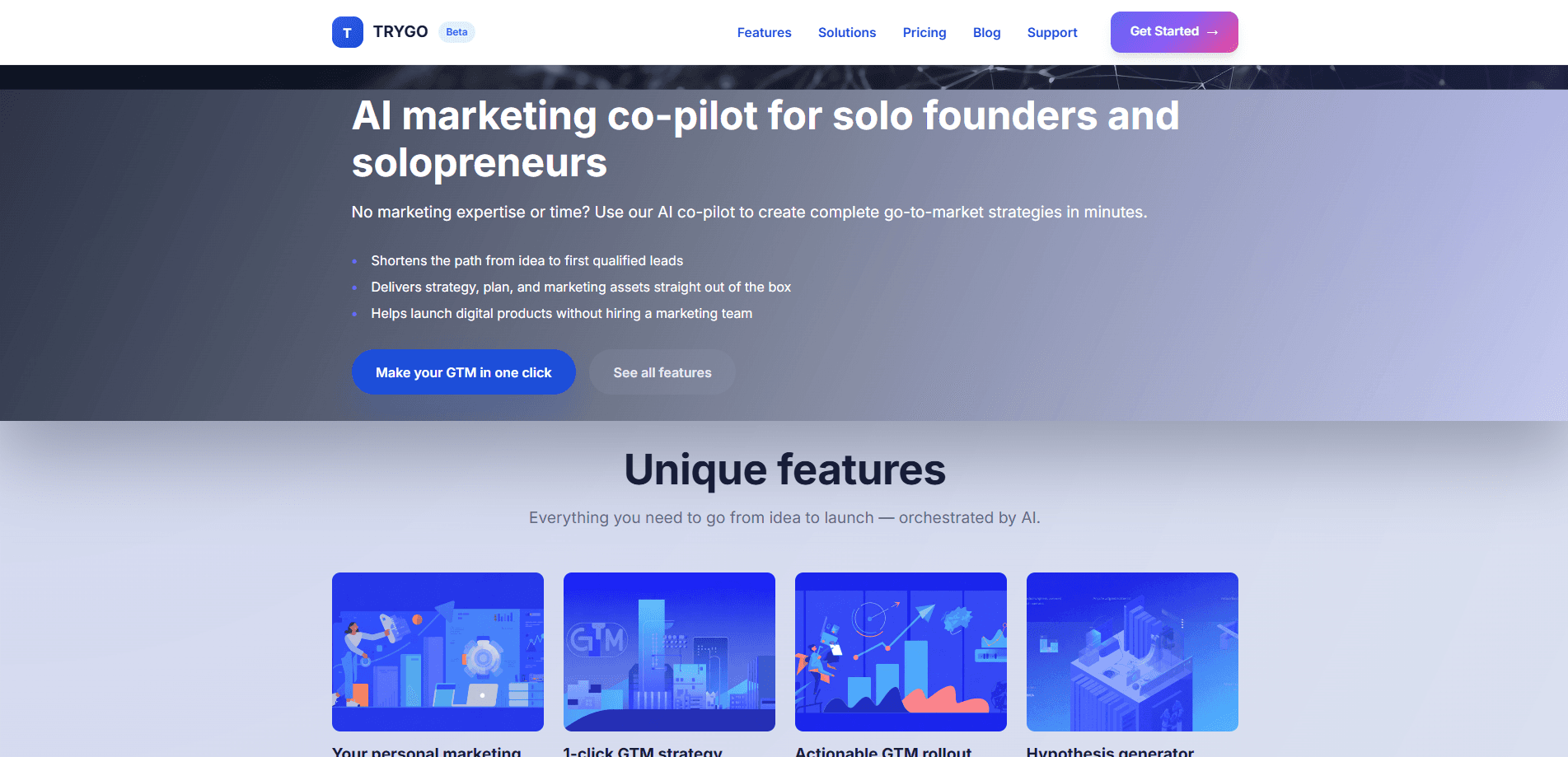
TRYGO is an AI marketing co-pilot for founders who've built something but haven't found buyers yet. You describe what you built, and it hands back one specific place to look for customers with a step-by-step plan for the week. This founder marketing tool is built for people without a marketing team, and the first result comes back in about five minutes. If you want to find first customers without hiring a marketer, the pitch is simple: describe the product, get a GTM plan you can start on today.
About TRYGO
What Is TRYGO
TRYGO is a web-based AI marketing advisor, sometimes described as a founder marketing tool, aimed at solo founders and small teams. Its pitch is narrow on purpose: your MVP is done, so the hard part now is finding the first paying customers rather than polishing the product further.
The tool works like a co-pilot instead of a full marketing department. You tell it what you built and who it's for, and it responds with a concrete starting point plus a weekly action plan, rather than a broad list of tactics you'd still have to sort out, prioritize, and schedule yourself before anything actually gets done.
The obvious limit is scope. TRYGO is a planning and direction tool, not an execution platform, and it won't run campaigns or write every asset for you. It also leans on what you feed it, so vague input tends to produce vague advice. Garbage in, garbage out. That's the tradeoff.
Getting Started
- Go to the TRYGO site and start a session (no marketing background assumed).
- Describe your product in plain language: what it does and who it's for.
- Answer the follow-up prompts about your stage, budget, and audience.
- Read the recommended channel and the step-by-step weekly plan it returns.
- Work through the steps, then come back to refine the plan as you learn what works.
Product Information
A quick look at TRYGO's pricing, supported platforms, and performance.
Best for
The users, tasks, and scenarios where this tool fits best.
Users
- Solo founders
- Small startup teams
- First-time makers
Tasks
- Choosing a first customer channel
- Drafting a GTM plan
- Validating go-to-market ideas
Scenarios
- Right after an MVP ships
- Weekend side projects
- Product pivots
Key features
One Recommended Channel
Instead of dumping a list of twenty growth tactics, TRYGO picks a single place to find buyers and explains why. If your goal is to find first customers, that focus is the point. Most founders stall on choosing. They don't lack options. Options are easy. Choosing is hard. A single clear starting point is easier to act on this week than an overwhelming menu.
Step-by-Step Weekly Plans
The output is a plan you can work through, not just advice. Each step maps to an action for the current week, so you're never left translating a strategy into a to-do list, and you always have something concrete to work on when you sit down at your desk on Monday morning. For someone with no marketing background, that translation step is usually where things fall apart. It rarely holds up well.
Built for Non-Marketers
TRYGO assumes no marketing degree. The prompts and recommendations are written in plain language, so you don't need to know jargon like "funnel" or "CAC" to get value, which is a real relief for someone who'd rather be writing code than reading growth blogs all afternoon. That lowers the barrier for technical founders who'd rather build than market. Fair enough. Not everyone wants to learn growth jargon to ship a product.
Fast First Result
The site promises a first result in about five minutes, which keeps the tool in the "try it now" category rather than a multi-day onboarding. Fast feedback matters when you're testing whether a go-to-market direction is worth pursuing at all. Nobody wants to spend a week configuring a tool before learning whether it helps, and the low time cost makes it reasonable to try a few different product descriptions until one produces a channel plan that actually fits the business you're running.
Plain-Language Product Input
You describe what you built in your own words rather than filling out a rigid form. That keeps the input accessible for founders without a marketing vocabulary. The advice quality still depends on how clearly you explain the product. So does any tool like this.
Pros and cons
Pros
- Focuses on one concrete channel instead of a long, vague tactic list.
- Designed for founders with no marketing background, so the language stays plain.
- Fast first result, which suits quick testing of a go-to-market idea.
- Free to start, so trying it costs nothing but a few minutes.
Cons
- Narrow scope: it plans marketing direction but doesn't run campaigns or publish content.
- Advice quality depends on how clearly you describe your product, so vague input gives vague output.
- As a newer tool, there's little public track record to judge how well the plans hold up. That one's worth watching.
Frequently asked questions
It's an AI marketing co-pilot that reads a description of your product and returns one specific place to find customers, along with a step-by-step plan for the week. It's aimed at founders who've finished building and now need buyers.
Related content
Explore related tools, skills, and articles for TRYGO.
TRYGO Alternatives

Emailwritr
Emailwritr · Writing · MarketingEmailwritr is an AI email copywriting tool built for affiliates, course creators, and online businesses that want more revenue from the list they already own. Instead of blank pages or generic chatbot prompts, this AI email writer generates welcome sequences, launch campaigns, cart recovery emails, and promo series from frameworks modeled on well-known direct-response copywriters. You connect your autoresponder, answer a few questions about your offer, and it writes the copy for you.

Prosp
Prosp · Writing · Voice & Language · MarketingProsp is an AI LinkedIn outreach tool built for agencies and sales teams, and it writes the message and the voice note in your own voice for each prospect so they actually reply. You connect your accounts, find leads, and let the AI draft and send personalized messages at scale, all from one inbox. It's built for people running outbound at volume. That's the whole pitch. Every touchpoint still has to feel human.

On Model
On Model · Image · MarketingOn Model is an AI fashion model tool that places your clothing on virtual models so online stores can get on-model product photos without booking a photoshoot. It runs as a Shopify app, letting you swap the model in an existing image, change backgrounds, and generate faces for cropped or headless shots. The goal is simple: match your product photos to your customers and stand out from competitors using the same supplier images.