

TuneTrain.ai
TuneTrain.ai · Coding · Other
TuneTrain.ai is an AI model fine-tuning platform that turns your own data into customized small language models. You upload a dataset, expand it with augmentation and distillation tools, pick a base model like Llama 3 or Mistral, and let the platform run the training for you. It targets teams that want to train custom AI models. You don't need to hire an ML engineer or stand up your own GPU cluster.
About TuneTrain.ai
What Is TuneTrain.ai
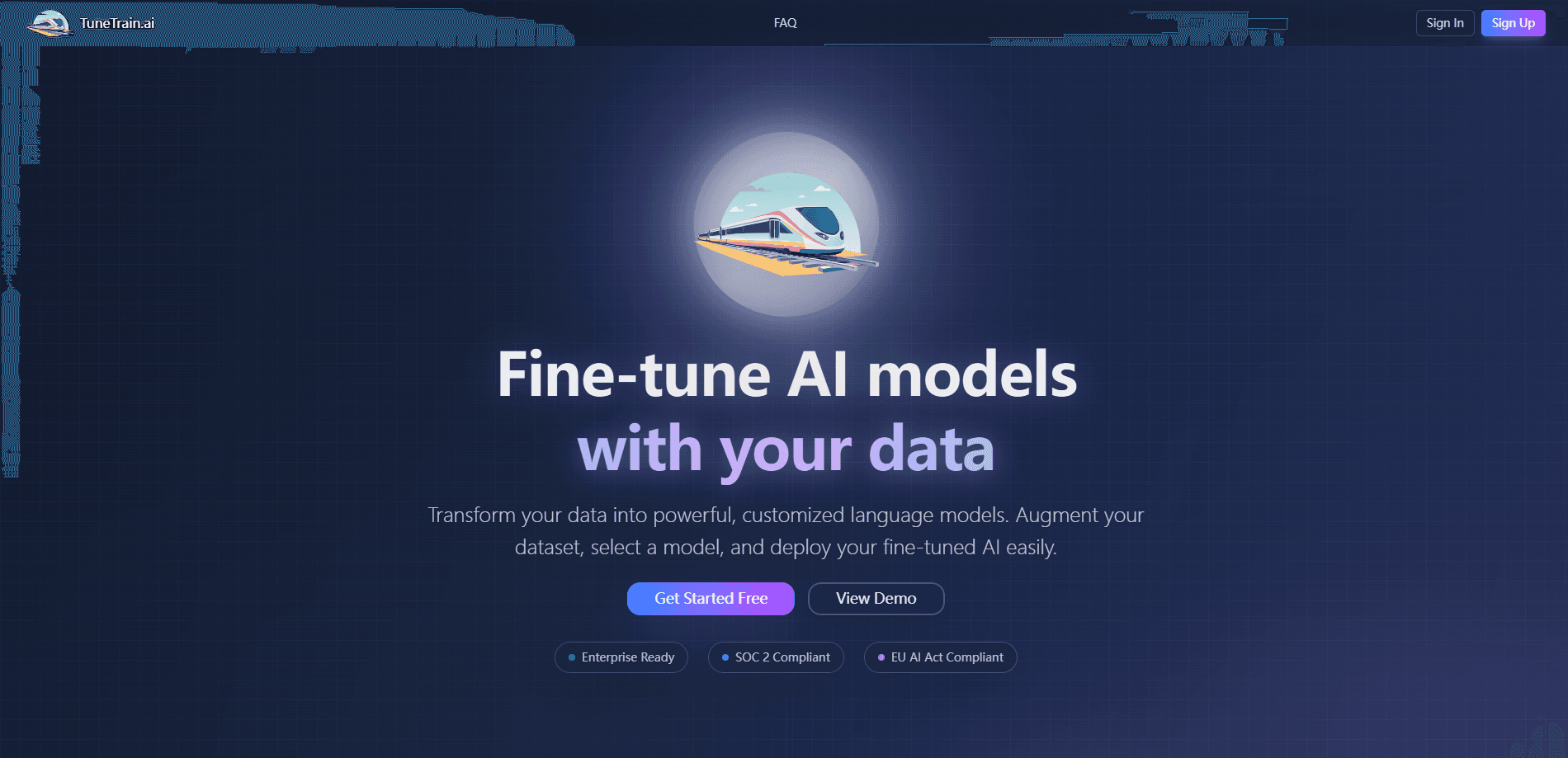
TuneTrain.ai is a web platform for fine-tuning small language models on your own data. It bundles three things that usually live in separate tools: dataset management, dataset augmentation, and model training. The company positions it for businesses that want customized AI but lack deep machine learning staff.
The core idea is that you don't need to be an ML researcher to get a model that knows your domain. You bring CSV or JSONL data, the platform handles the training pipeline, and you download the finished model. That removes the biggest barrier for small teams: the setup. So what does it actually take to fine-tune small language models here? Less than you'd think.
The limits matter too. Conversational fine-tuning and managed hosting are marked coming soon, so right now you get instruction fine-tuning plus downloadable model files, and you host them yourself. Pricing runs on credits rather than flat tiers, so costs scale with how much augmentation and training you actually do. Know that going in.
Getting Started
- Create a free account and sign in to the dashboard.
- Upload a dataset in CSV or JSONL format with an instruction-input-output structure.
- Optionally expand it using dataset augmentation or LLM-based distillation to improve coverage and quality.
- Pick a base model such as Llama 3, Mistral, or Phi-4 from the supported library.
- Start the training job, monitor progress in real time, then download the finished model for deployment.
Product Information
A quick look at TuneTrain.ai's pricing, supported platforms, and performance.
Best for
The users, tasks, and scenarios where this tool fits best.
Users
- Small and mid-sized teams
- Product and support teams
- Developers without ML backgrounds
- Regulated industries
Tasks
- Instruction fine-tuning
- Dataset augmentation
- LLM-based distillation
- Model export
Scenarios
- You have a few thousand support tickets and want a model that classifies and replies in your brand voice.
- You need a private model for a niche domain where off-the-shelf chatbots keep getting the details wrong.
- You want a lightweight model that runs on modest hardware instead of paying per call to a large hosted model.
- You're prototyping a specialized assistant and don't want to build the whole training pipeline from scratch.
Key features
Dataset Management
TuneTrain.ai handles your training data in one place, with support for CSV and JSONL files built around an instruction-input-output structure. You can create, edit, and organize datasets, track versions, and clone published datasets when you need a new variant. It's the part that keeps a fine-tuning project from turning into a folder of scattered spreadsheets. Messy data is the usual reason a run fails. Fix it first.
Dataset Augmentation
Augmentation takes your existing records and generates new ones based on them, which matters most when your real data is thin. The record-based tool expands a dataset by producing variations of records you already have, improving diversity so the model generalizes instead of memorizing. You can grow a whole dataset or pick specific records for targeted expansion. Thin data, better model.
LLM-based Distillation
This feature uses large language models to strengthen your training data. It's the sharpest tool in the box. It generates high-quality examples, refines existing records, and pushes knowledge from a big model into a smaller one. The payoff is a compact model that's faster and cheaper to run in production while still carrying the quality of the larger model behind it. Smaller, cheaper, still sharp.
Instruction Fine-tuning
Instruction fine-tuning trains a model to understand and carry out specific tasks rather than just continue text. You point it at your prepared dataset, choose a base model, and the platform runs the training. This is the option that's live today, and it covers most practical use cases like classification, extraction, and task-specific generation. It's the workhorse feature. Start here.
Curated Model Library
The platform offers a set of small language models (SLM) chosen for efficiency: Llama 3.2 3B, Llama 3.1 8B, Mistral 7B, Phi-3 Mini, Phi-3 Medium, Gemma 7B, Code Llama 7B, Qwen 2.5 7B, DeepSeek V2 7B, and Vicuna 13B. Every one of these is a small language model (SLM) built to run on modest hardware, which is the whole point of picking a compact model over a giant one. Pick the smallest one that does the job.
Real-time Training Monitoring
While a job runs, you can watch training progress as it happens instead of waiting blind for a result. That's useful for catching a bad dataset early, before you burn hours of compute on a run that was never going to work. No surprises at the end. Simple as that.
Private, Compliant Processing
Training data is encrypted and processed in secure environments, and TuneTrain.ai states it's EU AI Act compliant and follows GDPR. Your datasets and models stay private to your account, and the company says training data is never used to improve the platform or shared with third parties. For teams handling customer or internal data, that's the difference between a usable tool and a non-starter. Big deal for regulated teams. It really is.
Model Ownership and Export
You keep full ownership of the models you train. Once a run finishes, you can download the weights, configuration, and tokenizer, then deploy them however you want, including commercially. There's no lock-in forcing you back onto the platform to use what you built. Your model, your call. That matters.
Pros and cons
Pros
- Combines dataset management, augmentation, and training in one place instead of juggling several tools.
- Credit-based pricing means you pay for the augmentation and training you actually run, not a flat subscription.
- Supports a solid range of small language models from Meta, Microsoft, Google, Mistral, Alibaba, and others.
- Strong data privacy stance with EU AI Act and GDPR alignment, plus no third-party sharing.
- You own and can download the finished models for commercial use, with no platform lock-in.
Cons
- Conversational fine-tuning isn't available yet, so chatbot-style dialogue training has to wait.
- Managed hosting and API endpoints are still coming soon, meaning you must deploy downloaded models yourself.
- Pricing runs on credits with no published figures, so you can't estimate a project's cost up front before checking the dashboard.
- There's no mobile app, and the whole workflow lives in a browser, which is fine on desktop but not suited to mobile.
Frequently asked questions
TuneTrain.ai is a platform for fine-tuning small language models on your own data. You use it to prepare a dataset, expand it with augmentation and distillation, train a chosen base model, and download a customized model you can deploy yourself.
Related content
Explore related tools, skills, and articles for TuneTrain.ai.
TuneTrain.ai Alternatives
Forefront
Forefront · CodingForefront is a web platform for building with open-source AI. It lets you fine-tune leading open-source language models on your own data, evaluate how they perform, and run them through an API or export them to host yourself. Developers who want the convenience of a closed-source platform but insist on owning their models and data are the target audience here.

Startkit
StartKit.AI · CodingStartkit is a boilerplate for building AI SaaS and AI wrapper products. Think of it as an AI startup boilerplate with the boring parts already wired up: authentication, Stripe and Lemon Squeezy payments, usage limits, transactional email, and an AI API starter that talks to OpenAI, Anthropic, Groq, or Llama. You clone the repo, set your price, and start on the part of your product that people actually pay for. It's Next.js under React and Tailwind, so most of the boilerplate code already feels familiar.
Testim
Tricentis · CodingTestim is an AI-powered test automation platform for building and running end-to-end tests across web, mobile, and Salesforce applications. It leans on machine learning to keep tests stable when an interface changes, so teams spend less time fixing broken selectors. Not bad for an automated testing tool you can start using today. You create tests by recording actions in a browser, then optionally add JavaScript when you need more control. It's a solid pick for busy QA teams.