

TxGemma
Google · AI Assistant · Business
TxGemma is an open model family from Google for therapeutic research. It predicts drug and target properties, answers follow-up questions in chat, and runs on Hugging Face or Vertex AI.
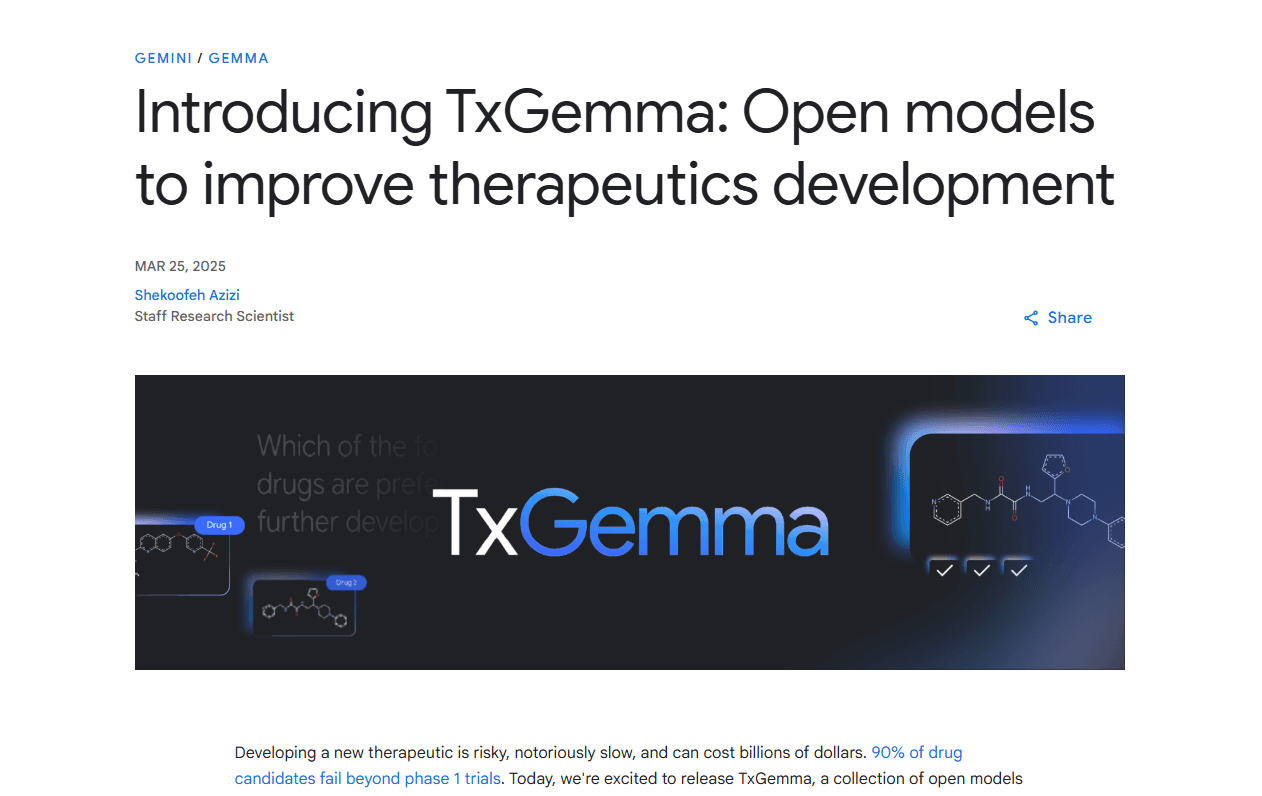
About TxGemma
What Is TxGemma
TxGemma is a family of open language models from Google, fine-tuned for therapeutic development. It builds on Gemma 2 and comes in three sizes: 2B, 9B and 27B parameters. Each size is trained to read the kinds of data drug researchers actually work with, from small molecules and proteins to nucleic acids, diseases and cell lines.
The models split into two jobs. A Predict version handles narrow property questions in a fixed format, like whether a molecule crosses the blood-brain barrier or how tightly a drug binds a target. A Chat version, available for the 9B and 27B sizes, holds a conversation and explains the reasoning behind a prediction. Google trained both variants on instruction data curated from the Therapeutics Data Commons, a public library of drug development benchmarks.
The main limit is scope. TxGemma predicts and reasons about therapeutic data, but it doesn't run lab experiments or replace wet-lab validation, and its Chat models trade some raw prediction accuracy for the ability to talk through results. Google released it under the Health AI Developer Foundations terms, which require agreement before you can download the weights.
Getting Started
- Accept the Health AI Developer Foundations terms on Hugging Face or Google Cloud to unlock the model weights
- Pick a size and a variant, choosing a Predict model for fixed property tasks or a Chat model for conversational work
- Format your input with the task prompts from the Therapeutics Data Commons, then load the model locally or deploy it on Vertex AI
- Fine-tune on your own therapeutic data, or call the model through a Vertex AI endpoint if you need to run predictions at volume
Product Information
A quick look at TxGemma's pricing, supported platforms, and performance.
Best for
The users, tasks, and scenarios where this tool fits best.
Users
- Drug discovery researchers
- Computational biologists and cheminformatics teams
- Machine learning engineers in biotech
- Small labs with limited compute
Tasks
- Property prediction
- Target and drug-target interaction work
- Clinical trial outcome signals
- Conversational analysis
- Fine-tuning for a niche endpoint
- Benchmark comparison
Scenarios
- You have a shortlist of compounds and a tight synthesis budget
- A senior scientist questions a model's call
- Your target is unusual and public models miss it
- You need batch predictions overnight
- You're evaluating tools for a new project
Key features
Three Model Sizes to Match Your Compute
TxGemma ships at 2B, 9B and 27B parameters, all derived from Gemma 2. The 2B model fits on a single GPU for quick experiments, while the larger sizes handle harder tasks and the conversational use cases. You can start small, prove the workflow, and scale up without switching to a different tool.
Predict and Chat Variants
Each size comes in a Predict version tuned for fixed property tasks and, for 9B and 27B, a Chat version that talks through its answers. The Predict models squeeze out the best numbers on narrow benchmarks, while the Chat models let you ask follow-up questions and read the reasoning. Google notes the conversational versions give up a little raw accuracy in exchange for that flexibility.
Broad Therapeutic Modality Coverage
TxGemma reads small molecules, proteins, nucleic acids, diseases and cell lines, rather than specializing in just one type of data. That range means a single model can touch several stages of discovery, from target identification to drug-target interaction and clinical trial outcome prediction, instead of you assembling a separate predictor for each.
Trained on Therapeutics Data Commons
Google fine-tuned the models on instruction data curated from the Therapeutics Data Commons, an open collection of drug development benchmarks and datasets. According to Google, TxGemma's Predict models beat or match state-of-the-art general models on 64 of the 66 TDC tasks, and beat or match specialized models on 50 of them, which is the kind of head-to-head result you can check for yourself on the public benchmarks.
Data Efficiency for Small Datasets
Fine-tuning TxGemma for a downstream task needs less training data than fine-tuning base Gemma 2 for the same job. For teams working with proprietary assays or rare endpoints where labeled data is scarce, that gap can decide whether a project is feasible at all.
Runs Locally or on Vertex AI
You can download the weights from Hugging Face and run them on your own GPU, or deploy TxGemma as a managed HTTPS endpoint on Vertex AI through Model Garden. Local runs suit experimentation and sensitive data, while Vertex AI covers production workloads, including batch prediction jobs for larger datasets.
Fine-Tuning Foundation
TxGemma works as a pre-trained base you can adapt to your own therapeutic tasks, with Google providing a fine-tuning notebook to get started. Because the models are open, you keep control over where your data lives and how the model is used, which matters when the data is proprietary.
Pros and cons
Pros
- Open weights under a clear license, so you can download, inspect and run the models on your own hardware
- Strong benchmark coverage across 66 Therapeutics Data Commons tasks, matching or beating specialized models on many of them
- Three sizes let a small lab start on one GPU and scale to a larger model later
- The Chat variants explain their reasoning, which helps you judge a prediction instead of trusting a bare number
- Fine-tuning needs less data than base Gemma 2, which helps when your assay data is limited
- Runs both locally and as a managed Vertex AI endpoint, so the same model fits an experiment or a production pipeline
Cons
- It predicts and reasons about therapeutic data but doesn't replace lab validation, so results still need wet-lab confirmation
- You must accept the Health AI Developer Foundations terms before downloading, and the license isn't a standard open-source one
- The Chat models trade some raw prediction accuracy for conversation, so the best numbers come from the Predict variants
- The 27B model needs serious GPU memory, which puts it out of reach for teams without decent hardware or Vertex AI credits
- The gated download on Hugging Face adds a login step, so it's not a one-command install like some smaller open models
Frequently asked questions
TxGemma is a family of open language models from Google for therapeutic development, built on Gemma 2 and released at 2B, 9B and 27B parameters. It predicts properties of drugs and targets, and its Chat versions explain the reasoning behind those predictions. Researchers use it to speed up drug discovery tasks like target identification and clinical trial outcome prediction.
Related content
Explore related tools, skills, and articles for TxGemma.
TxGemma Alternatives

Hark
Hark · Productivity · AI Assistant · China AIHark is a personal AI assistant that books, buys, and organizes things for you. It runs on web, iOS, and Android, remembers your preferences, and hands bigger jobs to a computer-use agent.

Rhem Labs
Rhem Labs · AI Assistant · China AIRhem is a tabletop health assistant robot from Rhem Labs that takes blood pressure and other wellness readings, runs reminders, makes calls, and sends fall alerts to family.

Wabi
Wabi, Inc. · Productivity · AI Assistant · ChatbotWabi is a messenger-style AI assistant for iOS, Android and Mac. It sorts your life into shared threads, builds small apps inside each one, and handles email, calendar and errands after you approve.