

Tyran AI
Terra · Coding · AI Assistant
Tyran AI is an AI health agent builder for apps. It connects to more than 500 health metrics from wearables, labs, nutrition, sleep, and HRV data, then turns that stream into features your users can act on. Instead of wiring up raw sensor feeds yourself, you pick an agent template or write a prompt, define a schedule and an outcome, and get typed JSON back. The pitch is simple. Real health insights in minutes, not months. It's a health metrics API with an agent layer on top.
About Tyran AI
What Is Tyran AI
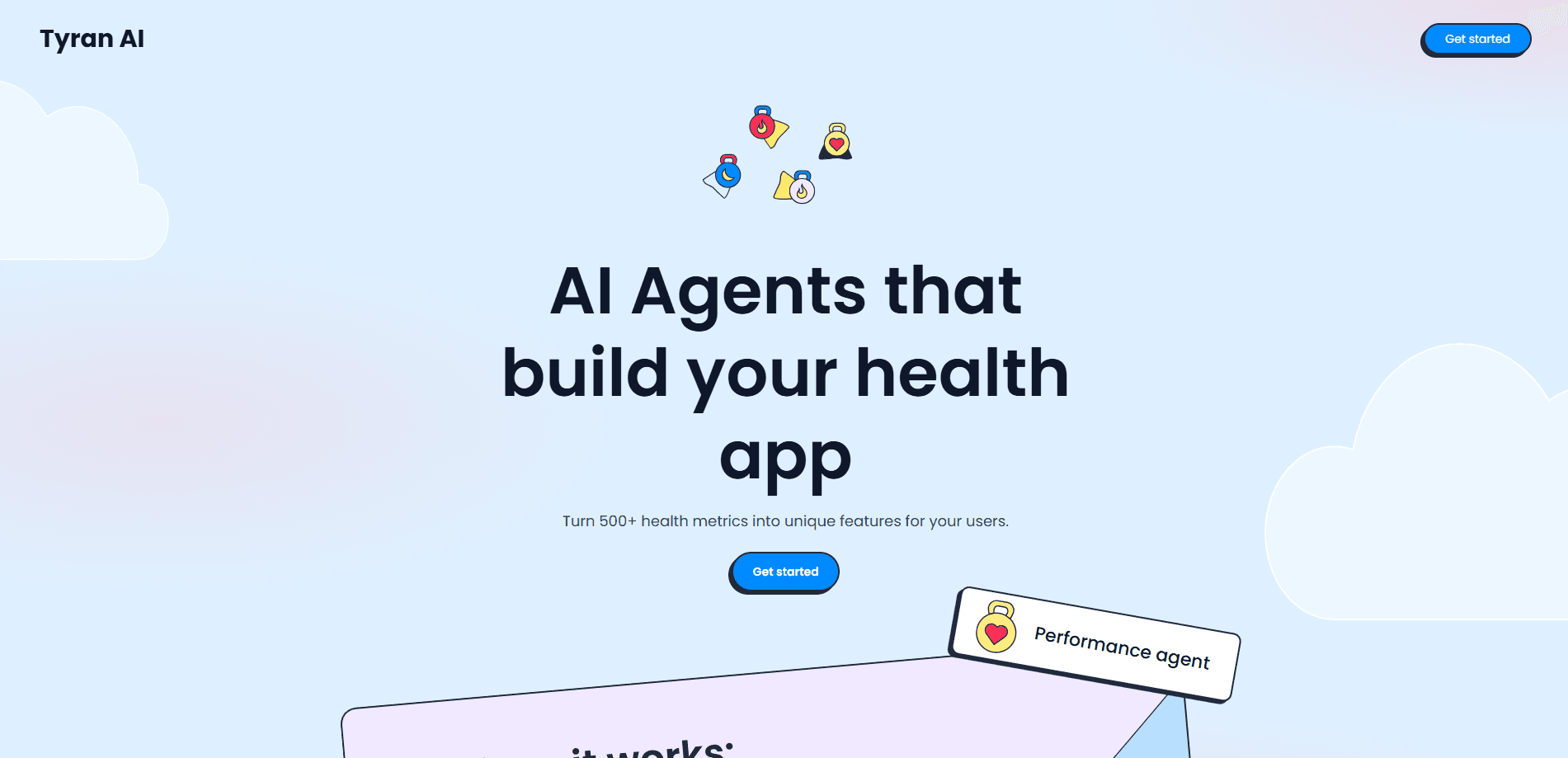
Tyran AI is a developer-first platform for adding AI health agents to an existing app. It sits on top of your users' connected health data and runs agents that watch for patterns, then trigger alerts, notifications, or plan changes. The company behind it, Terra, already runs a health data API, so Tyran arrives as the layer above the pipes rather than another tracker.
The product targets teams that want personalization without building machine learning infrastructure. You connect a health source through a drop-in auth widget, choose what the agent should look for, and let it run on a schedule. Outputs arrive as typed JSON. Your downstream UI and logic don't have to guess at the shape of the data. The whole point is no-code health agents you can configure instead of train.
The main limitation is that it's not a consumer app. There's no dashboard a normal person can sign into and use on a Tuesday night. Tyran is a builder's tool, and it expects you to have an app, an engineering team, and a reason to add health features. Pricing isn't published up front, so you'll have to talk to the team before you know what it costs.
Also worth knowing: Tyran agents surface patterns and signals, not diagnoses. The company is explicit that detecting signs of a possible condition isn't the same as a medical diagnosis, and any health claims in a shipped product still fall on the developer to validate.
Getting Started
- Sign up for a Tyran AI account on the official site and create a workspace for your app.
- Connect a health data source through the plug-and-play auth widget, so users can grant access to their wearable, lab, or sleep data.
- Pick a prebuilt agent template or write a prompt describing the behavior you want, such as flagging overtraining or spotting jet lag.
- Define the schedule and the outcomes: which alerts fire, which notifications send, and which plans get adjusted.
- Pull the validated typed JSON into your product, export it through webhooks, or let the agent act directly.
Product Information
A quick look at Tyran AI's pricing, supported platforms, and performance.
Best for
The users, tasks, and scenarios where this tool fits best.
Users
- Health app developers
- Digital health startups
- Fitness and wearables product teams
Tasks
- Detecting behavioral patterns
- Running experiments per user segment
- Triggering in-app actions
Scenarios
- Launching a wellness feature under time pressure
- Personalizing an existing tracker
- Supporting specialized health logic
Key features
500+ health metrics in one connection
Tyran AI pulls from wearables, labs, nutrition logs, sleep data, and HRV through a single auth widget. Users connect their source once. Your agent gets a broad view of their health instead of one narrow feed. That breadth is what makes cross-signal insights possible, like linking poor sleep to a drop in training performance.
Agent templates and custom prompts
You can start from a prebuilt agent or write your own prompt. The templates cover recovery, risk detection, women's health, root-cause analysis, and experimental logic. Most teams find a close starting point. No blank page. When the template doesn't fit, the prompt route lets you describe the behavior in plain language.
Custom logic and actions
Tyran agents don't just report. They act. They can trigger alerts, send notifications, update a workout plan, or push recommendations programmatically. That turns a passive insight into something that changes what happens inside your app. That last part matters most. A number nobody responds to isn't a feature.
Typed JSON output
Every agent returns validated, typed JSON rather than free text. Your downstream systems and UI stay reliable because the shape of the output is predictable. That predictability is the whole trick. It separates Tyran from chat-style tools that hand back prose your product can't easily parse.
Full agent lifecycle tools
Scheduling, versioning, and monitoring are built in. You can run agents on a cadence, ship a new version without breaking what's live, and watch how they perform. It's the difference between a demo and something you actually maintain in production.
Agent memory
Agents remember information over time and refine their behavior as they go. Instead of judging each reading in isolation, they build a running context for each user. The outputs get more relevant the longer someone uses the product. Think less "one-time reading" and more "someone who knows your habits."
Pros and cons
Pros
- Covers 500+ health metrics across wearables, labs, sleep, nutrition, and HRV in one integration.
- No-code agent setup means non-ML teams can ship health features without building a model stack.
- Typed JSON output keeps downstream product logic dependable.
- Built-in scheduling, versioning, and monitoring reduce the work of running agents in production.
- Templates cover several specialized health domains, so most teams have a starting point.
Cons
- Pricing isn't public, so you have to contact the team before you can budget for it.
- It's a developer platform with no consumer-facing dashboard, which rules it out for anyone wanting a ready-made app.
- Agents flag patterns rather than diagnose, so any clinical claim still needs independent validation.
- Meaningful value depends on users granting access to their health data, which is a real adoption hurdle.
Frequently asked questions
It's a platform for building AI health agents that run on top of connected health data. You connect a data source, define what the agent should watch for, and get typed JSON or triggered actions back that you can drop into your own app.
Related content
Explore related tools, skills, and articles for Tyran AI.
Tyran AI Alternatives
Forefront
Forefront · CodingForefront is a web platform for building with open-source AI. It lets you fine-tune leading open-source language models on your own data, evaluate how they perform, and run them through an API or export them to host yourself. Developers who want the convenience of a closed-source platform but insist on owning their models and data are the target audience here.

Startkit
StartKit.AI · CodingStartkit is a boilerplate for building AI SaaS and AI wrapper products. Think of it as an AI startup boilerplate with the boring parts already wired up: authentication, Stripe and Lemon Squeezy payments, usage limits, transactional email, and an AI API starter that talks to OpenAI, Anthropic, Groq, or Llama. You clone the repo, set your price, and start on the part of your product that people actually pay for. It's Next.js under React and Tailwind, so most of the boilerplate code already feels familiar.
Testim
Tricentis · CodingTestim is an AI-powered test automation platform for building and running end-to-end tests across web, mobile, and Salesforce applications. It leans on machine learning to keep tests stable when an interface changes, so teams spend less time fixing broken selectors. Not bad for an automated testing tool you can start using today. You create tests by recording actions in a browser, then optionally add JavaScript when you need more control. It's a solid pick for busy QA teams.