

Tyto by ai-coustics
ai-coustics GmbH · Voice & Language
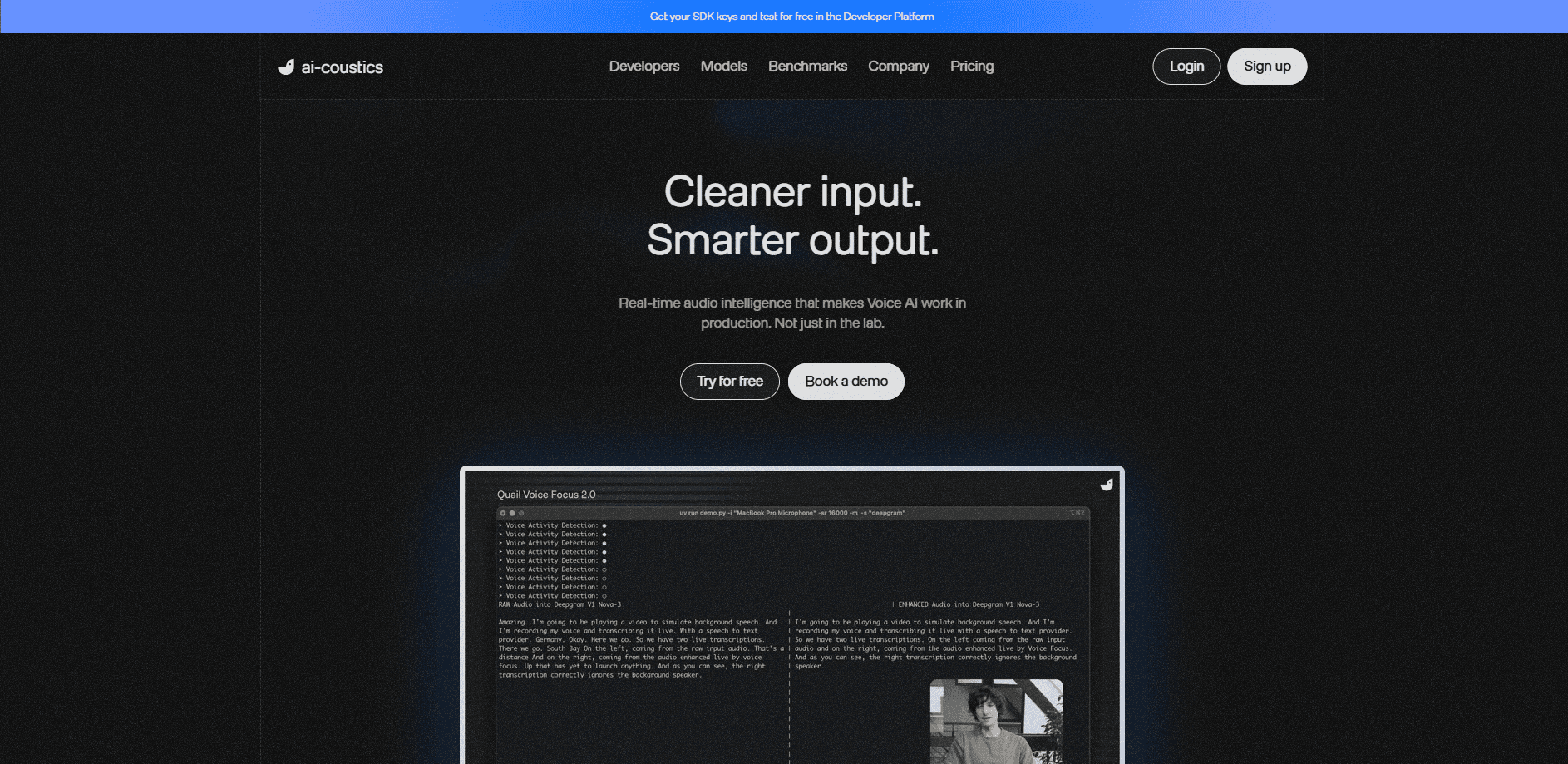
Tyto by ai-coustics is an audio insight tool that scores the audio arriving at a voice AI agent and predicts whether that audio will break speech recognition, voice activity detection, or turn-taking downstream. Instead of guessing why a voice agent fails on real calls, your team gets a single risk score per call plus six quality dimensions that name the exact culprit. It runs on CPU inside your own infrastructure, so call recordings never leave your stack. Most voice AI audio monitoring tools sample a slice of traffic. Tyto covers all of it. The speech enhancement SDK behind Tyto is small, cheap, and sits next to your audio, so AI audio quality scoring becomes a full-coverage job instead of a best-effort one.
About Tyto by ai-coustics
What Is Tyto by ai-coustics
Tyto is the audio insight model from ai-coustics, a Berlin company building speech intelligence for voice AI. Why does a voice agent that scores perfectly in the lab stumble on real calls? Usually the audio, not the model. Background chatter, room reverb, dropped packets, and codec artifacts all degrade the signal before your speech recognition model ever sees it. Tyto looks at the incoming audio and answers two questions: how likely is this call to fail, and what is causing the degradation.
The output comes in two parts, and both matter. A Tyto Risk Score gives you one number per call, predicting the likelihood of failure across STT, VAD, turn-taking, and speech-to-speech. Underneath that, six dimensions decompose the problem into noise, reverb, loudness, interfering speech, packet loss, and codec degradation. When the score jumps, you know where to look. That's the whole point.
Here's the catch. Tyto diagnoses audio. It doesn't fix it. If you want the audio cleaned up, that's a separate job handled by ai-coustics' Quail models. Tyto is the instrument panel, not the repair crew. It also assumes you're comfortable running an SDK on your own servers, since there's no drag-and-drop web app for non-developers.
Getting Started
- Sign up on the ai-coustics developer platform and start the 30-day free trial, which doesn't need a credit card.
- Pull the SDK and point it at your audio path, either as a live stream for real-time monitoring or as a batch job over recorded calls.
- Configure which checks to run, then let Tyto score incoming audio as it flows through your pipeline.
- Review flagged calls in the analysis dashboard and trace each low score back to its dominant quality dimension.
- Wire the risk score into your own alerts or logging so your team catches degradation as it happens, not after complaints arrive.
Product Information
A quick look at Tyto by ai-coustics's pricing, supported platforms, and performance.
Best for
The users, tasks, and scenarios where this tool fits best.
Users
- Voice AI engineering teams
- Support and QA leads
- Startups running small voice agents
Tasks
- Diagnosing unexpected agent failures
- Batch-analyzing a folder of call recordings
- Monitoring live call quality
Scenarios
- A voice agent that performs well in the lab but drops calls in noisy contact centers, where background chatter and reverb wreck accuracy.
- Post-call review at scale, when there are too many recordings for a human to audit and you need automated triage.
- Regulated deployments where call audio can't be sent to a third-party cloud, so the scoring has to run on your own hardware.
Key features
One Risk Score Across Your Whole Pipeline
Tyto collapses a messy audio problem into a single number per call. That score predicts the likelihood of downstream failure across STT, VAD, turn-taking, and speech-to-speech, so you don't have to instrument each component separately. When the number spikes, something in the audio is off. No guesswork.
Six Dimensions That Name the Cause
A score alone tells you a call went wrong. It doesn't tell you why. Tyto fixes that. Tyto breaks degradation into six parts: noise, reverb, loudness, interfering speech, packet loss, and codec degradation. That split matters. Each cause has a different fix. Reverb is an acoustics problem; packet loss is a network problem. Knowing which one dominates saves hours of blind debugging.
On-Premise Scoring With No Audio Leaving Your Stack
The model is small enough to run on CPU, and it processes audio where it already lives. Nothing gets uploaded to an external service, which keeps recordings inside your compliance boundary. For teams handling sensitive calls, that's often the difference between being able to use audio analysis at all and not.
Real-Time and Post-Call Analysis
You can monitor audio quality signals while a session is running, or review the analysis view once a conversation has finished. The real-time mode fits live agents that need to react to bad input, while the post-call mode suits teams auditing a backlog of recordings. Same model, two ways to use it.
Full-Coverage Scoring at Low Cost
Because it runs on CPU and stays cheap per minute, Tyto can cover 100% of traffic rather than sampling a fraction of calls. Sampling misses the rare failures that matter most. Scoring everything means no call slips through unnamed, and your failure data reflects real traffic instead of a lucky subset.
Built to Integrate With Your Existing Voice AI Stack
Tyto slots into the pipeline you already run, sitting alongside your STT, LLM, and TTS blocks rather than replacing them. It emits a reliability signal your team can route into logs, alerts, or dashboards. That keeps your existing architecture intact while adding a layer of audio visibility on top.
Pros and cons
Pros
- Predicts failures before customers notice, giving teams a chance to react instead of apologize.
- The six-dimension breakdown turns a vague "the call went badly" into a specific, fixable cause.
- On-premise, CPU-based processing keeps sensitive call audio inside your own infrastructure.
- Low per-minute cost makes full-traffic scoring realistic rather than a sampled compromise.
- Works for both live monitoring and batch review of existing recordings.
Cons
- No free plan, and the entry tier starts at $135 per month billed annually, so it's aimed at teams with real production traffic.
- It only diagnoses audio quality. If you need the audio cleaned up, you'll pair it with a separate enhancement model.
- Getting value requires SDK integration work, since there's no standalone app for people who don't write code.
Frequently asked questions
It scores the audio reaching a voice AI agent and predicts how likely that audio is to cause a downstream failure. Along with the score, it reports six quality dimensions so you can see what's degrading the signal. Think of it as an instrument panel for call audio.
Related content
Explore related tools, skills, and articles for Tyto by ai-coustics.
Tyto by ai-coustics Alternatives

Foley
Hanamori Labs, LLC · Voice & Language · Productivity · AI AssistantFoley is a voice to-do list that turns a spoken sentence into a filed task, complete with project, date and time, then helps you plan the day around what is already there.
HireKey
HireKey · Voice & Language · Productivity · LeaningHireKey is an AI job search copilot built by a former tech recruiter. It checks role fit, tailors resumes, runs interview practice and tracks every application.

Fluence
Yay Software (Yannick Huchard) · Writing · Voice & Language · ProductivityFluence is an Android app that reads PDFs, EPUBs, Word files and web articles aloud, follows each sentence as it speaks, and answers questions about the text on the phone itself.