
Unitree G1
Unitree Robotics · Other
The Unitree G1 is a 35kg humanoid robot from Unitree Robotics with 23 to 43 joints, a 2 m/s jog, and a $13,500 starting price. It runs on AI-driven reinforcement learning.
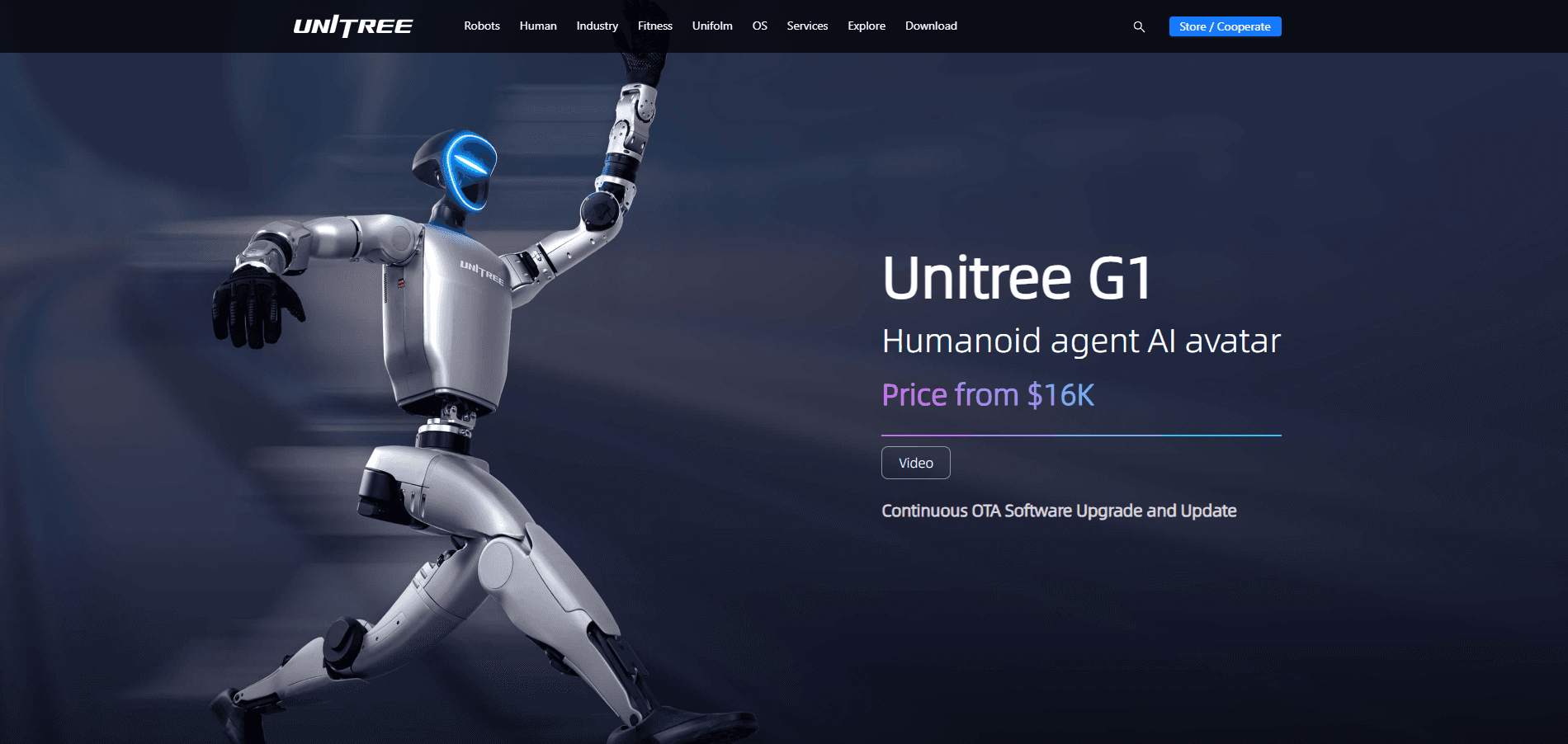
About Unitree G1
What Is Unitree G1
The Unitree G1 is a mid-size humanoid robot built by Unitree Robotics, a Hangzhou company known first for quadruped "robot dogs." Unitree announced the G1 in May 2024 as a general-purpose humanoid and priced the base edition at $13,500, a number that reset expectations for the category. Standing about 1.32 meters and weighing roughly 35kg with its battery, it packs 23 joints in the standard model and up to 43 in the G1 EDU.
The pitch is motion range and AI training, not household chores. Unitree gives the G1 an unusually wide joint range, so it can fold into a storage shape, stand up from lying flat, and jog above 2 m/s. Imitation and reinforcement learning drive its movement, which means the robot improves as new policies ship over OTA updates. Owners get a development platform for research, demos, and rental work rather than an appliance.
The honest limits are autonomy and support. The G1 does not cook or clean for you, and most impressive motion still needs a human operator. The base edition ships without dexterous hands and cannot run custom code, so secondary development requires the EDU edition. Unitree itself warns that the field is early and tells buyers to learn the limits before paying.
Getting Started
- Order the G1 through the official Unitree shop or a regional reseller, and pick the base edition or the EDU edition if you need hands and custom code.
- Handle shipping and customs, since the robot crosses borders as freight and the buyer covers duties, taxes, and import clearance.
- Charge the quick-release 9000mAh battery and pair the manual controller to bring the robot online.
- Run the built-in motion library through the controller, covering walking, waving, turning, and crouching.
- Load dance and skill packages or, on the EDU edition, connect the additional compute module and push your own reinforcement learning policies.
Product Information
A quick look at Unitree G1's pricing, supported platforms, and performance.
Best for
The users, tasks, and scenarios where this tool fits best.
Users
- Research labs and universities
- Robotics developers and integrators
- Event, rental, and media businesses
- Curious early adopters
Tasks
- Testing locomotion and balance research
- Demonstrating embodied AI
- Running scripted performances
- Prototyping manipulation
Scenarios
- Pitching at a product launch
- Building a robotics course
- Renting units for parties and exhibits
- Filming content
Key features
Wide-Range Joint System
The G1 carries 23 joint motors in the base model and up to 43 in the EDU edition, each built on an industrial crossed-roller bearing and a low-inertia PMSM. That range lets the robot fold into a 690x450x300mm package, stand up from lying flat, and hold deep crouches, movements a narrow joint layout cannot reach. The knee alone outputs up to 120N.m on the EDU.
Imitation and Reinforcement Learning
Unitree drives the G1's motion with imitation and reinforcement learning rather than hand-coded animation, so new skills arrive as software rather than hardware swaps. Updates land over the air, and the company says the robot's motions improve as policy training improves. This is the core difference between a fixed animatronic and a trainable embodied AI robot platform.
Force-Controlled Dexterous Hand
The optional Dex3-1 hand uses force and position blended control to hold both fragile and heavy objects. Its thumb has three active joints and each finger adds two, and the hand can take a tactile sensor array for touch sensing. The result is grip that adapts to an egg as readily as to a tool, which matters for any manipulation work.
Depth Camera and 3D LiDAR Sensing
A depth camera plus a Livox MID-360 3D LiDAR give the G1 360-degree awareness of what is around it, backed by a four-microphone array and a 5W speaker. That sensor stack feeds perception for navigation and interaction, and it gives developers the hardware they need to build vision-based behaviors instead of blind scripts. That sensor stack feeds perception for navigation and interaction, and it gives developers the hardware they need to build vision-based behaviors instead of blind scripts.
Quick-Swap Battery and Two-Hour Runtime
A 9000mAh pack runs the G1 for about two hours, and it releases quickly so a spare extends a session without downtime. A 54V 5A charger tops it back up. For demos and rentals that run all day, the swap design is what keeps the robot moving between events.
EDU Compute and Secondary Development
The G1 EDU adds a high-compute module, with options such as NVIDIA's Orin, and it is the only edition that supports secondary development. That opens the joint and sensor data to your own code, so teams can run custom reinforcement learning and control stacks. The base edition stays closed, which is the line that decides which model you buy.
Pros and cons
Pros
- Starts at $13,500, far below most full-size humanoids, which puts real hardware within reach for smaller labs and renters.
- 23 to 43 joints with a wide motion range enable folding, floor recoveries, and a jog above 2 m/s.
- The EDU edition supports custom code and a high-compute module, so it doubles as a research platform.
- Depth camera, 3D LiDAR, and a microphone array ship on every unit, giving developers a full sensor set.
- A quick-release battery and OTA updates keep sessions running and improve motion over time.
Cons
- The base edition has no dexterous hands and no secondary development, so serious research needs the pricier EDU.
- It ships with motion, not an assistant brain, so useful autonomy depends on what you or a partner build.
- About two hours of runtime per battery means long events need spare packs or planned breaks.
- Shipping crosses borders as freight and the buyer pays duties, taxes, and import clearance.
- The 35kg frame is heavy to move alone, and moving it between sites takes planning.
Frequently asked questions
The Unitree G1 is a mid-size humanoid robot from Unitree Robotics, standing about 1.32 meters and weighing roughly 35kg. It has 23 joints in the base model, up to 43 in the EDU edition, and jogs faster than 2 m/s.
Related content
Explore related tools, skills, and articles for Unitree G1.
Unitree G1 Alternatives

JarvisCore
Prescott Data · Coding · Productivity · OtherJarvisCore is an open source Python runtime where AI agents work as equal peers on an agent mesh, claim tasks from a shared ledger, and reach external services through a zero-trust broker.
Clef
Cloudflare · Business · OtherClef is Cloudflare's open-source decision model for Workers AI. It returns calibrated probabilities for typed questions, not generated text, so agents can classify, route, and act fast.

iFixAi
iFixAi · Business · OtheriFixAi is an open-source auditor for AI agents. It runs your agent through a simulation of your business, grades every reply, and returns an A to F scorecard backed by evidence.