

Unreal Speech
Unreal Speech · Voice & Language
Unreal Speech is a text to speech API that turns written content into natural AI voices, streaming audio in about 300ms with word-level timestamps at a fraction of the cost of mainstream voice APIs.
About Unreal Speech
What Is Unreal Speech
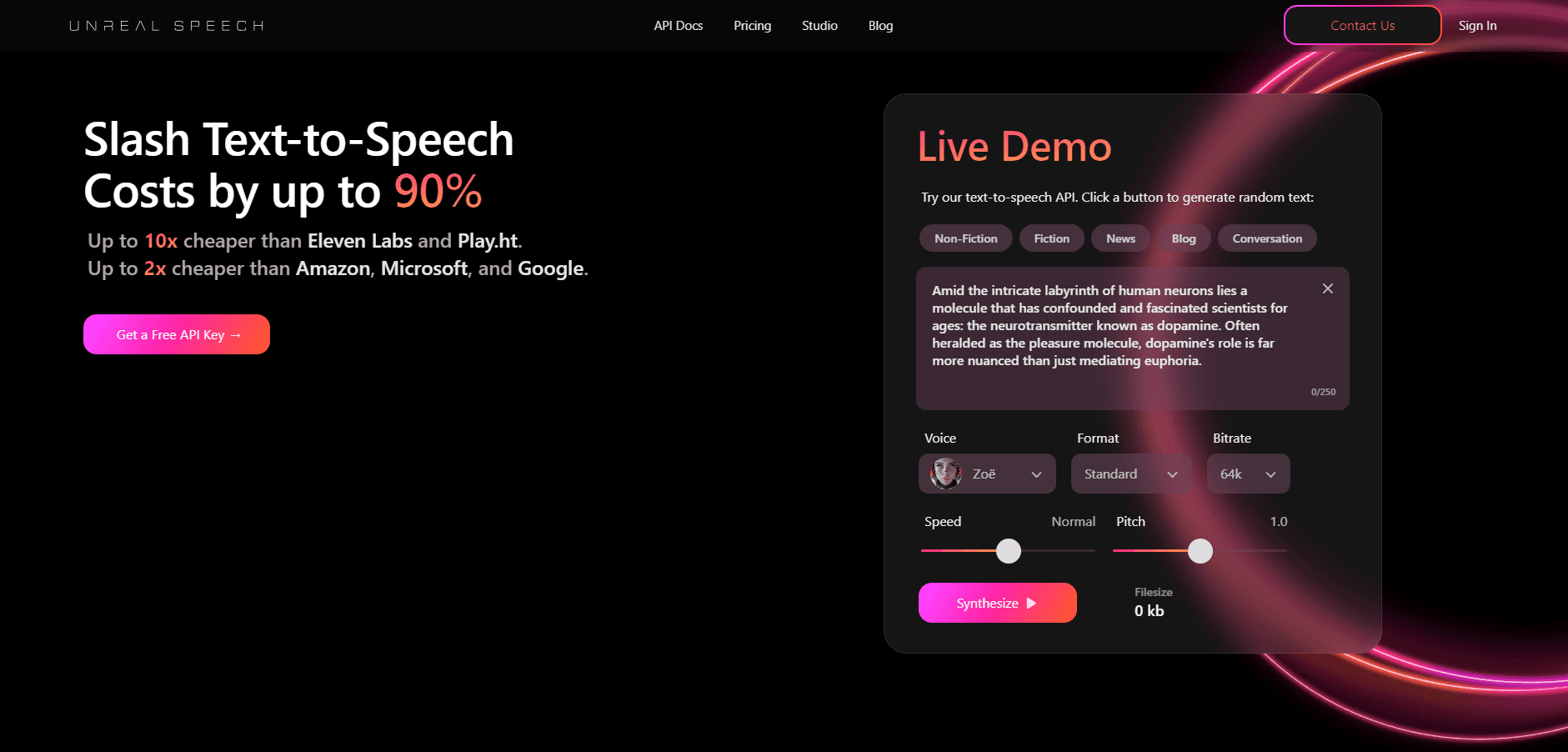
Unreal Speech is a text to speech API built for developers who need to add voice to an app without paying premium voice-AI prices. You send text to an endpoint, and it returns spoken audio through a simple REST call or a streaming websocket connection. The company positions the service as a speech synthesis API that costs roughly 11x less than ElevenLabs while keeping the voice output close to human. Teams comparing voice tools often look for a cheaper ElevenLabs alternative, and pricing is where this one competes.
The main job is speech generation at scale, with streaming TTS as the fast path. Beyond plain audio, Unreal Speech returns word-level timestamps that line up each spoken word with a start and end time, which is what you need for captions, karaoke-style highlighting, and subtitled video. It also handles long jobs: a single request can cover up to 10 hours of audio through the asynchronous tasks endpoint, so audiobooks and long-form narration don't fall apart on timeouts.
The limits are worth knowing. The free tier covers a fixed pool of characters per month, so production projects move to a paid plan or a per-use invoice. The voice catalog is smaller than what big cloud vendors ship, and the best quality depends on which voice and model you pick. It's also an API-first product: there's no drag-and-drop studio for editing a narration by hand, so non-developers need another tool to drive it.
Getting Started
- Grab a free API key from the Unreal Speech site, no card needed to start.
- Send a POST request to the /stream or /speech endpoint with your text, a VoiceId, and settings like bitrate, speed, and pitch.
- Pick a codec such as libmp3lame or pcm_mulaw and set the pitch and speed values to shape the voice.
- For long text, switch to the /synthesisTasks endpoint and poll it until the audio and timestamps are ready.
- Save the returned MP3, or wire the timestamps into a caption or word-highlighting layer in your app.
Product Information
A quick look at Unreal Speech's pricing, supported platforms, and performance.
Best for
The users, tasks, and scenarios where this tool fits best.
Users
- App and backend developers
- Indie studios and solo builders
- Content teams producing audio on a schedule
Tasks
- Generating narration for video
- Turning long documents into audiobooks
- Adding voice to an app or bot
Scenarios
- Shipping voice features on a startup budget
- Building a reading or accessibility tool
- Localizing narration for reach
Key features
Streaming Audio in About 300ms
The /stream endpoint returns audio fast, with the company listing a response of about 300ms. This is the core streaming TTS path, and it's the one to reach for when latency matters. Audio arrives as raw streaming data rather than a wait-for-the-whole-file response, which keeps spoken replies quick in assistants, games, and live interfaces. For real-time use, that speed difference is the whole point, since a slow voice makes a conversation feel broken.
Word-Level Timestamps
Unreal Speech returns timing data that marks the start and end of each word, delivered as JSON alongside the audio. That's the backbone of captions, karaoke highlighting, and subtitles that track the voice exactly. A newer websocket route streams audio and timestamps together, so a highlight layer can update in real time instead of waiting for the full clip.
Long-Form Synthesis Up to 10 Hours
The /synthesisTasks endpoint handles big jobs in one request, with the company citing support for up to 10-hour audio. That fits audiobooks, long courses, and full-length reports that would otherwise need chunking and stitching. You submit the text, poll the task, and pull the finished audio plus its timestamp file when it's done.
Natural Voices With Speed and Pitch Control
Each request takes a VoiceId plus values for speed, pitch, and bitrate, so you can shape delivery without re-recording. Bitrate runs up to 320k for clean playback, and speed and pitch shifts let you match a character or a pacing target. The catalog leans on a curated set of named voices rather than hundreds of options, which is simpler to pick from but narrower overall.
Flexible Codecs and Formats
The API outputs audio in codecs such as libmp3lame and pcm_mulaw, covering common MP3 delivery and lower-bandwidth telephony-style audio. You set the sample rate and bitrate to match the target platform, so the same service covers web playback and phone-style pipelines. That range saves you from converting between formats after the fact.
Simple REST and WebSocket API
The service is built around a handful of endpoints: /stream for quick clips, /speech for medium text with timestamp URLs, /synthesisTasks for long jobs, and /streamWithTimestamps for real-time audio plus timing. Auth is a plain bearer token, and the docs show working samples in Python, Node, and cURL. That low ceremony is why it slots into a prototype in an afternoon.
Pros and cons
Pros
- Pricing is the headline: as a low-cost TTS option it runs several times cheaper than ElevenLabs, which matters when a project generates a large volume of speech.
- The free tier lets you test the API with real characters before paying, so you can judge voice quality against your own script.
- Word-level timestamps come back with the audio, which removes the extra step of aligning captions or highlights by hand.
- The tasks endpoint handles up to 10 hours of speech in one job, so long audiobooks and reports don't need manual splitting.
- A streaming websocket route starts audio in about 300ms, keeping real-time voice replies responsive.
Cons
- The voice catalog is smaller than what large cloud speech vendors offer, so niche accents and languages may be missing.
- Word error rates and pacing vary by voice and model, so you should test a sample before committing a whole project to one pick.
- It's an API-only product with no point-and-click editor, which means non-developers need another tool to produce a finished narration.
- Quality on free or discounted tiers is capped by monthly characters, so heavy use can run past the included pool sooner than expected.
Frequently asked questions
Unreal Speech is a text to speech API and TTS API that converts written text into natural AI voices. Developers send text to REST or websocket endpoints and get back spoken audio, with word-level timestamps for captions and highlighting. It's built for teams who want voice features without paying premium voice-AI prices.
Related content
Explore related tools, skills, and articles for Unreal Speech.
Unreal Speech Alternatives

Foley
Hanamori Labs, LLC · Voice & Language · Productivity · AI AssistantFoley is a voice to-do list that turns a spoken sentence into a filed task, complete with project, date and time, then helps you plan the day around what is already there.

HireKey
HireKey · Voice & Language · Productivity · LeaningHireKey is an AI job search copilot built by a former tech recruiter. It checks role fit, tailors resumes, runs interview practice and tracks every application.

Fluence
Yay Software (Yannick Huchard) · Writing · Voice & Language · ProductivityFluence is an Android app that reads PDFs, EPUBs, Word files and web articles aloud, follows each sentence as it speaks, and answers questions about the text on the phone itself.