

UpRock
UpRock · Coding
UpRock is a DePIN app that pays UPT tokens for sharing idle bandwidth and sells real-device web data to AI developers through its API.
About UpRock
What Is UpRock
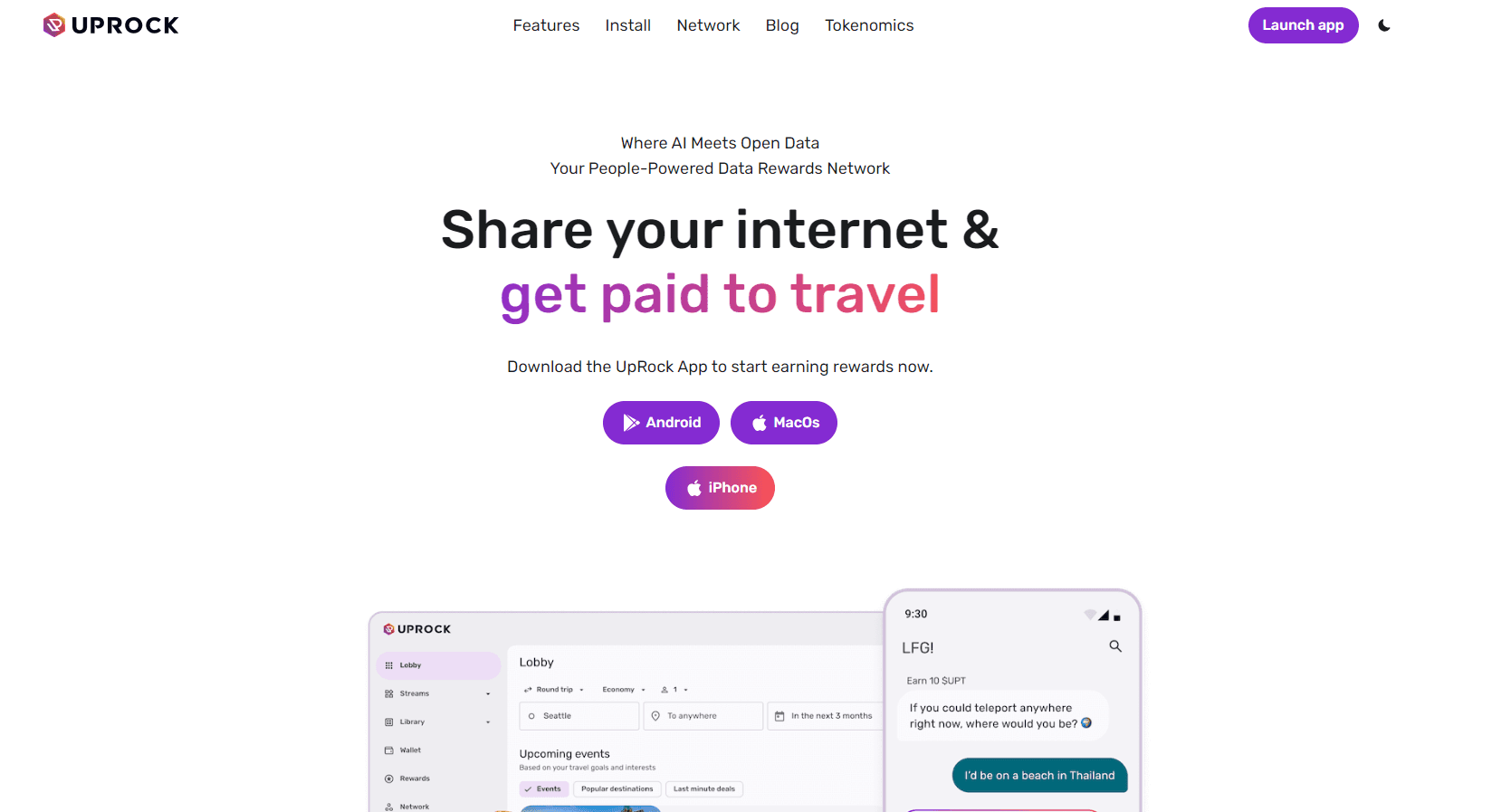
UpRock is an AI data network built on Solana. It turns ordinary phones, tablets and Macs into small data nodes: your device stays online, takes on small requests from paying customers, and you collect UPT tokens for the traffic it handles. Most of that work is web data collection, uptime checks and region-specific page views that datacenter proxies handle badly.
The product has two sides. On the consumer side, the UpRock app is a rewards dashboard with a base hourly rate, passive tasks, offers and a wallet. On the business side, the UpRock AI API gives developers search, crawl and site-verification calls that run on real devices in more than 190 countries, so a request from São Paulo returns what a person in São Paulo actually sees.
The limits matter as much as the pitch. Earnings depend on your connection score, your location and how many genuine residential networks you run, so a single phone in a low-demand country can earn very little. The app also bans proxies, servers, virtual machines and scripts, and it can close accounts it judges non-genuine. Treat the income as pocket money, not a salary.
Getting Started
- Create an account on uprock.com with an email address and confirm the login code.
- Install the UpRock app on Android, iOS or macOS, then sign in with the same account.
- Leave the app running on a real home connection and check the home screen for your base rate.
- Claim points from offers in the earn tab, convert them to UPT in the wallet, and withdraw or lock the balance when you have enough.
Product Information
A quick look at UpRock's pricing, supported platforms, and performance.
Best for
The users, tasks, and scenarios where this tool fits best.
Users
- Phone owners with flat-rate home internet
- Crypto users who want token exposure without buying
- Indie developers and AI builders
Tasks
- Checking how a page renders in another country
- Collecting pricing or listing pages at scale
- Topping up a small crypto balance
Scenarios
- A spare Android phone sitting on a charger all day
- An agency auditing a client site before a regional launch
- An agent workflow that needs live web pages
Key features
Passive earning from idle bandwidth
The core loop is simple: install the app, stay online, get paid. A base rate ticks up every hour based on your connection score and geo score, and passive tasks add separate entries in the transaction feed. The work covers uptime monitoring, rotating mobile proxies, basic URL collection and data security jobs. You do nothing after setup, which is the whole appeal.
Rocket AI inside the app
Rocket AI is UpRock's built-in assistant, trained on the data its own network collects. In the app it hunts deals, tracks prices and answers general questions, and it pays out small transactions when your device stays up. It is not a general chatbot competitor, so judge it as a bonus on top of earnings rather than a reason to install.
UpRock AI API and MCP endpoint
The business product is an insight engine for agents. One HTTP call covers search, crawl and site checks, and an MCP endpoint plugs the same engine into Claude, Cursor or a custom agent. Results come back structured, which cuts the parsing work that usually eats a scraping project. New accounts get 5,000 free credits with no card, enough to test a real workflow before paying.
Real-device web data from 190+ countries
Most scraping runs through datacenter proxies, and sites increasingly block them or serve different content. UpRock routes requests through real mobile devices in the target country, so you see local search results, local pricing and local consent screens. For market research and ad verification, that difference is the product.
Offers, streaks and boosters
Earning is not limited to passive tasks. The earn tab holds surveys, play-to-earn quests from partners and a daily check-in that pays for watching three short ads. Rocket Booster multipliers stack when you finish surveys, invite referrals or complete game quests, and they lift your hourly rate for a set period.
UPT staking and wallet controls
Points convert to UPT at a one-to-one rate inside the app, and the wallet handles claims and withdrawals on Solana. UPT staking lets you lock a balance for a chosen period, watch the yield accrue, and withdraw whenever you want. That gives long-term holders a reason to stay instead of selling every payout.
Pros and cons
Pros
- Free to start on all three platforms, with no deposit and no hardware to buy.
- Real payouts in a listed token, not points that never convert.
- The API side is genuinely useful: structured output, MCP support and a free credit allowance for testing.
- Regional data comes from actual devices, which beats datacenter proxies for local search and pricing checks.
Cons
- Earnings are small and unstable. A single phone in a low-demand region may bring in cents per day, so the hourly rate is not a reliable income figure.
- Strict device rules mean a VPS, a proxy or an emulator can get your account terminated with the balance inside it.
- Token payouts carry price risk, and UPT can lose value faster than you accumulate it.
Frequently asked questions
It sells web data collected by real user devices and pays those device owners in UPT tokens. The app is the supply side, the UpRock AI API is the demand side, and the token ties the two together.
Related content
Explore related tools, skills, and articles for UpRock.
UpRock Alternatives

Base Code
Base44 (Wix) · Coding · ProductivityBase Code is a shared cloud development environment from Base44. Teammates describe changes to an existing GitHub codebase in chat, preview them live and send them back as pull requests.

Google EmbeddingGemma 2
Google DeepMind · Writing · Image · CodingGoogle EmbeddingGemma 2 is a 740M-parameter open model that turns text, code, images, audio, and video frames into vectors in one 768-dimension space, running on phones and laptops.

GitGlow
GitGlow · Coding · ProductivityGitGlow is a local-first desktop Git client that lets independent developers review their own code and their AI agents' changes in one place before shipping.