

User Evaluation
User Evaluation · Voice & Language
User Evaluation is an AI research platform that runs moderated interviews, transcribes them, and turns transcripts into cited reports for product, design, and research teams.
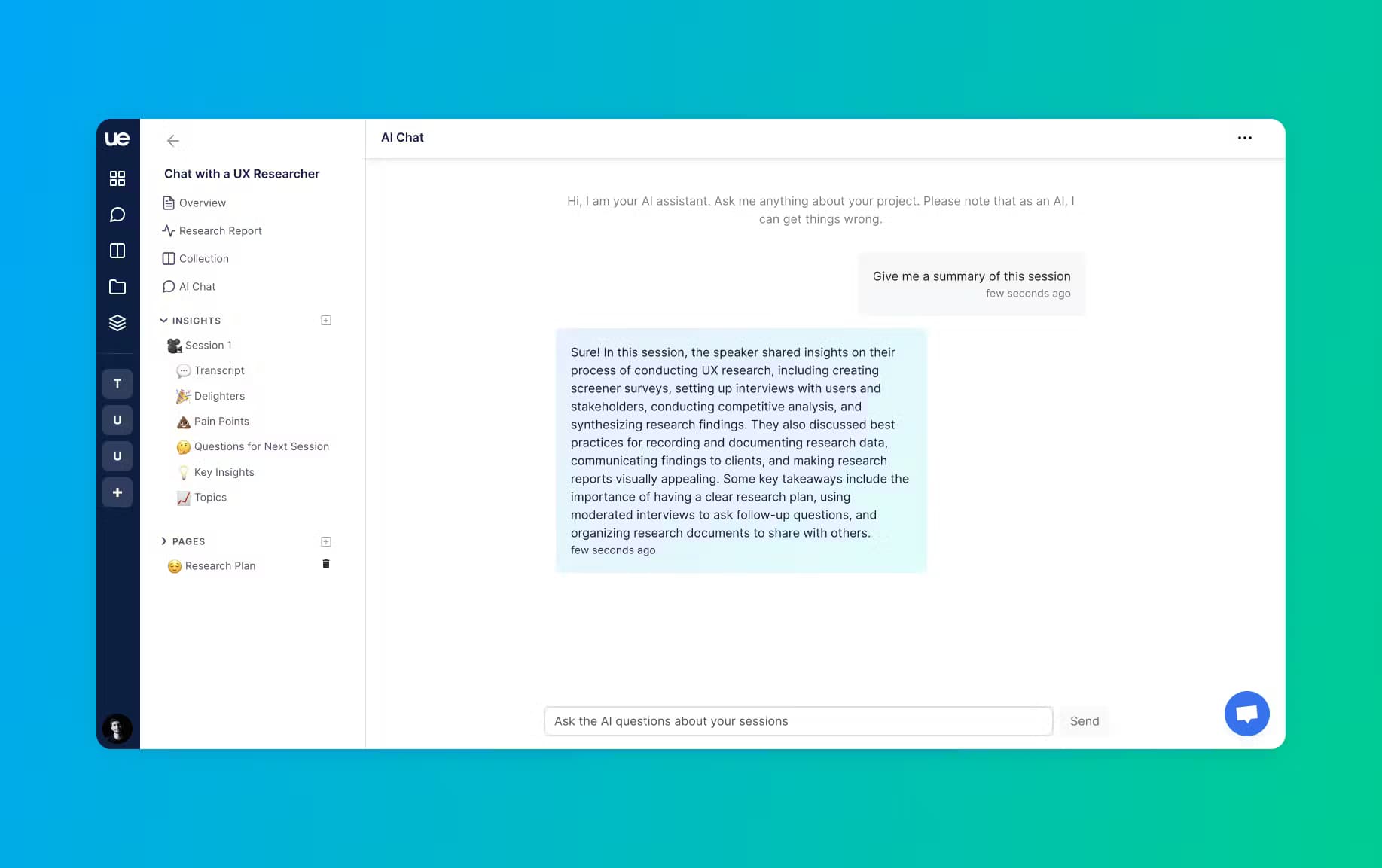
About User Evaluation
What Is User Evaluation
User Evaluation is a research platform built around an AI agent that reads interviews and answers questions from them. You start with a product or market question, and the agent plans the study and answers what it can from evidence you already have. When the answer needs real people, you approve an AI-moderated interview and the same thread turns the transcript into reports, charts, and clips.
The problem it targets is familiar to anyone who runs research. Reading a pile of interviews to pull out an answer takes days, and the answer often lives in one line nobody can find again. User Evaluation reads the transcripts once and stays ready to answer for as long as you have questions. Every claim it makes links back to the exact transcript line, and exports come out as cited PowerPoint decks rather than loose notes.
The company is a remote-first team that started shipping in 2022, with customers in research and product teams plus independent consultants and academic labs. The main limits sit on the human side: participant interviews are billed per completed session, so cost scales with how many people you talk to, and the platform leans on AI moderation rather than a human moderator for the standard flow.
Getting Started
- Create a Free workspace at userevaluation.com and sign in. The Free plan includes a monthly allowance of agent credits, so you can test the research agent before paying.
- Start a thread with the question you want answered. The agent plans the research and works from files you import or evidence it already has.
- Import your own research files or connect an interview study, then let the agent transcribe and analyze the sessions.
- Approve a paid interview only when the answer needs real people. Pick own-participant, consumer, or B2B professional sourcing, and set a budget so every paid action passes an approval card first.
- Review the findings in the same thread, then export a report, chart, or clip. On paid plans you can also move structured data through the public API or react to events through signed webhooks.
Product Information
A quick look at User Evaluation's pricing, supported platforms, and performance.
Best for
The users, tasks, and scenarios where this tool fits best.
Users
- Product managers who need fast answers between releases
- UX researchers running moderated studies
- Solo consultants and small labs
- Stakeholders who just want to watch
- Teams that need cited evidence for decisions
Tasks
- Turning a pile of transcripts into an answer
- Running an AI-moderated interview
- Exporting a stakeholder-ready deck
- Screening out fraudulent participants
- Wiring research into your own stack
Scenarios
- Validating a feature idea before a build
- Replacing an expensive agency study
- Showing evidence to leadership
- Keeping user data inside a review process
Key features
AI research agent
The agent is the core of the product, not a sidebar chat. You give it a question, and it plans the research, answers from evidence you already have, and stays available for follow-ups. When a study needs humans, the same thread moves from planning to interviewing to reporting, so context does not get lost between tools. Every answer cites the transcript line behind it.
AI-moderated interviews with real participants
When the answer needs people, you approve an AI-moderated study instead of booking a moderator. Own-participant interviews cost $8 to $9, consumer interviews cost $22 to $24, and B2B professional interviews cost $40 to $44, with sourcing and screening included in that price. That covers 40 languages, so studies are not limited to one market.
Cited reports and clips
Transcripts turn into reports, charts, and clips where each claim links to the moment it came from. Findings export as cited PowerPoint decks with claims, verbatims, participant source lines, and clip references. That format matters when a finding has to survive scrutiny, because a stakeholder can check the evidence instead of trusting the summary.
Live research theater
Stakeholders can listen near-live and steer the moderator while a study runs. Captions arrive first with relayed audio in 5 to 10 seconds, up to five listeners can join, and the AI uses consented screen snapshots to ask context-aware follow-ups. It turns a study from a black box into something a team can watch and adjust.
Participant quality checks
The platform reviews session, network, device-reuse, and response-pattern signals to catch fraud, and it reports flags in plain language rather than a hidden rejection. A flagged session gets replaced free, with no extra interview credit used. That matters because online research panels carry real fraud risk.
Data in, data out, and integrations
Research files import through short-lived signed upload URLs, and results come back as structured data through the public API. Signed webhooks push project, interview, response, transcription, report, and session events without polling, and compatible AI clients connect through MCP. The API covers interviews and research data in and out, while chat stays in the product.
Private by default with approval gates
Approval cards gate every paid action, so nothing gets charged without a check. Public links show only the report or thread you choose to share, scrub common contact and secret patterns, exclude source recordings, and can be revoked. Enterprise workspaces add SSO through SAML 2.0 or OpenID Connect, SCIM 2.0 provisioning, and admin audit and retention controls.
Pros and cons
Pros
- The agent reads transcripts once and answers later questions, which cuts the re-reading pass that slows most studies.
- Every claim links to the exact transcript line, so a finding can be checked instead of trusted.
- A completed consumer interview costs $24 with sourcing and screening included, well under the agency price.
- The Free workspace includes a monthly agent-credit allowance, so you can test the agent before paying.
- Flags on bad participants come with a free replacement, and the flagged interview does not use another credit.
Cons
- Interview costs are per completed session, so a large study adds up quickly once real participants are involved.
- The standard flow leans on AI moderation, and chat is not on the public API, so teams that need a human moderator or API-level chat access have to look elsewhere.
- The public documentation declines to claim SOC 2, ISO 27001, or HIPAA status, so a procurement review needs direct confirmation rather than a badge.
- Data location and residency commitments are contract-specific, so a team with strict hosting rules needs that confirmed in writing.
Frequently asked questions
It runs the full user research loop in one workspace. You ask a question, the agent plans the study and answers from your existing evidence, and when the answer needs people it runs AI-moderated interviews and turns the transcripts into cited reports. Product, design, and research teams use it to get to an answer faster than re-reading interviews by hand.
Related content
Explore related tools, skills, and articles for User Evaluation.
User Evaluation Alternatives

Foley
Hanamori Labs, LLC · Voice & Language · Productivity · AI AssistantFoley is a voice to-do list that turns a spoken sentence into a filed task, complete with project, date and time, then helps you plan the day around what is already there.

HireKey
HireKey · Voice & Language · Productivity · LeaningHireKey is an AI job search copilot built by a former tech recruiter. It checks role fit, tailors resumes, runs interview practice and tracks every application.

Fluence
Yay Software (Yannick Huchard) · Writing · Voice & Language · ProductivityFluence is an Android app that reads PDFs, EPUBs, Word files and web articles aloud, follows each sentence as it speaks, and answers questions about the text on the phone itself.