

Vectra AI
Vectra AI, Inc. · Marketing
Vectra AI is an AI-driven network detection and response platform that watches traffic across network, identity, and cloud, then ranks the attacker behavior that actually needs a human.
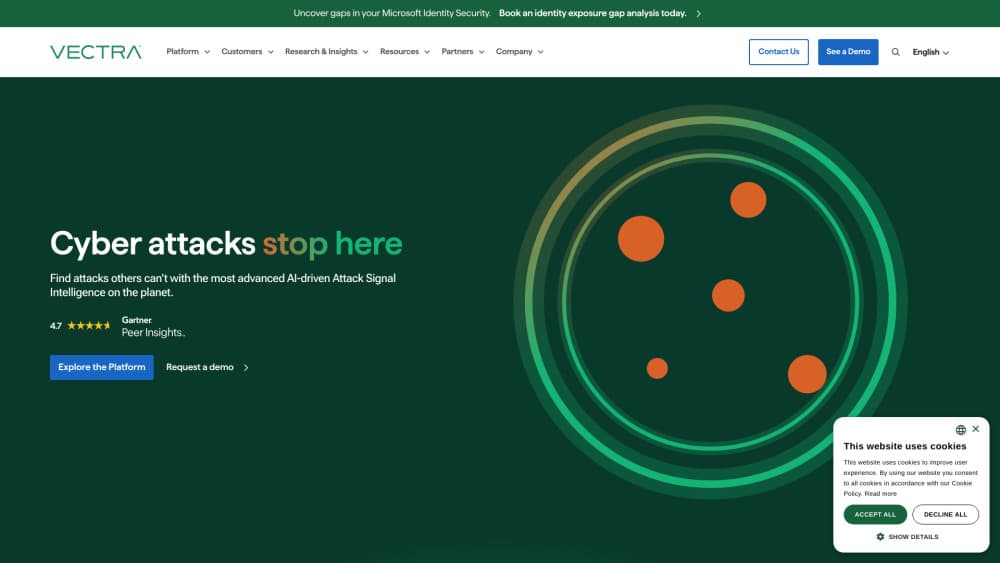
About Vectra AI
What Is Vectra AI
Vectra AI is an NDR platform built around one idea: most breach alarms are noise, and the few that matter hide inside it. It sits on your network as a set of sensors plus a cloud console, studies how devices, accounts, and services normally behave, and flags the moments when that behavior turns into an attack.
Its AI threat detection work rests on 39 patents and more than 200 models. The company started in 2011 in San Jose and now serves over 2,000 security teams. Gartner named it a Leader in the 2026 Magic Quadrant for network detection and response, the second year running.
It's not a product you sign up for on a Tuesday afternoon. Vectra AI sells to security operations teams through a sales process, and getting real value depends on deploying sensors where your traffic actually flows. Small companies without a SOC will find it heavy. Mid-size and enterprise teams drowning in alerts are the ones who benefit.
Getting Started
- Talk to the sales team and scope which environments you need covered: data center, remote sites, cloud accounts, or identity providers.
- Deploy sensors. Physical appliances cover core switches, virtual sensors cover remote sites, and cloud sensors plug into AWS, Azure, Google Cloud, IBM Cloud, or Oracle Cloud.
- Connect identity sources such as Microsoft Entra ID, Active Directory, and Microsoft 365 so account activity lands in the same view.
- Let the platform learn normal behavior for a few days, then review the ranked detections it surfaces.
- Wire responses into your existing tools, whether that's a SIEM, a firewall, or an endpoint platform, and set your triage routine.
Product Information
A quick look at Vectra AI's pricing, supported platforms, and performance.
Best for
The users, tasks, and scenarios where this tool fits best.
Users
- Security operations centers
- Threat hunting teams
- Network and infrastructure engineers
- Compliance and risk owners
Tasks
- Cutting alert volume
- Catching lateral movement
- Investigating identity attacks
- Proving coverage
Scenarios
- A ransomware crew lands on one workstation and starts probing
- A hybrid estate spans two clouds and a data center
- A regulated audit lands on the calendar
- A lean SOC needs backup
Key features
Behavior-Based Attack Detection
Vectra AI learns what normal looks like for every host and account, then flags deviations that match real attack patterns. The company says coverage reaches more than 90% of MITRE ATT&CK techniques. Detection keeps working inside encrypted traffic, so TLS doesn't blind it.
Attack Signal Intelligence
SOC alert triage is the reason most teams buy it. Three AI assistants handle the grunt work. One triages detections to separate real threats from benign activity, one stitches events across domains into a single attack path, and one ranks what's left by risk. The pitch is simple: fewer alerts, better order.
Unified Network, Identity, and Cloud Coverage
Most tools watch one surface. Identity threat detection at this depth is rare outside dedicated ITDR products. Vectra AI watches several at once and correlates them, so a compromised account and the machine it touched read as one incident. Coverage runs across data centers, campus networks, remote workers, SaaS, IoT and OT devices, and major cloud providers.
Network Observability and Asset Inventory
The platform monitors 13.3 million IPs daily and processes 10 billion sessions an hour, according to Vectra. That telemetry produces an inventory of devices and identities, which is often the first honest answer a team gets about what's running on its network.
Investigation Workspace
Analysts dig into a ranked entity with prebuilt queries, then pivot to a deeper look in a click. Query building supports SQL, so people who already write queries don't have to learn a new language. Logs get categorized automatically, which saves the hours usually spent reading long lines of raw data.
Network Exposure Management
This module flips the question from "are we breached" to "where are we exposed". It maps reachable services, weak configurations, and unmonitored segments, then tracks whether the fixes actually happened. Useful for compliance reporting and for convincing leadership that a gap is worth budget.
Managed Detection and Response
Vectra runs an MDR service on top of the platform for teams that want someone else on the night shift. It combines the same detections with human analysts and response actions, which is the practical option when hiring is slower than the threat calendar.
Pros and cons
Pros
- Detection quality holds up on encrypted and east-west traffic, which is where endpoint-only stacks go quiet.
- Alert triage and correlation cut the daily queue in a way analysts notice within the first week.
- One console covers network, identity, and multi-cloud, so investigations don't bounce between four tools.
- MITRE ATT&CK mapping makes coverage conversations with leadership concrete.
- The managed service option means a small team can run 24/7 coverage without hiring a night shift.
Cons
- No published pricing and no self-serve signup, so evaluating it means a sales cycle measured in weeks.
- Full value depends on sensor placement, which takes network planning and change windows before you see anything.
- The feature set is deep enough that untrained users will use maybe a third of it. Budget onboarding time or the console becomes shelfware.
- Mid-market teams on tight budgets will find the annual commitment hard to justify against lighter tools.
Frequently asked questions
It detects attacks by watching behavior rather than signatures. Sensors collect network and identity telemetry, AI models compare it against known attacker patterns, and the console surfaces ranked incidents with the context needed to investigate.
Related content
Explore related tools, skills, and articles for Vectra AI.
Vectra AI Alternatives

ngram 2.0
ngram · Video · Marketingngram 2.0 is an AI video generator for teams. It turns a prompt, a screen recording, or a product URL into a narrated explainer, product demo, or AI avatar video, and every scene stays editable.

shippedit.me
Krawlup · Marketing · Businessshippedit.me now redirects to Krawlup, a web platform that audits SEO, AEO and page speed every week, then hands the fixes to AI coding agents over MCP.

MePersona
MePersona, Inc. · Writing · Productivity · MarketingMePersona is an AI unified inbox for creators. It learns your voice, drafts replies to fan messages from 12 platforms, and sends only what you approve.