

Vectra AI
Vectra AI, Inc. · Other
Vectra AI is an AI-driven network detection and response platform that watches network, identity and cloud traffic to catch attacks in progress and speed up response.
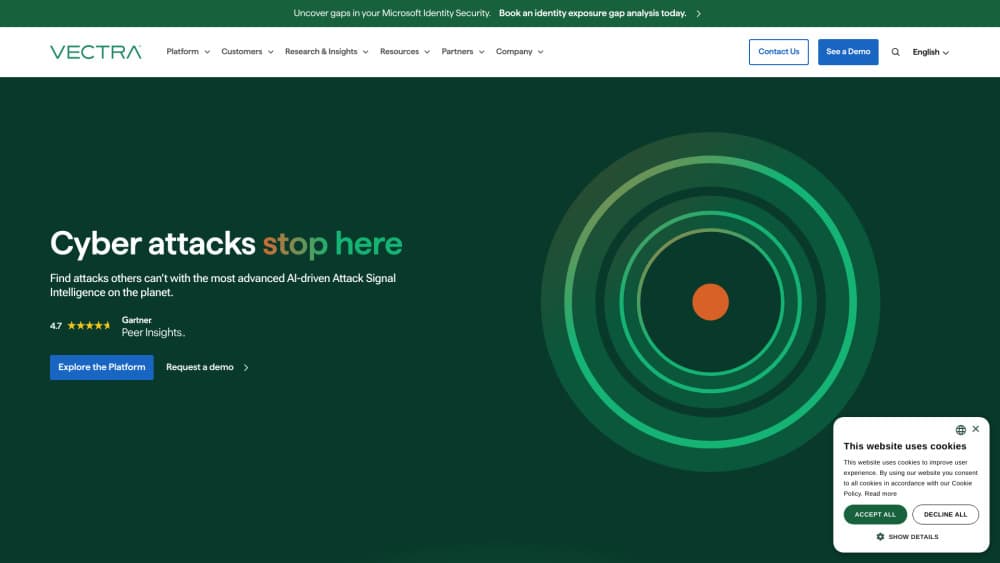
About Vectra AI
What Is Vectra AI
Vectra AI is a cybersecurity vendor in San Jose, California, that sells network detection and response (NDR) as a platform. The company started in 2010 and built its name on one idea: read the traffic already crossing a network, then use machine learning to spot behavior that looks like an attacker rather than a signature someone has seen before.
The platform pulls telemetry from data centers, branch offices, public cloud workloads, SaaS traffic and identity providers. Its models score that traffic and turn it into a short list of detections with the entities involved: a host, an account, an IP address. Analysts then work those detections inside one console instead of stitching together logs from five tools, which is the whole pitch for seeing the hybrid attack surface in one place.
Vectra's own numbers are worth reading with care. The company claims 39 AI patents, more than 200 detection models and over 90% MITRE ATT&CK coverage, and analyst firms have placed it in the leader tier of NDR reports. Those are vendor and analyst claims, not independent lab results, so treat the coverage figure as a starting point for a proof of concept rather than a guarantee.
The bigger limit is fit. This is enterprise software sold through a sales team, with no self-serve signup, no published price list and no consumer tier. A five-person startup has no reason to buy it. A security team running a SOC across a hybrid estate has plenty.
Getting Started
- Book a demo or a tour of the platform through vectra.ai, since there's no free account to spin up.
- Scope the proof of concept with the sales engineer: which network segments, which cloud accounts, which identity providers.
- Deploy sensors. Physical appliances sit in the data center, virtual sensors cover VMware and public cloud VPCs, and packet brokers feed traffic from places where a sensor can't be installed.
- Connect identity sources and your SIEM or SOAR so detections land where analysts already work.
- Tune the detection scope with your team over the first weeks, then decide on a production rollout and an annual contract.
Product Information
A quick look at Vectra AI's pricing, supported platforms, and performance.
Best for
The users, tasks, and scenarios where this tool fits best.
Users
- SOC analysts and detection engineers
- Security teams without 24/7 staffing
- Security leaders facing audit questions
- Organizations with unmanaged devices on the network
Tasks
- Catching lateral movement
- Investigating an alert with context
- Cutting alert volume before it reaches the SIEM
- Proving exposure went down
Scenarios
- Ransomware response in a hybrid Active Directory estate
- A hospital or factory with decade-old equipment
- A cloud migration that widened the blind spot
Key features
Attack Signal Intelligence
Vectra's detection layer scores behaviors across network, identity and cloud instead of matching known bad files or domains. The vendor says more than 200 models feed it. In practice, you get detections described in plain language: this account authenticated to twelve hosts in four minutes, and that pattern isn't normal here. Analysts can accept, dismiss or escalate each one, and the feedback shapes what the team sees next.
Agentless Network Observability
Sensors read traffic and build an inventory of every device that talks on the network, including the ones nobody installed an agent on. That covers user laptops, servers, virtual machines, IoT sensors, printers and industrial controllers. For a security team that has never had a reliable asset list, this is often the first feature that earns its keep.
Detection, Investigation and Response Workflow
Detections open into an investigation view with the host, the account, the related detections and a timeline. From there an analyst can pivot to other entities, check what else the same host touched, and hand off to a response action. The workflow matters more than any single model, because most SOC time goes into confirming whether an alert is real.
Identity Threat Detection
The platform correlates network behavior with identity signals from providers like Microsoft Entra ID and Okta. That combination catches things a network-only tool misses, such as a valid account being used from an unusual host at an unusual hour. Since most intrusions now start with stolen credentials, this is the module that closes the biggest gap.
Cloud and Data Center Coverage
Virtual sensors cover AWS, Azure and Google Cloud workloads, while appliances and packet broker integrations handle physical networks. One console shows all of it, so a detection that starts in a branch office and continues in a cloud VPC stays one story. Teams running a mixed estate avoid the usual situation where cloud traffic lives in a separate tool with separate rules.
Exposure Management and Integrations
Beyond detection, the platform tracks exposed services and attack paths so teams can close gaps before someone uses them. Findings flow into SIEM, SOAR, EDR, firewall and ticketing tools through prebuilt connectors, and a REST API plus a streaming feed lets engineers pull data into their own pipelines. That matters for teams that won't adopt a tool which only works inside its own dashboard.
Pros and cons
Pros
- Agentless coverage of devices you can't instrument, which is where most asset inventories fall apart.
- Detections arrive with entity context and a timeline, so triage takes minutes rather than a research project.
- Network, identity and cloud signals sit in one console instead of three disconnected views.
- Broad integration list for SIEM, SOAR, EDR and firewalls, plus an API for custom pipelines.
- Consistent placement in NDR analyst reports gives procurement a defensible shortlist argument.
Cons
- No published pricing and no self-serve trial, so evaluating it costs meetings and a proof of concept before you see a number.
- Sensor deployment takes real network work: span ports, packet brokers or virtual taps in every segment you care about.
- The platform is built for enterprise budgets, which puts it out of reach for small teams.
- Detection tuning takes weeks, and a team without NDR experience will lean on vendor support more than they expect.
Frequently asked questions
It reads network, identity and cloud traffic, then uses machine learning to flag behavior that looks like an attack in progress. The output is a prioritized list of detections with the hosts and accounts involved, plus tools to investigate and respond.
Related content
Explore related tools, skills, and articles for Vectra AI.
Vectra AI Alternatives

Odyssey 3
Odyssey · OtherOdyssey-3 is Odyssey's foundation world model. It simulates physics in real time, turns a prompt into an interactive environment, and adapts to robots, cars and games.

JarvisCore
Prescott Data · Coding · Productivity · OtherJarvisCore is an open source Python runtime where AI agents work as equal peers on an agent mesh, claim tasks from a shared ledger, and reach external services through a zero-trust broker.
Clef
Cloudflare · Business · OtherClef is Cloudflare's open-source decision model for Workers AI. It returns calibrated probabilities for typed questions, not generated text, so agents can classify, route, and act fast.