

Vercel
Vercel Inc. · Coding
Vercel is a cloud platform that turns a Git push into a live web app, and now handles AI deployments, serverless functions and model routing through AI Gateway.
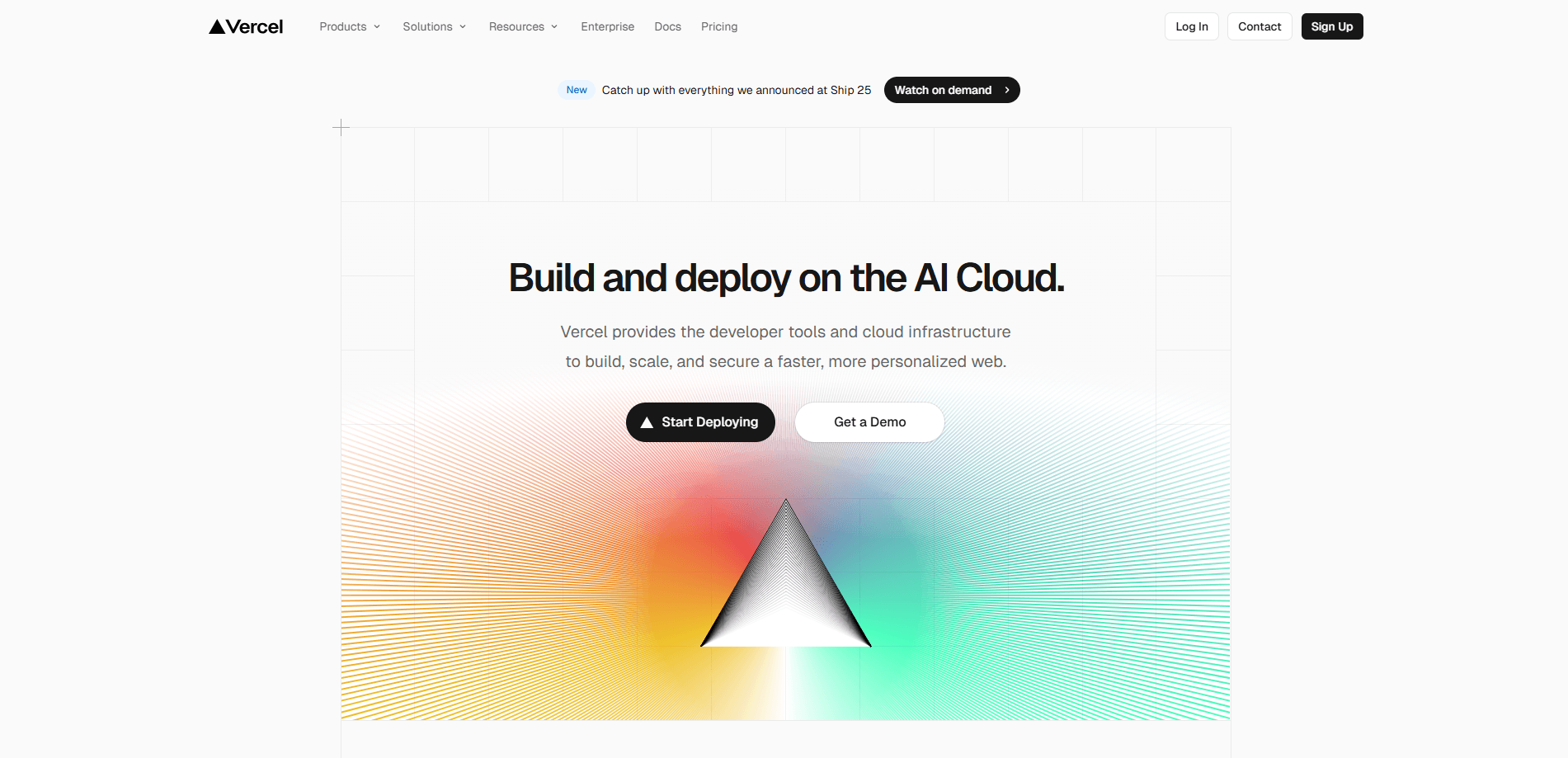
About Vercel
What Is Vercel
Vercel is a cloud platform for frontend deployment, and it has grown into a home for AI projects and model calls. You connect a Git repo, push your code, and the platform builds and ships it to a global network without you managing servers. That web app deployment workflow made it the default host for Next.js, the framework Vercel also maintains.
The bigger shift is AI. Vercel runs AI SDK apps, generative endpoints and agent backends, and AI Gateway lets you call models from many providers through a single endpoint with shared credentials, request logs and spend controls you configure in one dashboard. For teams that ship model-powered features, that means the hosting tier and the model tier sit in one account.
The limits matter. Good workflows assume a JavaScript or framework-based stack, so a plain static host or a Python-heavy backend isn't always the best fit. Costs also scale with traffic and usage, and a single viral moment can surprise a Hobby or Pro budget with a bill far above the flat plan price before anyone has time to react. The free plan is for personal and non-commercial work only.
Getting Started
- Sign up with GitHub, GitLab or Bitbucket and import a repository
- Let Vercel detect the framework, or set the build command and output yourself
- Push a commit to trigger a build, and review the preview URL for that branch
- Promote to production, then add a custom domain and set up analytics or AI Gateway keys
Product Information
A quick look at Vercel's pricing, supported platforms, and performance.
Best for
The users, tasks, and scenarios where this tool fits best.
Users
- Frontend developers
- AI product teams
- Small startups and indie builders
- Agencies and freelancers
Tasks
- Deploy a web app
- Run AI endpoints
- Route model calls
- Ship a preview
- Host a marketing site
Scenarios
- A weekend prototype
- A team code review
- A launch day traffic spike
- An AI feature rollout
- A multi-region audience
Key features
Git-Based Deploys and Previews
Vercel ties deployments to your Git workflow, and every push to a connected repository triggers a fresh build without any manual step or release ceremony. Every branch or pull request gets its own preview URL, so a reviewer opens the actual site instead of a screenshot. You promote a preview to production when it's ready. Rollbacks are a click. That turns a bad deploy into a short interruption rather than a long outage. Deploys stop being an event and become a habit.
AI Gateway
AI Gateway routes model calls from many providers through one endpoint. You keep one key, watch requests and spend in a dashboard, and set budgets so a runaway loop doesn't wreck your bill. It supports provider failover too, so if one model is down or rate limited a request can fall back to another provider before the user ever notices a failure. This is the feature that pulls Vercel into AI stacks that used to live somewhere else entirely, and it's the main reason the platform shows up in conversations about model routing.
Serverless and Edge Functions
Functions run code close to the user without you provisioning servers. Edge functions execute at the network edge for low latency on things like auth checks and redirects. Serverless functions handle heavier work instead. AI SDK routes commonly run here to stream tokens to the browser. You pay per invocation and duration. Idle time costs nothing, which suits spiky traffic.
Global Edge Network and CDN
Vercel serves your app from a global network with automatic HTTPS, compression and caching. Static assets sit close to visitors. Incremental static regeneration refreshes cached pages in the background. For a site with steady traffic, this means fast loads in most regions without tuning a CDN yourself. You get the delivery layer for free.
Framework Support and Next.js
Vercel maintains Next.js, so the framework's newest features land there first. Support also covers React, SvelteKit, Nuxt, Astro, Remix and others, often with no config. If you're on Next.js, the integration is the tightest, which is a big reason teams pick Vercel in the first place.
Observability and Analytics
The dashboard collects build logs, runtime logs, analytics and speed insights in one place, so you rarely need to open a separate monitoring product to see what happened. Web Vitals and real user metrics show how the site performs for actual visitors, not just in a lab. When something breaks, you trace it from the deploy down to the request. No stitching tools together. One screen covers the whole path.
Pros and cons
Pros
- Git push to live URL is the whole workflow, so deploys and previews take minutes, not setup days.
- AI Gateway gives one key, shared budgets and failover for model calls across providers.
- The edge network and caching keep global load times short without manual CDN work.
- A free Hobby plan and a $20 Pro plan make it cheap to start and easy to scale.
- Tight Next.js support means new framework features show up here first.
Cons
- Costs scale with traffic and usage, so a sudden spike can push a Hobby or Pro bill well past the plan price.
- The Hobby plan is limited to personal and non-commercial use, so any real product needs a paid plan.
- It favors JavaScript and framework stacks, which makes it a weaker fit for arbitrary Python or container-heavy backends.
- Bandwidth-heavy media and large downloads get expensive compared to object storage and a plain CDN.
Frequently asked questions
Vercel hosts and deploys web apps, and increasingly AI projects. You connect a Git repo, and it builds and serves the site on a global network. It also runs serverless and edge functions and routes model calls through AI Gateway, so frontend and AI infrastructure live in one place.
Related content
Explore related tools, skills, and articles for Vercel.
Vercel Alternatives

Base Code
Base44 (Wix) · Coding · ProductivityBase Code is a shared cloud development environment from Base44. Teammates describe changes to an existing GitHub codebase in chat, preview them live and send them back as pull requests.

Google EmbeddingGemma 2
Google DeepMind · Writing · Image · CodingGoogle EmbeddingGemma 2 is a 740M-parameter open model that turns text, code, images, audio, and video frames into vectors in one 768-dimension space, running on phones and laptops.

GitGlow
GitGlow · Coding · ProductivityGitGlow is a local-first desktop Git client that lets independent developers review their own code and their AI agents' changes in one place before shipping.