

VibeDefend by CybeDefend
CybeDefend · Coding · Productivity
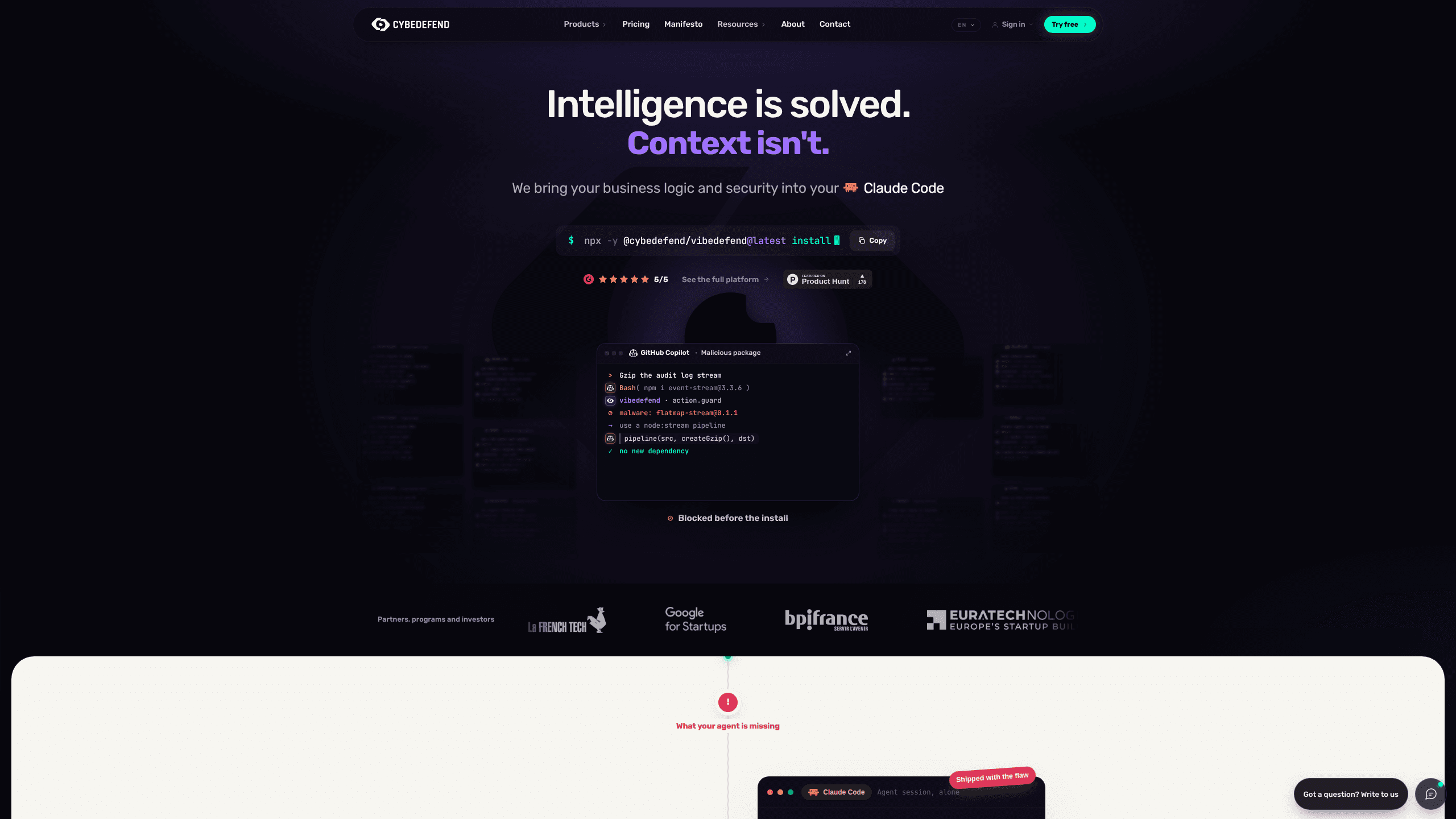
VibeDefend adds your business and security rules to Claude Code, Cursor, Windsurf, Copilot and Codex with one command, blocks risky actions, and scans every diff before the commit.
About VibeDefend by CybeDefend
What Is VibeDefend
VibeDefend is the agent layer of CybeDefend, a security company founded in Lille in 2025. You install it as a command line tool on a developer machine, and from the next session it holds the coding agent to rules your team already agreed on. The agent stays the same. What changes is the context it works with.
The tool is aimed at AI coding agent security, a category that appeared once agents started shipping production code. The failure it targets is specific. Teams write AGENTS.md or a rules file, the agent reads it, and then breaks the rule anyway two lines later. CybeDefend ran a controlled study on 24 August 2026 with one agent working the same thirty tickets in three setups: 2.28 broken rules per ticket with no tool, 2.27 with a hand-kept rules file, 0.28 with VibeDefend. The company also cites Wallarm's API ThreatStats 2026 figure that 43% of API vulnerabilities exploit business logic rather than a known CVE, which is the class of bug a generic scanner tends to miss.
Three limits matter before you install. Guards, the part that refuses a command outright, run in Claude Code, Cursor and Codex only; Windsurf and Copilot get the rules and the diff scan. BLSA, the business-logic analysis, is open to design partners rather than generally available. And the free plan covers a monthly allowance, with usage billing past it.
Getting Started
- Check that Node 18.17 or later is installed, then run
npx -y @cybedefend/vibedefend@latest installin any terminal on macOS, Linux or Windows. - Confirm the agents the installer detected. It writes the MCP wiring, the rule hooks and the doctrine files into each one.
- Choose your region, EU or US, and sign in once through the browser.
- Open Claude Code, Cursor, Windsurf, Copilot or Codex and work as usual. Rules arrive with the edit, and a blocked command shows up in the editor with the reason.
- Review what happened in the Brain, the CybeDefend console that maps every rule served and every action refused to its developer.
Product Information
A quick look at VibeDefend by CybeDefend's pricing, supported platforms, and performance.
Best for
The users, tasks, and scenarios where this tool fits best.
Users
- Developers who let Claude Code or Cursor write most of their code
- Engineering leads standardising five agents across a team
- Security teams that need evidence
Tasks
- Keeping tenant scoping and permission checks in agent-written queries
- Stopping destructive shell commands and secret reads
- Clearing injection and dependency findings before review
Scenarios
- Codebases under GDPR, SOC 2 or the EU AI Act
- Teams where four people use four different agents
- Hiring or onboarding
Key features
One command for five agents
The installer detects which of Claude Code, Cursor, Windsurf, GitHub Copilot and OpenAI Codex live on the machine and wires each one in a single run. It writes the MCP wiring, the rule hooks and the doctrine files itself, so there's no pipeline to build and nothing to configure agent by agent. Setup finishes in seconds, and the developer signs in once.
Rules served at the line
Business rules for coding agents are mined from your repository, and security rules come from your stack, your licence obligations and frameworks such as OWASP, SOC 2 and GDPR. The pair arrives as the agent edits a file, picked for that file rather than dumped as one long instruction block. CybeDefend reports that agents applied 89% of the precise rules with VibeDefend, against 12% with no tool and 13% with a rules file.
Guards that refuse before execution
Schema drops, sudo, force pushes, reads of .env and writes to protected directories are checked against your guardrails before the command runs. These AI agent guardrails sit in the tool loop, so a refusal happens before execution rather than in a report afterwards. The agent gets a refusal that explains the rule and suggests another route, such as a WHERE expires_at < now() clause or a process.env reference. Each block lands in the audit trail, and any rule can switch between warn and block.
Diff scan with the fix attached
The pre-commit security scan runs when the agent stops, checking its changes for reachable injection, vulnerable dependencies, leaked tokens, risky Terraform or Kubernetes settings and compromised CI actions. Findings come back into the agent's own session as one fixable item, with CWE, file and line. The agent patches the diff before the commit, so reviewers read clean code rather than a report.
Business-logic analysis in proof mode
BLSA, built with the CNRS and the CRIStAL laboratory, checks whether a change still honours a business rule. Its proof mode shows the rule, the path through the code and the line where the check sits, so a verdict comes with an argument instead of a score. It runs after the commit and sits behind a design-partner programme today.
The Brain, one map per team
Every rule served, every refused action and every fix is traced to an agent and a developer on a single map. Security teams see which repository attracts blocks, and leads see whether the rules are reaching the people who need them. Nothing in the map requires reading a per-agent log.
Pros and cons
Pros
- Install is a single npx command on macOS, Linux or Windows, with Node 18.17 as the only prerequisite.
- Rules arrive before the edit instead of as advice after the fact, which is the difference the August 2026 study measured.
- The same rules cover five agents, so a team on mixed editors stops arguing about whose config wins.
- Blocked actions and fixes are logged per developer, which gives security a record without asking engineers to file one.
Cons
- Guards only work in Claude Code, Cursor and Codex. Windsurf and Copilot users get rules and scanning, so a dangerous command can still run there.
- The console, BLSA and usage billing assume a CybeDefend account, which means a cloud dependency and a region choice at install.
- It's young. BLSA is a design-partner product, and the vendor's own study is the main public evidence so far.
Frequently asked questions
VibeDefend is a command line tool from CybeDefend that puts business and security rules inside AI coding agents, refuses dangerous commands and scans each change before the commit.
Related content
Explore related tools, skills, and articles for VibeDefend by CybeDefend.
VibeDefend by CybeDefend Alternatives

Base Code
Base44 (Wix) · Coding · ProductivityBase Code is a shared cloud development environment from Base44. Teammates describe changes to an existing GitHub codebase in chat, preview them live and send them back as pull requests.

Google EmbeddingGemma 2
Google DeepMind · Writing · Image · CodingGoogle EmbeddingGemma 2 is a 740M-parameter open model that turns text, code, images, audio, and video frames into vectors in one 768-dimension space, running on phones and laptops.

GitGlow
GitGlow · Coding · ProductivityGitGlow is a local-first desktop Git client that lets independent developers review their own code and their AI agents' changes in one place before shipping.