

Vitra.ai
Vitra.ai · Voice & Language · Video · Marketing
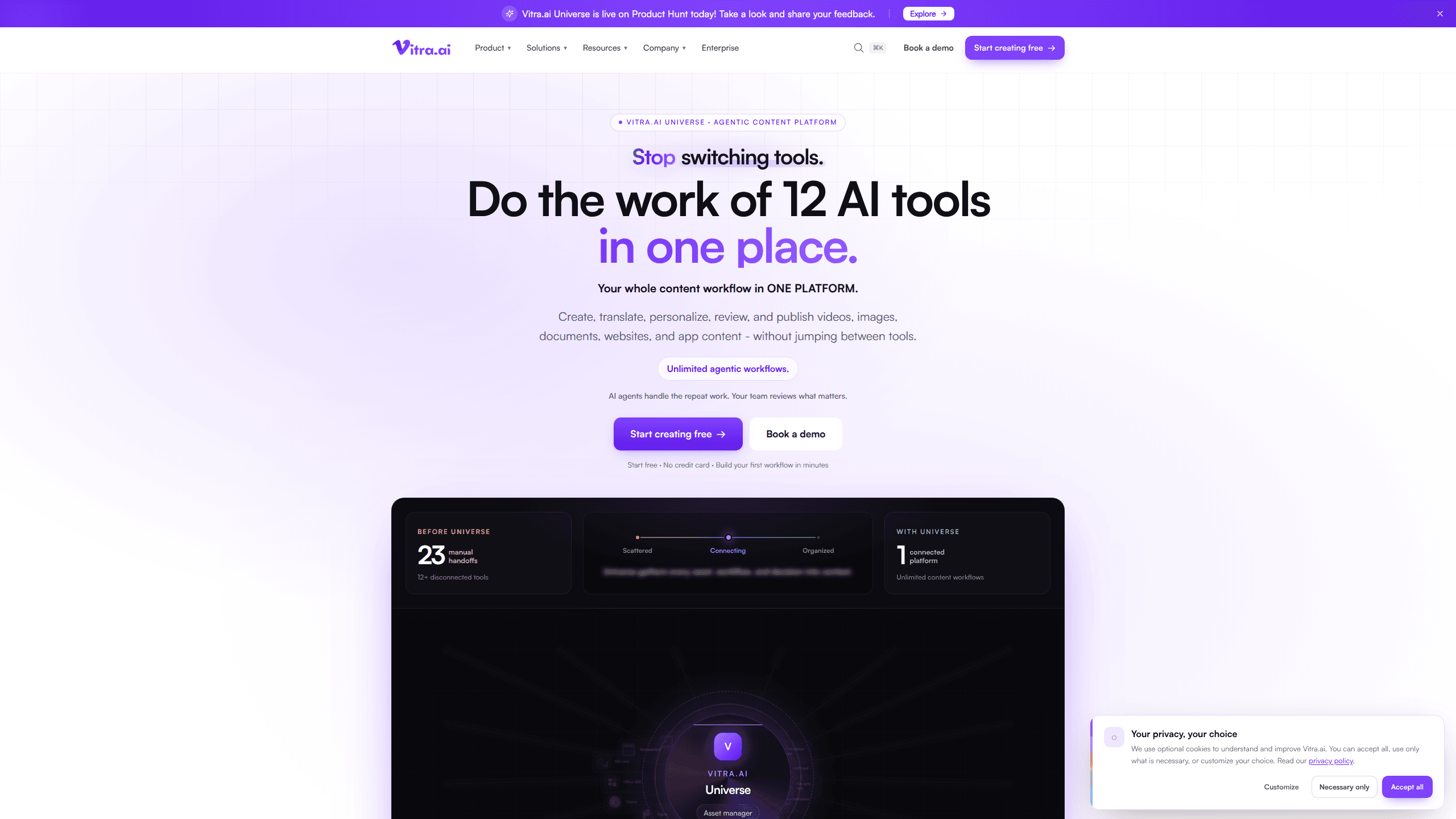
Vitra.ai is an agentic content platform that creates, translates, reviews, and publishes video, images, documents, and app content in 120 languages from one shared brief.
About Vitra.ai
What Is Vitra.ai
Vitra.ai is a web platform for teams that ship the same content into several markets. It combines content creation agents, an AI translation platform, review workflows, and publishing tools in one account. The company started in 2020 as a website and subtitle translation service and now sells the whole stack under the name Vitra Universe.
The problem it addresses is familiar to anyone who runs a global campaign. A brief gets rebuilt in a design tool, a video editor, a translation vendor portal, a spreadsheet, and a CMS. Each handoff loses context, and the approved wording from last quarter rarely survives into this quarter's asset. Vitra keeps the brief, brand facts, terminology, and past approvals in one place, so every agent reads the same source.
Breadth is also the main limit. To get useful output you have to load brand context, translation memory, and a glossary first. A team that wants a quick one-off translation will spend more time setting up the workspace than doing the job. The platform is built for repeatable production, not for a single file on a deadline.
Getting Started
- Create an account at universe.vitra.ai. The first 500 credits are free, and no card is required.
- Load your context. Add product facts, brand rules, preferred terms, and any existing translation memory so agents work from approved material.
- Start a workflow or a single task. Pick creation, translation, dubbing, personalization, or a chain of steps, and attach the source asset and target markets.
- Review what the agents produce. Quality checks return each asset as approved, sent for review, or blocked, with the evidence attached to the finding.
- Publish or export the approved versions, then reuse the workflow as a template for the next campaign.
Product Information
A quick look at Vitra.ai's pricing, supported platforms, and performance.
Best for
The users, tasks, and scenarios where this tool fits best.
Users
- Global marketing teams
- Product and localization managers
- Agencies and language service providers
Tasks
- Translating a website or app into many locales
- Dubbing a product film for several markets
- Adapting one approved asset for distributors
Scenarios
- A quarterly launch that has to land in 18 markets on the same day
- A regulated industry that cannot send files to a public tool
- A support team whose help center drifts out of date
Key features
One Brief Across Every Format
Vitra connects video, image, document, website, and app production to the same brief and brand rules. You supply product facts, audience notes, and approved claims once. Each agent reads that context before it writes a script, lays out a key visual, or drafts a landing page, which cuts the re-briefing that usually happens between teams.
Vitra TMS and Contextual Translation
Vitra TMS is the translation layer inside the platform. It holds adaptive memory, a terminology base, style guides, and glossaries, and it passes that context to every format. A term approved for the website is available when the same sentence appears in a dubbing script or an app screen. Back-translation shows meaning drift as a concrete difference rather than a reviewer's hunch.
Multimodal Quality Control
Quality agents check images, text, audio, video, web pages, and app screens before anything ships. Each asset comes back as approved, sent for review, or blocked, and the finding includes the evidence behind the call. Regional rules and language acceptance are checked at the same time, so a compliant asset for one market is not assumed to be compliant for another.
Workflows With Human Approval Gates
Vitra Flow lets you chain content steps, branches, and approvals in a visual builder. A branch that needs sign-off waits for a named reviewer while the other branches keep running. Linguists, proofreaders, and managers see only the work assigned to them, and every run is recorded node by node against an append-only ledger.
Agentic Access Over MCP and API
Every capability is callable, not just clickable. An MCP agent can discover Vitra skills and use them as tools, and the same operations are exposed through REST, an SDK, a CLI, and connectors for n8n, Make, Zapier, CMS platforms, and webhooks. That means a business event can start a multilingual content workflow without anyone opening the dashboard.
AI Dubbing and Voice
The dubbing step produces native voice, subtitles, timing, and mouth movement for the target language. Vitra lists support for 20 voices in the marketing example on its homepage. For training videos and product films, that removes a separate studio booking, a native speaker should still check tone and pronunciation on customer-facing material.
Enterprise Controls and Deployment
The platform ships with role separation, tenant isolation, bring-your-own keys and storage, and an audit trail. Vitra states that its controls align with SOC 2, GDPR, and VAPT requirements. Where cloud hosting is not acceptable, the same operation runs on your hardware in an air-gapped setup, and the whole platform can be white-labeled with your own branding, credits, and entitlements.
Pros and cons
Pros
- Creation, translation, review, and publishing share one brief, so approved terms carry from a web page into a video script without a second glossary.
- The free tier is real: 500 credits and no card, which is enough to test a workflow on your own content before a sales call.
- MCP, REST, SDK, and CLI access means the same skills people use in the browser can be triggered by an agent or an internal system.
- Review is built into the workflow, and blocked assets come back with the finding attached instead of a vague rejection.
- Deployment options cover teams that cannot use a public cloud, including air-gapped installs and white-label resale.
Cons
- Plan prices are not published. You have to talk to sales to work out what your monthly volume will cost, which slows down budgeting for a small team.
- Getting good output takes setup. Brand facts, terminology, and memory have to be loaded before agents produce anything worth shipping, so the first week is front-loaded.
- Credit use varies by task, and video or dubbing work consumes far more than text. Forecasting spend on a heavy campaign is difficult until you have run one.
- The workflow builder assumes a team with roles and review steps. A solo operator who only needs a page translated will find more machinery than the job requires.
Frequently asked questions
Vitra.ai is an agentic content platform for creating, translating, personalizing, reviewing, and publishing content across video, images, documents, websites, and apps. It bundles creation agents, Vitra TMS translation, quality checks, and approval workflows in one account.
Related content
Explore related tools, skills, and articles for Vitra.ai.
Vitra.ai Alternatives

Foley
Hanamori Labs, LLC · Voice & Language · Productivity · AI AssistantFoley is a voice to-do list that turns a spoken sentence into a filed task, complete with project, date and time, then helps you plan the day around what is already there.

HireKey
HireKey · Voice & Language · Productivity · LeaningHireKey is an AI job search copilot built by a former tech recruiter. It checks role fit, tailors resumes, runs interview practice and tracks every application.

Fluence
Yay Software (Yannick Huchard) · Writing · Voice & Language · ProductivityFluence is an Android app that reads PDFs, EPUBs, Word files and web articles aloud, follows each sentence as it speaks, and answers questions about the text on the phone itself.