

VoltAgent: OpenSource AI Agent Framework
VoltAgent · Coding · Other
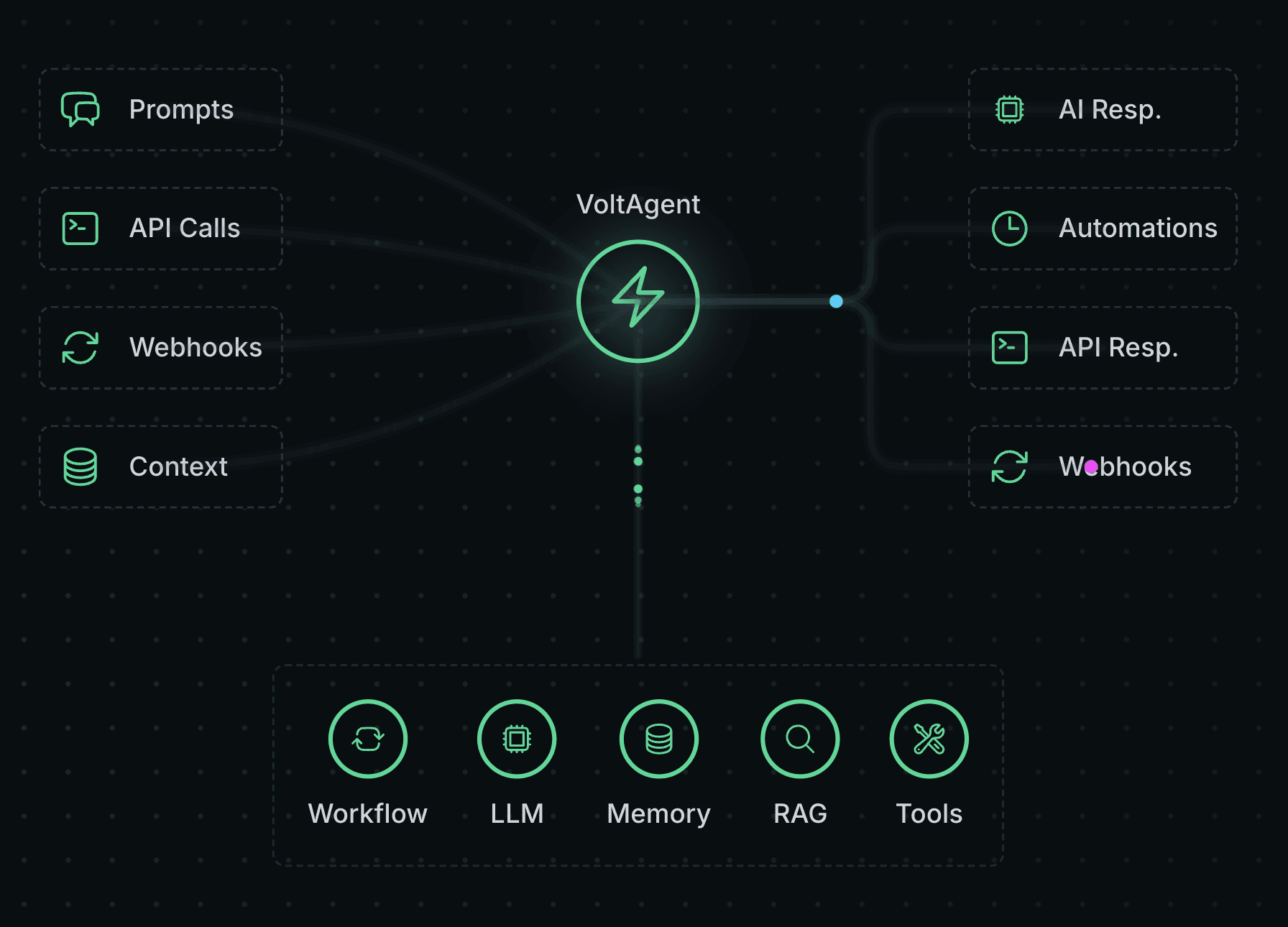
VoltAgent is an open-source TypeScript framework for building AI agents with memory, tools, RAG, and multi-agent workflows, paired with the VoltOps console for observability and deployment.
About VoltAgent: OpenSource AI Agent Framework
What Is VoltAgent
VoltAgent is an AI agent engineering platform built on an open-source TypeScript framework. It handles the parts of agent work that are hard to get right: keeping memory across runs, routing tasks between specialized agents, connecting tools and databases, and watching what happens once agents reach production. The framework itself is free and MIT licensed, so you can read, change, and self-host every part of it.
The project targets developers who already write Node.js or TypeScript. You define agents in code, pick a model provider, and attach the tools, memory, and workflows they need. There's no drag-and-drop builder here. That's the tradeoff: you get full control over agent logic, but you also own the setup.
The biggest limitation follows from the same design. VoltAgent assumes you're comfortable with package managers, API keys, and code deployments. Teams without a developer can't really use it. The companion VoltOps console, which handles tracing, prompts, and deployment, runs as a hosted service or you can self-host it.
Getting Started
- Install Node.js 18 or later and run the create-voltagent-app CLI to scaffold a project.
- Add your model provider API key, such as an OpenAI or Anthropic key, to the environment file.
- Define your first agent in
src/index.tswith instructions, a model, and any tools. - Start the dev server and open the VoltOps console to chat with the agent and inspect each run.
Product Information
A quick look at VoltAgent: OpenSource AI Agent Framework's pricing, supported platforms, and performance.
Best for
The users, tasks, and scenarios where this tool fits best.
Users
- TypeScript and Node.js developers
- Backend engineers building agent features
- Small product teams without a platform engineer
Tasks
- Building multi-agent systems
- Adding persistent memory to a chatbot
- Grounding answers in your own documents
- Automating multi-step approvals
Scenarios
- Shipping an internal agent tool
- Prototyping an agent idea fast
- Running agents where data must stay private
- Connecting agents to existing apps
Key features
Multi-Agent Workflows With Supervisors
VoltAgent lets you define a team of specialized agents under a supervisor that decides which one handles each task. The runtime routes work, keeps sub-agents in sync, and aggregates their results. This structure fits problems where one general agent would get confused, such as research that splits into search, analysis, and writing stages.
Unified Model Provider Support
You swap between OpenAI, Anthropic, Google, and other providers by changing config rather than rewriting agent logic. The framework uses model strings like openai/gpt-4o-mini, so migration is a one-line edit. That keeps you from getting locked into a single vendor as pricing and model quality shift.
Persistent Memory Across Runs
Agents attach memory adapters so they remember important context between sessions. A local SQLite-style adapter works for development, while the managed option stores conversations in a hosted database. Without this, every chat starts blank and users repeat themselves.
Retrieval and RAG
You plug in retriever agents that pull facts from your own data sources before the model answers. The framework also offers a managed knowledge base that handles document ingestion, chunking, embeddings, and search. This is how you ground responses in company documents instead of relying on the model's training data.
Tools and MCP Integration
Tools are defined with Zod schemas for typed inputs, and they support lifecycle hooks and cancellation. The framework connects to Model Context Protocol servers, which is the emerging standard for exposing databases and internal systems to agents. In practice, that means less custom plumbing for each new integration.
Guardrails and Evals
You intercept and validate agent input or output at runtime to enforce content policies and safety rules. Separate eval suites measure agent behavior alongside your workflows, so you can catch regressions when prompts or models change. Both features matter once an agent faces real users.
Resumable Streaming
Clients can reconnect to an in-flight stream after a page refresh and keep receiving the same response. This solves a common annoyance with chat interfaces, where a dropped connection means losing the reply mid-sentence.
VoltOps Observability Console
The companion console gives you full LLM observability, visualizing agent runs as interactive flow charts that show which model ran, which tool fired, and where a step stalled. It also covers prompts, evals, deployment, and automation triggers. The Developer tier is free, and the paid tiers raise trace and usage limits.
Pros and cons
Pros
- The core framework is fully open source under the MIT license, so you can self-host it and audit every line.
- TypeScript-first design keeps agent logic type-safe and readable for JavaScript teams.
- Memory, RAG, guardrails, and multi-agent support ship in the framework rather than as add-ons.
- Swapping model providers takes a config change, which limits vendor lock-in.
- The hosted console gives production visibility for traces, prompts, and evals without building your own dashboard.
Cons
- There's no visual builder, so non-developers can't create agents. You need to write TypeScript.
- The paid VoltOps plans run $50/mo for Core and $250/mo for Pro, which adds up for small teams that outgrow the free tier.
- The feature set is broad, and learning workflows, MCP, and memory together takes time before you're productive.
- The community is younger than longer-established agent frameworks, so examples and third-party guides are thinner.
Frequently asked questions
VoltAgent is used to build AI agents and multi-agent systems in TypeScript. Developers use it for chat assistants, research tools, approval automations, and any workflow that needs memory, tools, and observability.
Related content
Explore related tools, skills, and articles for VoltAgent: OpenSource AI Agent Framework.
VoltAgent: OpenSource AI Agent Framework Alternatives

Base Code
Base44 (Wix) · Coding · ProductivityBase Code is a shared cloud development environment from Base44. Teammates describe changes to an existing GitHub codebase in chat, preview them live and send them back as pull requests.

Google EmbeddingGemma 2
Google DeepMind · Writing · Image · CodingGoogle EmbeddingGemma 2 is a 740M-parameter open model that turns text, code, images, audio, and video frames into vectors in one 768-dimension space, running on phones and laptops.

GitGlow
GitGlow · Coding · ProductivityGitGlow is a local-first desktop Git client that lets independent developers review their own code and their AI agents' changes in one place before shipping.