

Vy by Vercept
Vercept · Other · Chatbot
Vy by Vercept was a vision-first AI agent that controlled a computer by reading pixels on the screen and simulating mouse and keyboard input, so it could drive any app without an API.
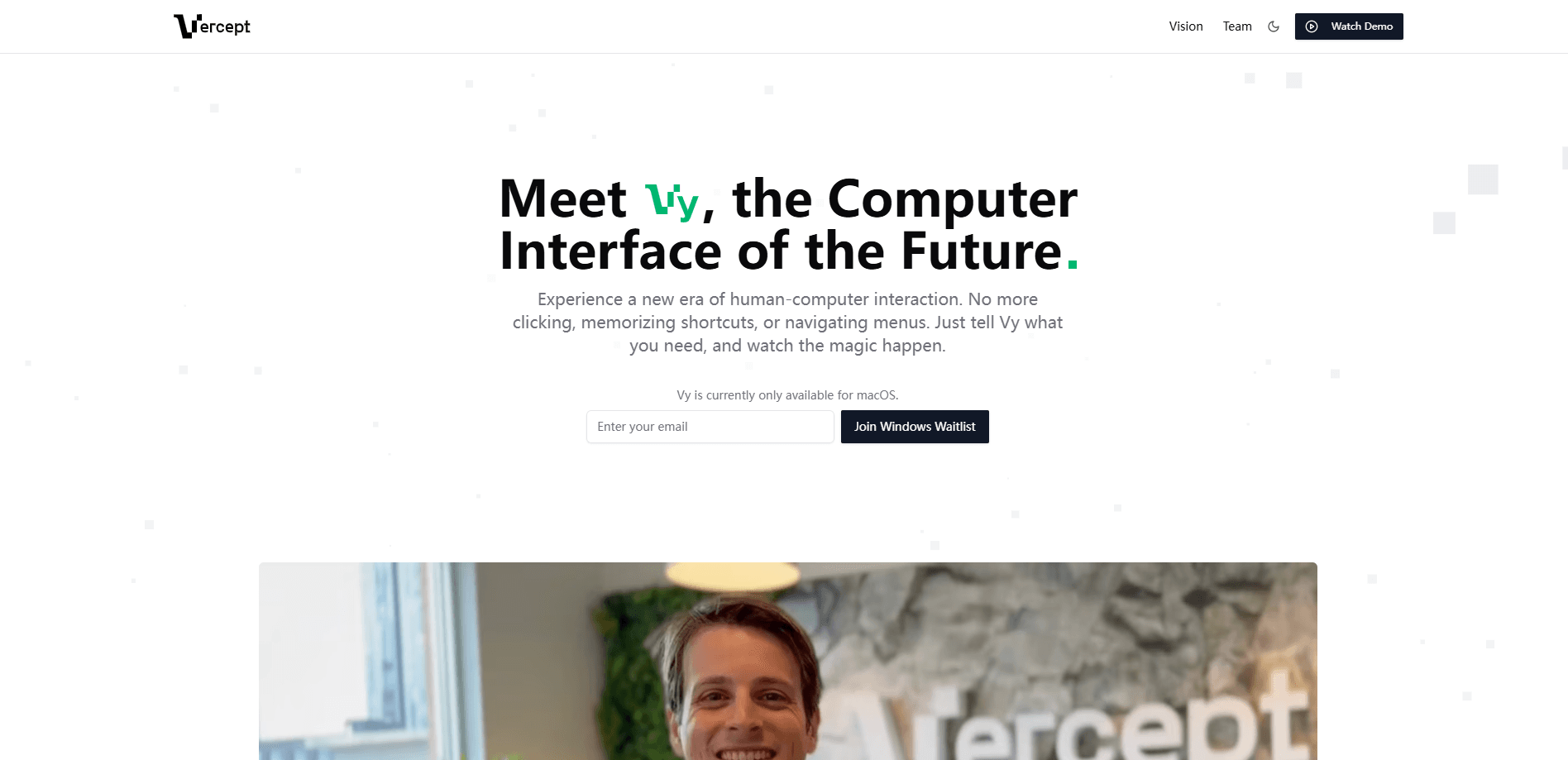
About Vy by Vercept
What Is Vy by Vercept
Vy by Vercept was an AI computer-use agent built by Vercept, a Seattle startup founded in 2024 by alumni of the Allen Institute for AI. Instead of connecting to software through APIs or backend code, Vy looked at the screen the way a person does. It took screenshots, used a vision model to identify buttons, fields and menus, then moved the mouse and typed on the keyboard to get the job done.
That approach is what the company called vision-first. A screen automation tool like this can drive any software with a visible interface, including old desktop programs that never shipped an API. It was the same promise as Anthropic's Computer Use and OpenAI's Operator, but Vercept staked its pitch on accuracy at reading the interface itself. According to the company's own numbers, its model hit 92% on the ScreenSpot v1 UI element benchmark, a common test for spotting on-screen controls.
The story changed in early 2026. Anthropic announced it was acquiring Vercept on February 25, 2026, folding the team into its Computer Use effort. Vy itself shut down on March 25, 2026. So this is a look at what the product was, how it worked, and what its closure means if you were thinking about a computer-use agent today.
Getting Started
- Vercept ran Vy as a cloud agent, so you signed in through the web rather than installing a heavy local app.
- You connected or handed over a computer for the agent to control, with a MacBook as the common setup.
- You described the task in natural language, such as opening a file, filling a form or pulling data out of an app.
- Vy took screenshots, decided where to click and type, and worked through the steps on its own.
- You watched the run and stepped in when a task needed a decision the agent could not make. As of March 2026, new signups were no longer available.
Product Information
A quick look at Vy by Vercept's pricing, supported platforms, and performance.
Best for
The users, tasks, and scenarios where this tool fits best.
Users
- Automation builders
- Researchers and tinkerers
- Small teams with repetitive desktop work
- Technical evaluators
Tasks
- Driving apps without an API
- Automating repetitive computer chores
- Testing interfaces
- Cross-app workflows
- Researching GUI agents
Scenarios
- A daily data-entry routine
- Working with an old internal tool
- A one-off cleanup task
- Evaluating computer-use agents
Key features
Vision-First Screen Understanding
Vy's defining trait was reading the screen rather than the code behind it. The agent took screenshots, ran them through a vision model, and identified buttons, input boxes and menus by how they looked. That let it work with any software that has a visible interface, including programs with no API at all. The approach also meant it adapted as layouts changed, since it judged the screen fresh each time instead of relying on fixed coordinates.
No-API Automation
Because Vy worked from the screen, it did not need an integration for every app it touched. That broadens what you can automate, since many desktop and internal tools never shipped a public API. The trade-off is that screen-based control is slower and fussier than a clean API call. For software that has no other hook, seeing pixels is the only option.
High-Accuracy UI Element Detection
The pitch rested on how well the model spotted on-screen controls. According to Vercept, its model scored 92% on the ScreenSpot v1 benchmark, a test that measures whether an agent can locate a named element on a real interface. That number mattered because computer-use agents live or die on clicking the right thing. A wrong click on a checkout or delete button is more than an inconvenience.
Cloud Agent Controlling a Mac
Vercept ran Vy as a cloud computer-use agent that could operate a remote machine, a MacBook being the common example. You didn't have to keep your own laptop open and attended, because the agent worked on a machine it controlled. That setup is convenient for long or repeated tasks, and it raises obvious questions about who can see what the agent does and what data passes through.
Natural Language Task Control
You drove Vy by describing what you wanted in plain language rather than scripting each step. The agent turned that description into a sequence of clicks and keystrokes and carried it out. That lowers the skill bar for automation, since you don't need to know a scripting language to set it going. It also means vague instructions go wrong, so clear task phrasing matters.
Spatial Reasoning on Dynamic Interfaces
Real screens move. Menus expand, dialogs pop up, and content shifts as the page loads. Vy leaned on spatial reasoning to keep track of where things were and to follow an interface as it changed during a task. That's the hard part of screen-based automation and the reason vision-first agents exist at all. It's also where these agents still stumble, which is why supervision stayed part of the job.
Pros and cons
Pros
- Reads the screen directly, so it can drive software that never shipped an API.
- Reported 92% accuracy on the ScreenSpot v1 UI benchmark, which put its element detection ahead of several rivals at the time.
- Runs as a cloud agent on a controlled machine, so long tasks don't need your own computer tied up.
- Natural language control lowers the bar, since you describe the task instead of scripting each click.
- Its team and technology carried over into Anthropic's Computer Use work, so the screen-reading research lives on.
Cons
- Vy shut down on March 25, 2026, so you can no longer sign up or run new tasks on it.
- Vision-based control is slower and more fragile than a direct API call when one exists.
- Screen-driven agents can misread a busy interface, so supervision stayed necessary for anything risky.
- The cloud setup meant handing over a machine for the agent to operate, which raises privacy questions for some teams.
Frequently asked questions
Vy by Vercept was a vision-first AI computer-use agent. It read the screen through a vision model and then simulated mouse and keyboard input to control software, so it could automate any app with a visible interface, even one with no API.
Related content
Explore related tools, skills, and articles for Vy by Vercept.
Vy by Vercept Alternatives

JarvisCore
Prescott Data · Coding · Productivity · OtherJarvisCore is an open source Python runtime where AI agents work as equal peers on an agent mesh, claim tasks from a shared ledger, and reach external services through a zero-trust broker.
Clef
Cloudflare · Business · OtherClef is Cloudflare's open-source decision model for Workers AI. It returns calibrated probabilities for typed questions, not generated text, so agents can classify, route, and act fast.

iFixAi
iFixAi · Business · OtheriFixAi is an open-source auditor for AI agents. It runs your agent through a simulation of your business, grades every reply, and returns an A to F scorecard backed by evidence.