

Warestack
Warestack · Coding · Productivity
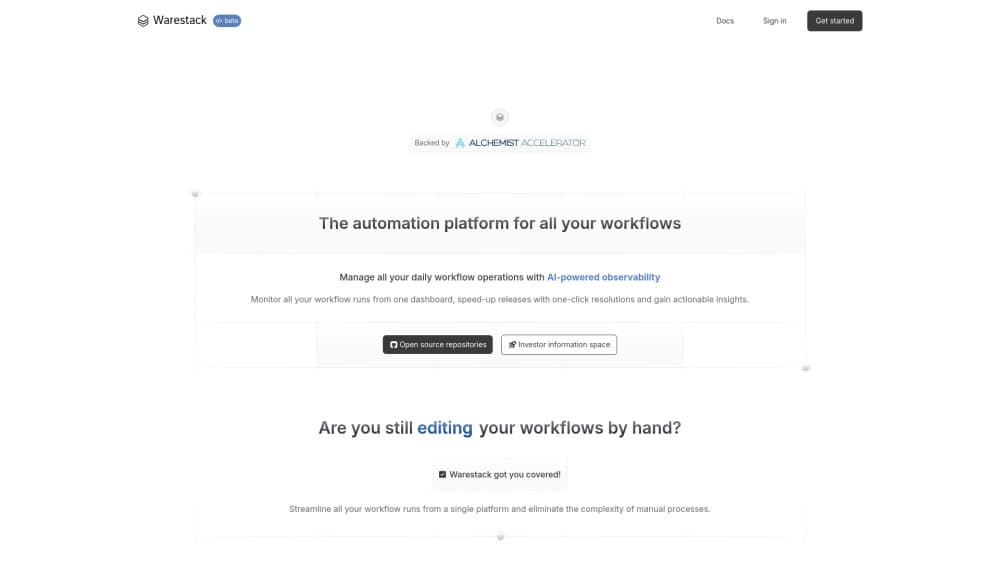
Warestack adds engineering delivery governance to GitHub, checking pull requests and deployments against your team's written standards and reporting misses where people already work.
About Warestack
What Is Warestack
Most engineering teams keep their delivery rules in a wiki and trust reviewers to remember them. Warestack turns them into GitHub pull request rules that run on the pull request itself. A rule looks for a missing approval, an unlinked work item, a migration without rollback notes, or a merge outside the change window, and it posts the result as a GitHub check with a comment naming the finding and the next step.
The scope is narrow on purpose. Warestack doesn't review your code. It checks how a change was delivered: who approved it, what it's tied to, and whether the evidence exists. The checks are deterministic, and the company states there's no language model in the merge path. That matters if you've been asked to let bots sit anywhere near a merge button.
The same rules apply to a pull request opened by a person and one opened by an AI coding agent. Approval rules count humans only, so a bot approving its own work never satisfies them. The main limit is reach: Warestack starts at GitHub, with Slack, Linear and Jira as follow-on connections, so teams on GitLab or Bitbucket can't use it yet.
Getting Started
- Install the Warestack app from the GitHub Marketplace as an organization admin and pick one to three repositories for the pilot.
- Enable a few catalog rules in reporting mode, or paste your standards document in plain English and review the evidence each rule will read.
- Connect Slack, Linear or Jira so findings arrive as a live card with an owner instead of sitting in a checks tab.
- After two or three weeks of reports, require the Warestack check in branch protection on the repositories where the signal has been clean.
Product Information
A quick look at Warestack's pricing, supported platforms, and performance.
Best for
The users, tasks, and scenarios where this tool fits best.
Users
- Engineering managers who own a delivery standard but can't see whether it's followed
- Platform and DevOps engineers running shared repositories
- Security and compliance reviewers preparing for audits
Tasks
- Enforcing approvals by branch prefix
- Catching pull requests without a linked work item
- Routing reviews that stall
- Collecting change-management evidence
Scenarios
- A team adopting coding agents and getting more pull requests than reviewers can read
- A SOC 2 or Vanta review that needs a sampleable trail of who approved what
- A pilot before an organization-wide rollout
Key features
Rules written in plain English, backed by named evidence
You describe the standard, and Warestack shows what it will read to check it: changed paths, the pull request body, reviews or the linked work item. Saved interpretations are versioned, so you can re-interpret a rule against a newer checklist and adopt the new version or keep the old one. When the evidence is missing, the rule returns "not evaluated" rather than a pass it can't support.
Your repository instructions become the rulebook
A rule can point at CLAUDE.md, Cursor rules or a named policy file in the repository. Each evaluation reads that file at the pull request's base revision, so the check follows the policy that was in force for that change. This is the feature that makes agent-heavy repositories manageable: the instructions you already wrote for coding tools turn into something enforced.
Chains that act on a finding
A rule can mark, act or block. In the middle mode, a chain picks up the finding and does something with it: opens a live card in Slack, messages the reviewer, notifies the owner if nobody responds, or writes to a Linear issue. You build the path once and it runs the same way for every flagged pull request.
Scoping down to a folder
Every rule is enabled on a scope you pick: a team, a repository, or a path inside one. A rollback-notes rule can run only on control-plane/db/migrations/ while a finance approval rule runs only on the billing service. New repositories join their team's rules as they're created, which saves the manual work of re-listing them.
Merge blocking as a separate switch
Rules report first. Merge blocking is a per-repository setting that stays off until you require the Warestack check in GitHub branch protection, and that decision is yours, not the vendor's. This ordering is the reason a pilot is realistic: you watch the findings for a few weeks before any of them can stop a deploy.
Reports, deployment records and an audit trail
Ask a question in plain English, inspect the rows behind the answer, export a CSV, or schedule delivery to Slack or email. Deployment reviews and production deployments get their own rules and their own records, including traceability back to a merged pull request. The same console also exposes an MCP server, so Cursor, Claude or Codex can read the live space during a session.
Pros and cons
Pros
- Deterministic checks with no model in the merge path, which is easier to defend to a security reviewer than an AI reviewer that scores risk.
- Reporting mode first, so pull request compliance improves before anyone argues about a blocked merge.
- Humans and agents are held to the same standard, and bot approvals never count as human approval.
- Path-level scoping keeps a rule from spilling across every repository in the organization.
- The Free plan covers up to five repositories with no usage charges, which is enough to test the idea on real work.
Cons
- GitHub is the only supported source control host, so GitLab and Bitbucket teams are out of scope for now.
- Pro is still listed as planned at $49 per space each month, which makes budgeting awkward until the terms are confirmed.
- It won't review code, so you still need a code reviewer or a separate AI review tool for correctness and design.
- Setup assumes someone with organization admin rights and a standards document that's actually written down.
Frequently asked questions
It checks how a change was delivered, not what the code says. Typical rules look for a missing approval, an unlinked work item, an oversized pull request, a stale review request, a migration without rollback notes, or a merge outside the allowed window.
Related content
Explore related tools, skills, and articles for Warestack.
Warestack Alternatives

Base Code
Base44 (Wix) · Coding · ProductivityBase Code is a shared cloud development environment from Base44. Teammates describe changes to an existing GitHub codebase in chat, preview them live and send them back as pull requests.

Google EmbeddingGemma 2
Google DeepMind · Writing · Image · CodingGoogle EmbeddingGemma 2 is a 740M-parameter open model that turns text, code, images, audio, and video frames into vectors in one 768-dimension space, running on phones and laptops.

GitGlow
GitGlow · Coding · ProductivityGitGlow is a local-first desktop Git client that lets independent developers review their own code and their AI agents' changes in one place before shipping.