

WeatherNext By Google
Google DeepMind and Google Research · Other
WeatherNext By Google is a Google DeepMind AI weather forecasting model that reads live satellite data to issue hourly global weather prediction down to 5 km resolution.
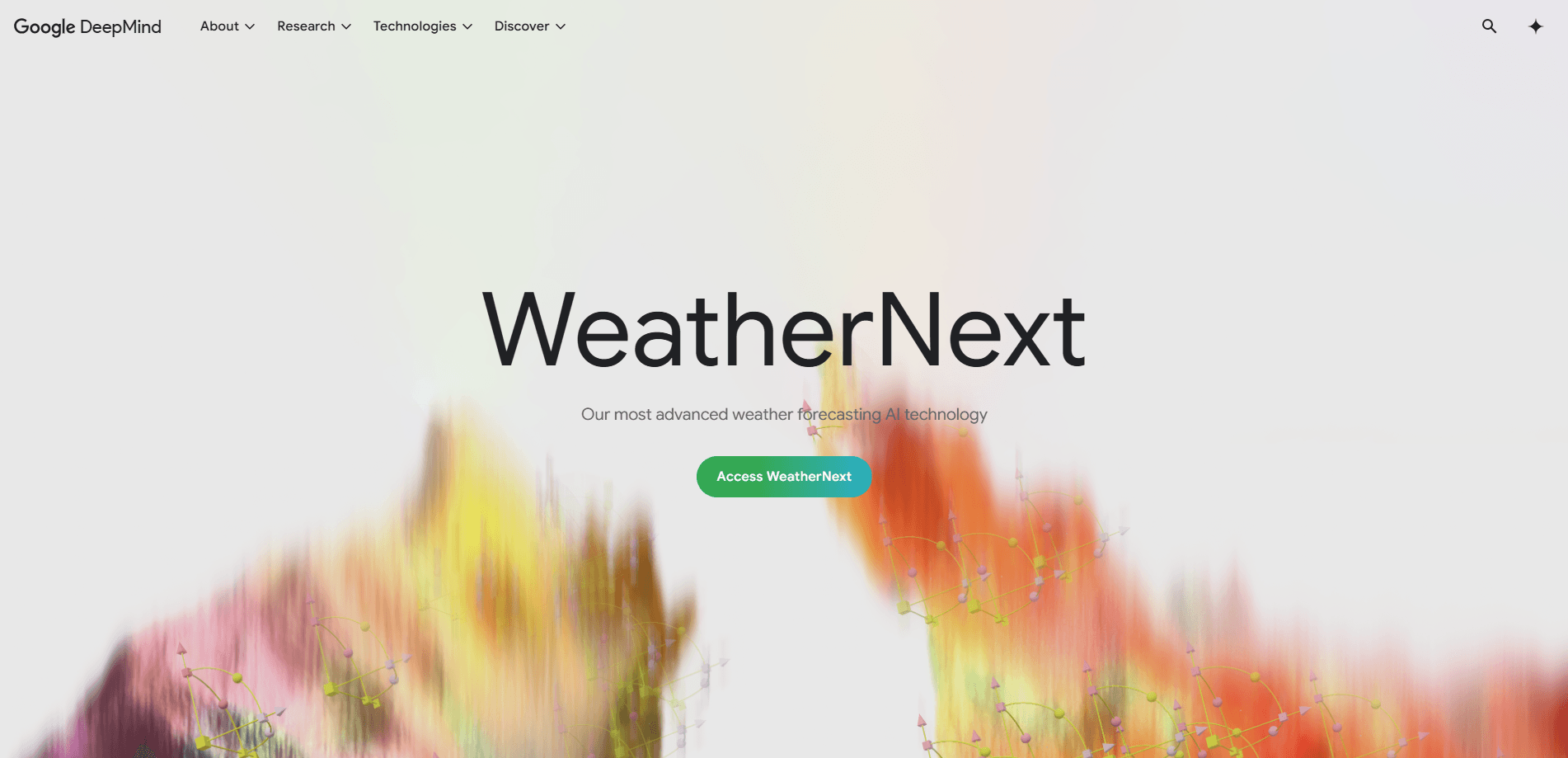
About WeatherNext By Google
What Is WeatherNext By Google
WeatherNext By Google is a family of machine learning weather models built by Google DeepMind and Google Research. The current flagship, WeatherNext 3, replaces the physics simulations that traditional forecasting leans on with a neural network trained on decades of atmospheric records. Independent evaluations from Brightband, whose live leaderboard works as a weather benchmark, rank it among the most accurate global models available today.
The appeal is speed and detail. Traditional numerical weather prediction runs massive physics equations on supercomputers and can lag behind fast-moving weather by hours. WeatherNext 3 skips that lag by reading live geostationary satellite images and refreshing its forecast every hour. That matters when a storm line forms in the afternoon and you need to know whether it hits your area before evening.
The bigger limit is that it's a research system, not an official forecasting service. Outputs come with an explicit warning: they don't count as weather watches or warnings, and Google says never to use it as your only source during severe weather. Real-time data also sits behind an access request, so you can't just start pulling forecasts without applying first.
Getting Started
- Submit the WeatherNext data request form with the Google Account email you use for Google Cloud, BigQuery, or Earth Engine.
- Wait for allowlist approval, which Google says usually takes 5 to 7 business days.
- Pick a surface: BigQuery for SQL analytics, Earth Engine for mapping work, or Cloud Storage for raw ensemble files.
- Run a starter Colab notebook to pull a forecast and plot a first map.
- Query live weather yourself at Weather Lab if you just want to see the model in action.
Product Information
A quick look at WeatherNext By Google's pricing, supported platforms, and performance.
Best for
The users, tasks, and scenarios where this tool fits best.
Users
- Meteorologists and forecasters
- Renewable energy operators
- Data scientists and developers
Tasks
- Tracking fast-developing storms
- Planning a weekend outdoors
- Sizing clean energy capacity
- Building local forecast products
Scenarios
- An energy trader checking the next 48 hours of wind before bidding
- A researcher benchmarking a new weather model against a strong baseline
- A city team watching a coastline where temperature swings over a few kilometers
Key features
Hourly forecasts from live satellite data
WeatherNext 3 reads a live global geostationary satellite mosaic as a direct input. That lets it initialize a new forecast every hour instead of waiting on the six-hourly data lag that slows physics-based models. When rain or a storm front builds quickly, the faster cycle buys forecasters extra lead time.
Multi-resolution output from one run
A single forward pass drops forecasts at several resolutions at once. Weather station fields land at 0.05° (roughly 5 km), gridded surface variables like wind and sea surface temperature sit at 0.1° (about 10 km), and 3D upper-air fields come at 0.25° (near 25 km). You pick the layer you need, not the one the model was stuck with.
Ground-truth station training
Rather than learn only from reanalysis grids, WeatherNext 3 trains dedicated heads on raw weather station readings. The payoff is 5 km temperature and dew point output that lines up better with what a thermometer on the ground actually shows. Coastal, valley, and mountain communities see the clearest gain.
Sharper precipitation forecasting
Hourly weather forecasts help, but precipitation has long been the weak spot of AI weather models. WeatherNext 3 trains against NASA's IMERG satellite data and Google's own satellite-radar reanalysis, and the company reports up to a 60% improvement in one precipitation score against IMERG baselines. Google says day-ahead precipitation accuracy in its consumer products rises by as much as 50% in previously unreliable regions.
Clean energy variables
The model forecasts 100 metre wind speeds near turbine height, full cloud layer distributions, and complete solar irradiance fields. This clean energy weather data lets grid operators and renewables developers estimate how much power a wind or solar asset will produce and match it against demand. That's a narrower use case than general forecasting, but it's a real one for the energy sector.
Access through Google Cloud tools
Forecast data flows into BigQuery, Earth Engine, and Cloud Storage, so you can query it with SQL, plot it in a mapping stack, or pull raw Zarr files for custom models. The same model also powers weather in Google Search, Gemini, Google Maps, and the Google Maps Platform Weather API. No model weights ship with WeatherNext 3, so access means data, not a downloadable network.
Pros and cons
Pros
- Hourly updates and 5 km station resolution give more local detail than the six-hourly, 25 km models it replaces.
- Live satellite input cuts the lag that biases fast-changing variables like rain and surface temperature.
- Data access is free once approved, and reaches BigQuery, Earth Engine, and Cloud Storage together.
- Precipitation accuracy improves meaningfully, which is where most AI weather models fall short.
- Purpose-built clean energy variables cover wind and solar planning that standard models ignore.
Cons
- Real-time data sits behind an allowlist, and approval can take 5 to 7 business days, so it isn't instant.
- Google labels it experimental and says outputs aren't official forecasts or warnings, which limits any safety-critical use.
- WeatherNext 3 model weights aren't public, unlike earlier WeatherNext versions, so you can't self-host the network.
- Reading raw ensemble data takes Python or SQL skills, which rules out casual users who just want a weather app.
Frequently asked questions
It's used to generate global weather forecasts from machine learning instead of physics simulation. The forecasts feed Google Search, Maps, and Gemini, and researchers or businesses can query the raw data for their own models and products.
Related content
Explore related tools, skills, and articles for WeatherNext By Google.
WeatherNext By Google Alternatives
JarvisCore
Prescott Data · Coding · Productivity · OtherJarvisCore is an open source Python runtime where AI agents work as equal peers on an agent mesh, claim tasks from a shared ledger, and reach external services through a zero-trust broker.
Clef
Cloudflare · Business · OtherClef is Cloudflare's open-source decision model for Workers AI. It returns calibrated probabilities for typed questions, not generated text, so agents can classify, route, and act fast.

iFixAi
iFixAi · Business · OtheriFixAi is an open-source auditor for AI agents. It runs your agent through a simulation of your business, grades every reply, and returns an A to F scorecard backed by evidence.