
Weavel
Weavel, Inc. · Other
Weavel is an AI prompt engineering platform for developers building LLM apps, pairing log analytics with Ape, an AI prompt engineer that tunes prompts.
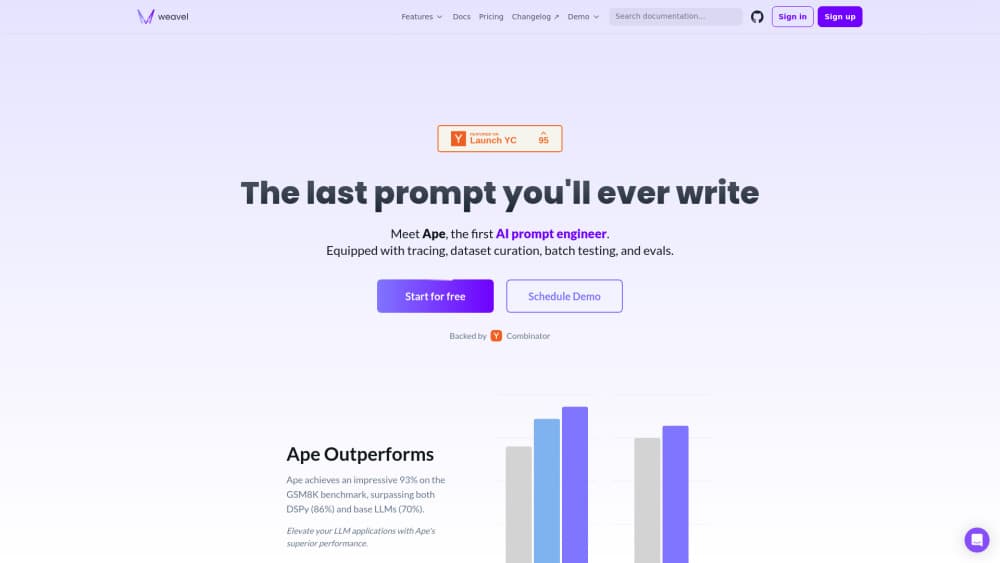
About Weavel
What Is Weavel
Weavel is a developer tool for teams that ship products on top of large language models. The pitch is narrow and honest. Prompt engineering eats hours you'd rather spend elsewhere, so Weavel automates the loop of logging outputs, scoring them, and rewriting the prompt until it performs.
The company behind it, Weavel Inc., went through Y Combinator's Summer 2024 batch. Its headline product is Ape, an AI prompt engineer that improves your prompts on your behalf instead of leaving you to guess which word tweak helped. In practice Weavel behaved as a prompt optimization tool wrapped around an LLM observability layer: you watch the calls, then you fix the words.
The main catch is availability. Weavel has moved on from its original prompt tooling and now describes itself as building a storytelling platform under the Typa name. The old weavel.ai landing page no longer hosts the analytics product, and the Python SDK and evaluation features described at launch are hard to reach today. Treat this page as a record of what Weavel offered, not a live signup flow.
Getting Started
- Install the Weavel Python SDK and swap in a single line of code to log your LLM calls as they run.
- Let Ape group those logs into datasets, or import existing data if you already track outputs elsewhere.
- Create a prompt tied to a dataset, then let Ape generate evaluation code or plug in your own metrics.
- Review Ape's suggested prompt rewrites and compare cost, latency, and accuracy before promoting one.
- Keep logging production traffic so Ape keeps refining the prompt as new inputs arrive.
Product Information
A quick look at Weavel's pricing, supported platforms, and performance.
Best for
The users, tasks, and scenarios where this tool fits best.
Users
- LLM app developers
- AI engineers evaluating prompt quality
- Startup teams with limited headcount
Tasks
- Logging and reviewing LLM calls
- Building evaluation datasets
- Automatic prompt refinement
- Comparing prompt versions
Scenarios
- Cutting token spend on a high-volume assistant
- Tightening accuracy on a reasoning task
- Handing prompt upkeep to a teammate with less LLM experience
Key features
Ape, an AI Prompt Engineer
Ape is the centerpiece. It reads your logged inputs and outputs, builds datasets, and iteratively rewrites prompts to chase better results. What does that buy you? Fewer wasted tokens. Less guessing, too. According to Weavel, Ape hit 94.5% on the GSM8K benchmark, ahead of plain prompting at 54.5%, chain-of-thought at 87.5%, and DSPy at 90.0%. Vendor numbers, so read them that way, but the direction is clear.
One-Line SDK Logging
The Python SDK logs LLM calls without reshaping your code. Weavel says it supports sync and async OpenAI chat completions plus structured outputs, and switching it on takes around one line. That low-friction setup matters a lot, because tools that demand heavy instrumentation rarely survive a busy sprint.
Auto-Generated Evaluations
Scoring LLM output is the part most teams skip. Ape writes evaluation code for you, and it can use LLMs as judges for open-ended tasks. You can also wire in your own metrics when you already have a standard. Either way, you get a number to improve against instead of a vibe.
Production Data Feedback Loop
Ape keeps refining as more real traffic flows in. Prompts drift as users find edges you didn't test. A loop that updates on live data stays closer to reality than a one-time tuning pass. This is the difference between a demo prompt and a shipped one.
Dataset Building From Logs
Raw logs are noisy. Ape filters them into datasets you can actually reuse, so your test set reflects real usage rather than the tidy examples you typed by hand. You can also import existing data. Or build a dataset manually if you'd rather control the shape.
Pros and cons
Pros
- Automatic prompt tuning saves the trial-and-error hours that prompt engineering usually burns, and it does so without asking you to sit and rewrite each instruction by hand.
- One-line SDK logging keeps setup light for Python and OpenAI-based stacks.
- Built-in evaluation, including LLM-as-judge, gives you a clear quality signal.
- Continuous refinement from production data keeps prompts current as usage shifts.
Cons
- The original prompt tooling is hard to access now that Weavel has pivoted to Typa, so new users can't easily try it.
- SDK coverage leans on OpenAI chat completions and structured outputs, which limits worth for teams on other model providers.
- Launch pricing and live plan details are no longer published, so budgeting is guesswork.
Frequently asked questions
Weavel logged LLM app calls, built datasets, and used an AI prompt engineer called Ape to tune prompts for lower cost, lower latency, and higher accuracy. It targeted developers building on top of language models.
Related content
Explore related tools, skills, and articles for Weavel.
Weavel Alternatives
BinkBink
BinkBink · OtherBinkBink is a free online game platform and AI game maker that lets anyone turn a short text description into a playable browser game. You can jump into hundreds of community-made games. Or describe your own idea and play it in seconds, then share it with friends. Want to create your own game? You don't need to code. No engine setup, no download, no hassle.

Audiogen
Audiogen Inc. · OtherAudiogen is an AI music generator built by Audiogen Inc., a small research team that spent about 2.5 years training its own generative music model and designing a web interface around it. Instead of a plain text box, this AI music tool turns the timeline into a beginner-friendly Generative Audio Workstation, or GAW, where inpainting, extending, remixing and stem editing work more like painting on a canvas. The product is still in beta, so access runs through a waitlist or an invite. Paid plans aren't published yet.

Aiml API
AIMLAPI OÜ · OtherAiml API is a unified AI model API that puts more than 1000 models from OpenAI, Google, Anthropic, and others behind one endpoint and one bill. You write code against a single OpenAI-compatible schema, then switch between chat, image, video, and audio models by changing a model string. It suits developers and small teams who want multi-model access without juggling a dozen separate provider accounts, and it removes the usual billing headache that comes with testing several vendors. One key covers it all.