

Webb Fontaine
Webb Fontaine Group · Other
Webb Fontaine is an AI trade facilitation platform for governments. Its customs management system bundles single window, risk, valuation, and cargo tracking modules.
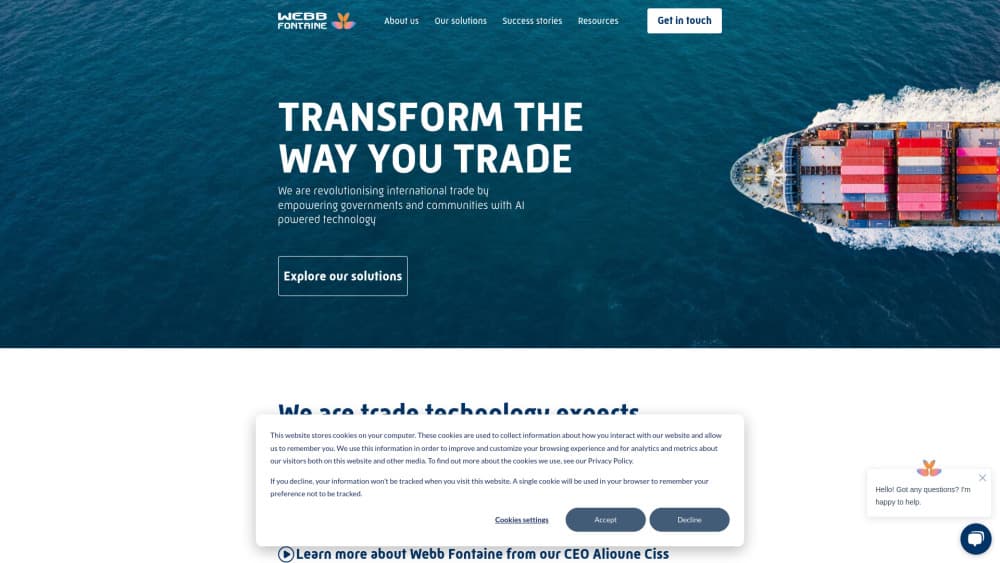
About Webb Fontaine
What Is Webb Fontaine
Webb Fontaine sells AI trade facilitation software to customs administrations and the agencies around them. The catalog covers the full clearance chain: declaration processing, duty and tax assessment, risk scoring, port operations, transit monitoring, and a single window where traders file documents once instead of at six counters.
The company started in 2002 and runs from Dubai, with offices across Europe, the Middle East, Asia, and Africa. That geography explains the customer list. Most deployments sit in emerging markets where a government is replacing a paper process or an aging system in one move, and where the vendor is expected to train staff as well as ship code. Benin, Egypt, Ethiopia, Côte d'Ivoire, Nepal, Panama, the Philippines, Bangladesh, Bahrain, Guinea, and the UAE appear on the company's own country list.
Two limits shape any evaluation. There's no published price list, so budgeting starts with a procurement conversation rather than a checkout page. And there's no self-serve trial. A customs management system touches revenue collection, so every project runs through a tender, a scoping phase, and a pilot before anything goes live. Small importers and freight forwarders are not the buyers here. The buyer is the authority that collects the duty.
Getting Started
- Contact the company through the site form or a regional office, and describe the agency, the current system, and the deadline you're working against.
- Run a scoping phase that maps declaration types, tariff and valuation rules, and the systems the new platform has to talk to, from the trade ministry to the port authority.
- Configure the chosen modules against a pilot site, using real declarations so staff can compare output with the old process.
- Train customs officers and brokers, then roll out in stages, with support and rule updates handled by the vendor after go live.
Product Information
A quick look at Webb Fontaine's pricing, supported platforms, and performance.
Best for
The users, tasks, and scenarios where this tool fits best.
Users
- Customs administrations replacing a legacy clearance system
- Trade ministries building a national single window
- Port authorities that need cargo visibility
Tasks
- Scoring incoming declarations before release
- Checking declared value against reference prices
- Collecting advance cargo information before arrival
- Tracking transit cargo across borders
Scenarios
- A government wants to cut dwell time at a congested port
- Revenue leakage is the political problem, not speed
- A new tariff schedule takes effect next quarter
Key features
Webb Customs With 20 Modules
Webb Customs is the core system, and it ships as a set of 20 modules rather than one monolith. Declaration processing, manifest handling, exemption management, and payment sit in that set, so an administration can buy the clearance core first and add modules later. The practical benefit is a staged rollout that matches budget cycles.
Webb Single Window
The single window gives traders one submission point for import, export, and transit paperwork. Behind the form, the platform routes each document to customs, health, standards, and any other agency with a say. Fewer counters means fewer trips, and it gives the authority a clean audit record of who submitted what.
Webb Risk Intelligence
This is the module that decides which containers get opened. It scores declarations using declared data, trader history, route patterns, and external watchlists, then routes high scores to inspection. The vendor's pitch is revenue protection and fraud detection. Ask for the false positive rate during scoping, because an over-eager model slows legitimate trade and a lax one lets goods through.
Webb Valuation
Webb Valuation checks the declared price of goods against reference values and historical transactions for the same product. When the price looks low, the officer gets a suggested assessment with the reasoning attached. For customs, that's a defensible number. For the trader, it means a valuation dispute has a documented starting point.
Webb Ports and Webb Tracker
Webb Ports is a port community system, which is the shared layer terminals, shipping lines, and customs use to exchange cargo status. Webb Tracker adds real time position and seal data for goods in transit, so a bonded truck that leaves the corridor shows up before it disappears. Together they close the visibility gap between the quay and the border post.
Webb ACI for Advance Cargo Information
Advance cargo information rules require carriers and importers to file shipment details before the vessel loads. Webb ACI handles that filing and screens the data against risk rules while the cargo is still at sea. The authority gets a decision window measured in days instead of hours.
Webb Fontaine Zero
Zero is the newest piece, launched at the WCO Technology Conference in February 2026. It's an LLM-based layer that lets an administration configure and deploy trade applications by describing the process in chat rather than writing specifications. The pitch is faster adaptation when tariff rates or regulations change. It's early, so treat vendor demos as a concept until a reference site publishes results.
Pros and cons
Pros
- One vendor covers the clearance chain, from declaration processing to port operations, which cuts integration work and contract overhead.
- The module structure lets an administration start with the customs core and add single window or tracking later.
- Webb Fontaine Zero targets the slowest part of any customs project: rewriting rules when the tariff schedule changes.
- Local presence in Africa, the Middle East, and Asia means implementation teams who have run similar rollouts nearby.
- The company has a long reference list of national deployments, which matters when a tender asks for comparable projects.
Cons
- No public pricing and no self-serve trial, so a small agency can't estimate cost without a formal procurement process.
- Implementation depends on the vendor's project team, which means timelines stretch when a government changes requirements mid-rollout.
- Zero is a 2026 concept with limited public performance data, so claims about faster configuration are hard to check.
- The suite is built for national administrations. Freight forwarders and small importers get a portal, not a product they can buy.
Frequently asked questions
It builds and runs customs and trade software for governments. That covers declaration processing, risk scoring, a national single window, port community systems, cargo tracking, and valuation checks.
Related content
Explore related tools, skills, and articles for Webb Fontaine.
Webb Fontaine Alternatives

Odyssey 3
Odyssey · OtherOdyssey-3 is Odyssey's foundation world model. It simulates physics in real time, turns a prompt into an interactive environment, and adapts to robots, cars and games.

JarvisCore
Prescott Data · Coding · Productivity · OtherJarvisCore is an open source Python runtime where AI agents work as equal peers on an agent mesh, claim tasks from a shared ledger, and reach external services through a zero-trust broker.
Clef
Cloudflare · Business · OtherClef is Cloudflare's open-source decision model for Workers AI. It returns calibrated probabilities for typed questions, not generated text, so agents can classify, route, and act fast.