

Webnovels AI
Webnovels AI · Writing
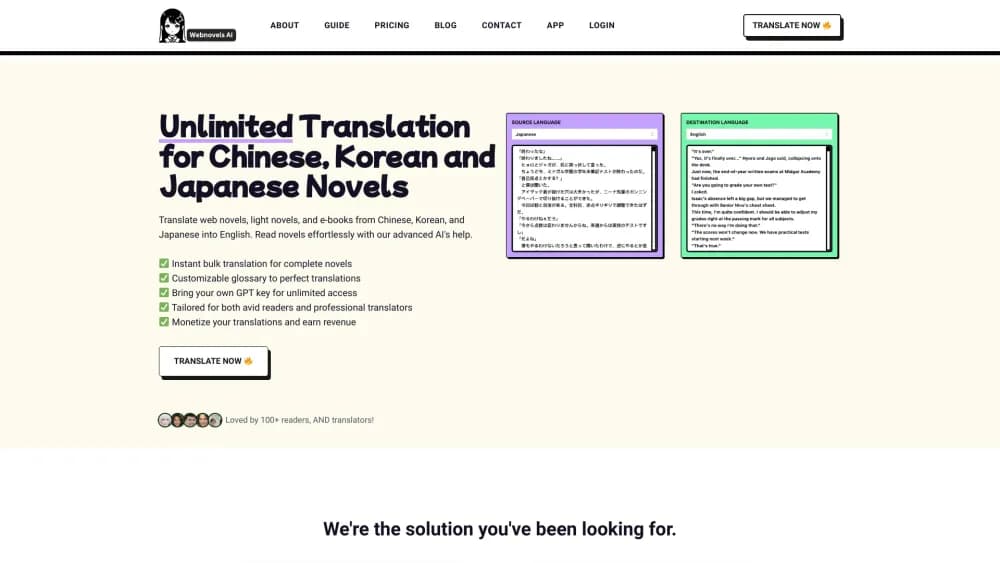
Webnovels AI is an AI novel translation service for Asian fiction. It turns Chinese, Korean, Japanese and Thai web novels into English with a glossary per book.
About Webnovels AI
What Is Webnovels AI
Webnovels AI is a translation service built around one narrow job: taking a raw Asian novel file and returning a readable English version. The team behind it comes from fan translation, and they built the tool after publishing translated Chinese novels themselves. As an AI novel translator, it behaves differently from chatbot-style tools. That background shows in the design. The product expects a whole book, not a single paragraph pasted into a box.
The pitch rests on glossaries. Each novel gets its own term list, so a character name, a cultivation stage, or an honorific stays the same from chapter one to chapter nine hundred. Anyone who has read machine translated web fiction knows how badly this goes wrong otherwise. Names shift, genders flip, and a sect master becomes a master of a completely different sect by volume three.
The catch is that automatic output still needs a person. The company says so on its own FAQ: the translation is readable as delivered, but a real editor should still go through it before publication. The other limit is content. The engine runs on OpenAI models, which don't handle NSFW text, so the service routes those passages to Google Translate or Bing Translate. Translation quality drops on those sections, and there's no way around it.
The pricing page now points to Novel Translator, a sibling product from the same team, and states that the bring-your-own-key method is discontinued. So what you buy today is a subscription, not a wrapper around your own OpenAI key.
Getting Started
- Open webnovelsai.com and follow the pricing link to Novel Translator, the current entry point for translation credit.
- Create an account, then pick a model. The default auto option costs two credits per file as a base fee and suits ordinary jobs.
- Upload your file. EPUB and TXT are accepted, with a 30MB cap per upload.
- Check the cost estimate before you commit. Pricing runs on a base fee per file plus a charge for the amount of text inside it.
- Translate, then read the result in the browser or download it as EPUB, PDF, or TXT. Expect a human editing pass before you publish anything.
Product Information
A quick look at Webnovels AI's pricing, supported platforms, and performance.
Best for
The users, tasks, and scenarios where this tool fits best.
Users
- Fan translators
- Readers who import their own books
- Small publishing teams
Tasks
- Translating a full Chinese novel
- Preparing an English sample chapter for promotion
- Testing a book before you buy the rights
- Turning a light novel into something readable on a phone
Scenarios
- Finishing a series that stopped getting fan translations
- Working through a backlog of purchased epubs
- Handing a translation to a reviewer who doesn't read Japanese
Key features
Per-Novel Glossaries
The auto glossary is the core of the product. The system extracts names, places, and specialized terms from a book, builds a list, and then forces the translation to follow it. You can export the list, edit it in a spreadsheet, and import it back. This fixes the worst failure of plain MTL, the machine translation route most readers still use. If your protagonist is named Wei Ying and the translator keeps calling him Wei Ying in one chapter and Wei Yin in the next, the glossary stops it.
Glossary Generation From Source Text
Nobody enjoys building a term list by hand, so the platform generates one for you before you translate. The team warns that extraction is thorough to a fault, meaning your job is trimming rather than adding. The tradeoff is time: the tool parses the entire novel to find candidates, so generation takes a while on long books.
Whole-Book Translation
You upload a book and get a book back. The product is built for full-length novels rather than short excerpts, and the team reports that a 200,000 to 300,000 character novel typically finishes within about an hour. That's the practical reason people use it. Chapter by chapter was never the bottleneck for readers, waiting months for an official release was.
File Output in Three Formats
Finished translations download as EPUB, PDF, or TXT. EPUB translation is the format most readers pick, and stay available in the account for online reading. EPUB keeps chapter breaks, so the file opens in a normal reader app with a working table of contents. TXT suits anyone feeding the text into another tool. PDF is the least useful for long novels, but it exists.
Source and Target Language Coverage
The engine handles Chinese, Japanese, Korean, and Thai, mostly into English. Each source gets its own page: Chinese novel translation, Korean novel translation, and Japanese novel translation are treated as separate services. Separate pages cover simplified Chinese, traditional Chinese, Japanese, Korean, Vietnamese, Thai, and Indonesian, each treated as its own service with its own sample. The bias is clear: this is an English-first tool for readers of Asian fiction.
Image and Web Page Translation
Beyond files, the platform translates text inside images, which covers manga and manhwa pages where dialogue is baked into the artwork. A web page translator lets you paste a URL and translate the content directly. Neither feature replaces the book workflow, but they're handy when a story only exists as a serialized web page.
Cleanup and Chapter Splitting
Raw epubs from fan sites often carry junk: stray tags, broken paragraphs, duplicated headers. The platform cleans the text automatically and splits chapters into consistent units before translation. The result reads like a book, not like a scrape.
Pros and cons
Pros
- Glossaries solve the name drift that ruins most MTL web novels, and the list is editable by hand.
- Whole-book upload suits readers who come with a file rather than a request.
- EPUB output keeps chapter structure, so the result opens cleanly in ordinary reading apps.
- Thai, Vietnamese, and Indonesian sit alongside the big three Asian languages, which few competitors cover.
- Pricing per file scales well for a one-off novel compared with per-character services.
Cons
- Translated text still needs an editor. Mechanical phrasing shows up in dialogue-heavy scenes, and published work demands a pass by a human.
- NSFW passages get routed to Google Translate or Bing Translate, so quality falls exactly where many web novels spend the most words.
- The bring-your-own-key option the site still describes in its guide is gone. Readers now pay a subscription or buy credits, which is pricier for heavy users than their own OpenAI bill.
- Communication and support lean on Discord, and answers about roadmap items aren't published anywhere formal.
Frequently asked questions
It's an AI translation service for Asian novels. You upload a Chinese, Korean, Japanese, or Thai book file and get an English version back with a glossary that keeps names and terms consistent.
Related content
Explore related tools, skills, and articles for Webnovels AI.
Webnovels AI Alternatives

Emailwritr
Emailwritr · Writing · MarketingEmailwritr is an AI email copywriting tool built for affiliates, course creators, and online businesses that want more revenue from the list they already own. Instead of blank pages or generic chatbot prompts, this AI email writer generates welcome sequences, launch campaigns, cart recovery emails, and promo series from frameworks modeled on well-known direct-response copywriters. You connect your autoresponder, answer a few questions about your offer, and it writes the copy for you.

Swms
Swms AI · Writing · Productivity · BusinessSwms is an AI safety compliance tool that turns a plain description of a job into ready-to-use safety documents. Describe your project, trade, and known hazards, and it writes a safe work method statement, job hazard analysis, safe work procedure, RAMS, or safety data sheet in seconds. It also ships with Oscar, a chat assistant that answers workplace safety questions in any language. Teams in construction, mining, transport, and warehousing use it to cut the paperwork that usually eats into a workday.

Prosp
Prosp · Writing · Voice & Language · MarketingProsp is an AI LinkedIn outreach tool built for agencies and sales teams, and it writes the message and the voice note in your own voice for each prospect so they actually reply. You connect your accounts, find leads, and let the AI draft and send personalized messages at scale, all from one inbox. It's built for people running outbound at volume. That's the whole pitch. Every touchpoint still has to feel human.