

Windward
Windward Ltd. · Coding · Marketing
Windward is a maritime AI platform that turns AIS, satellite and ownership data into vessel risk scores, sanctions screening and container tracking for compliance, logistics and defense teams.
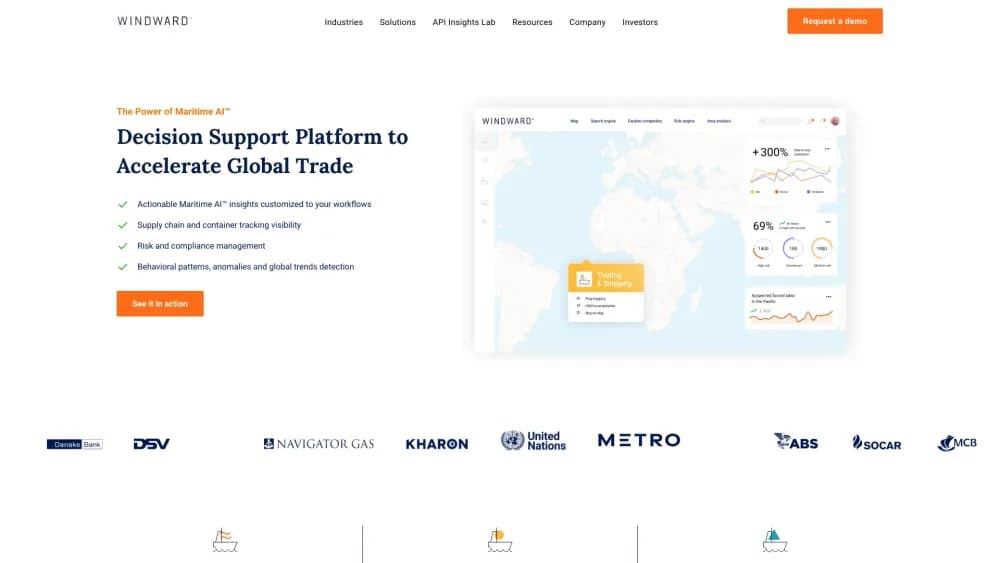
About Windward
What Is Windward
Windward is a maritime intelligence platform built on what the company calls Maritime AI. It takes raw ship signals, mainly AIS broadcasts plus satellite imagery and radio frequency data, and turns them into risk scores, behavioral timelines and ownership profiles that a compliance analyst or a naval officer can act on.
The problem it solves is noise. Around 100 million maritime data points arrive every day, and a fair share of them are spoofed, jammed or missing. Windward's models clean that stream down to roughly 10 million validated vessel movements, then flag the patterns that matter, such as dark activity, ship-to-ship transfers, flag changes and ships loitering above a pipeline.
The catch is access. Windward sells to organizations rather than individuals. There's no self-serve signup, no published price list and no free tier. You book a demo, scope a contract and get onboarding help from the company's solutions engineers.
Getting Started
- Request a demo on the Windward site and describe the workflow you want to cover, whether that's pre-fixture screening, container visibility or border monitoring.
- Agree on scope with the sales team. Seat count, data modules and API access all change the contract, and pricing comes back as a quote.
- Connect the platform to your stack. Teams can work in the web interface, pull data through the GraphQL API, or push alerts into Microsoft Teams and Slack.
- Set your risk logic and alerts. Organization Defined Risk lets you decide what counts as low, moderate or high risk, so the platform scores vessels against your policy instead of a generic checklist.
Product Information
A quick look at Windward's pricing, supported platforms, and performance.
Best for
The users, tasks, and scenarios where this tool fits best.
Users
- Compliance and sanctions analysts at banks, traders and shipowners
- Freight forwarders and logistics teams
- Government, customs and defense analysts
Tasks
- Pre-fixture vessel screening
- Post-fixture fleet monitoring
- Container arrival forecasting
Scenarios
- Checking a tanker before chartering it
- Customs and border review
- Managing a rerouted shipment
Key features
Organization Defined Risk
Most risk tools hand you a fixed score. Windward lets compliance teams define their own thresholds, so a vessel that's acceptable for one charterer can still be blocked by a stricter bank policy. The same risk logic carries into the API, which keeps screening decisions consistent across teams.
Behavioral Detection of Deceptive Shipping
Windward's models look at how a vessel behaves over time rather than at a single moment. AIS gaps, identity spoofing, unusual flag changes and ship-to-ship transfers get weighed together, and the platform points to the indicators behind each score. The company reports about 75% fewer false positives than rule-based systems, a number it publishes rather than one verified by outside auditors.
All-Source Data Fusion
The platform blends more than 30 sources: terrestrial, satellite and vessel-based AIS, electro-optical and radar imagery, radio frequency signals, sanctions lists and ownership registries. When one feed degrades or gets manipulated, the others fill the gap. That redundancy is the core selling point for navies and coast guards working in contested waters. It's the difference between watching one feed and real maritime domain awareness.
Container Tracking
This module follows containerized cargo across carriers, ports and trade lanes. It validates departure and arrival events, harmonizes every container on the same vessel to one timeline, and raises exceptions for rollovers, transshipment delays and long port stays. Shippers can share a status link with customers, which cuts down on "where is my box" emails.
MAI Expert Gen AI Agent
MAI Expert writes plain-language summaries of detections, answers follow-up questions and drafts case notes for review. It ships with templates in English, Spanish, French, German and Italian, and organizations can add private data and their own prompts. Windward says customer data isn't used to train the models, and every AI answer links back to the evidence that produced it.
GraphQL API and Webhooks
The API exposes risk scores, ownership hierarchies, sanctions exposure and behavioral timelines at vessel, company, fleet or geographic level. Because it's GraphQL, you request only the fields you need instead of pulling whole records. Webhooks push risk changes and vessel-of-interest events into internal systems without polling.
Ownership Intelligence
Windward keeps a pre-matched ownership database covering seven levels, from the registered owner up to the ultimate beneficial owner. Each profile is reviewed by maritime analysts and refreshed when control structures change. For sanctions work, that saves the manual matching that eats analyst hours.
Pros and cons
Pros
- Behavioral analytics catch deceptive shipping practices that list-based screening misses, and every score links back to the underlying evidence.
- One platform covers commercial and government work, so a group with shipping and security operations doesn't need two vendors.
- The GraphQL API and webhooks fit into existing compliance and logistics systems, with implementation support included.
- Ownership data goes seven levels deep, up to the ultimate beneficial owner, which shortens manual due diligence.
Cons
- No public pricing and no free trial. You can't test the platform without a sales conversation, which rules out quick side-by-side comparisons.
- It's built for enterprise budgets. Small forwarders and single-vessel operators will find the contract size hard to justify.
- The breadth of modules means a long setup. Teams that only need container ETAs still sit through configuration for risk logic and data connections.
Frequently asked questions
Windward turns maritime data into risk and operational intelligence. It screens vessels for sanctions exposure, tracks behavior such as dark activity and ship-to-ship transfers, monitors fleets, and forecasts container arrivals. Customers include banks, commodity traders, insurers, freight forwarders, customs agencies and navies.
Related content
Explore related tools, skills, and articles for Windward.
Windward Alternatives

Base Code
Base44 (Wix) · Coding · ProductivityBase Code is a shared cloud development environment from Base44. Teammates describe changes to an existing GitHub codebase in chat, preview them live and send them back as pull requests.

Google EmbeddingGemma 2
Google DeepMind · Writing · Image · CodingGoogle EmbeddingGemma 2 is a 740M-parameter open model that turns text, code, images, audio, and video frames into vectors in one 768-dimension space, running on phones and laptops.

GitGlow
GitGlow · Coding · ProductivityGitGlow is a local-first desktop Git client that lets independent developers review their own code and their AI agents' changes in one place before shipping.