

WinningHunter
WinningHunter · Marketing · Business
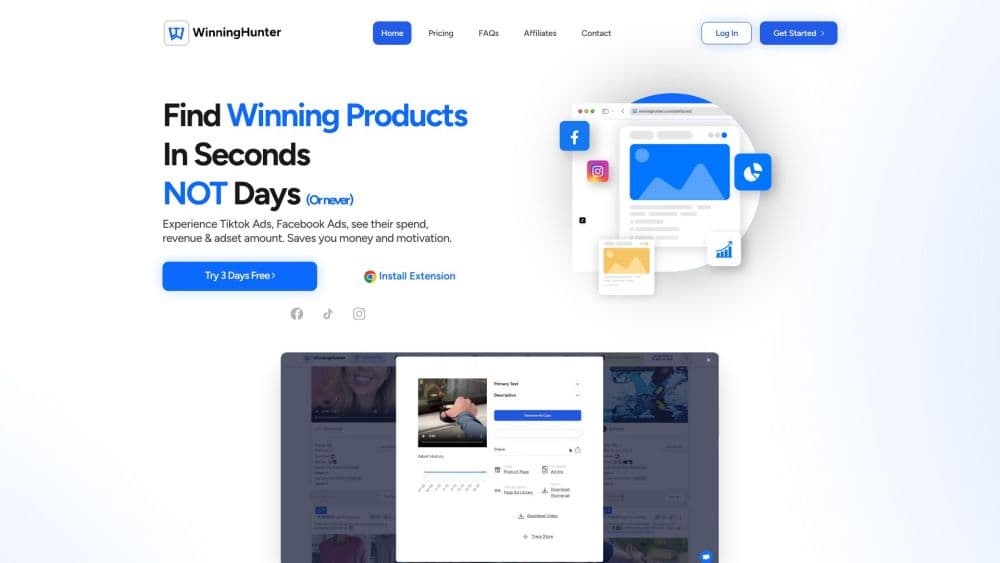
WinningHunter is an ecommerce research platform that surfaces winning ads, stores and products across Meta, TikTok and Pinterest so dropshippers can validate demand before they spend.
About WinningHunter
What Is WinningHunter
WinningHunter is an ecommerce research platform for people who sell physical products online, mostly dropshippers and small brand owners. Its pitch is simple: instead of guessing which product to test, you look at what competitors already spend money on. The platform pools ads from the Meta Ad Library, TikTok, and Pinterest into one searchable dashboard, then layers spend data, store revenue, and trend signals on top.
The core of the product is the Ad Library. You filter ads by estimated ad spend, ad set volume, media type, creation date, and performance to separate live campaigns from dead tests. A spend filter is the main event, because an advertiser who scales an ad is spending real money, and that's a stronger signal than a like count. From there, the Store Tracker and Magic AI fill in the rest: how much a store appears to earn, how saturated a niche is, and where else the same product is being sold.
The main limit is that all of this is inference, not proof. Spend figures, revenue estimates, and ad scores are modeled from public data, so they point at likely winners rather than guarantee one. WinningHunter also sits in a crowded field with tools like Minea and PiPiADS, so the real question for a buyer isn't whether it works but whether its filters match how you research. Pricing starts at $49 a month with no free tier.
Getting Started
- Sign up at app.winninghunter.com with email; no credit card is required to start searching.
- Open the Ad Library and set filters for ad spend, media type, and creation date to find ads that are actively scaling.
- Run the product through Magic AI to check how many competitors sell it and in which countries.
- Confirm demand with the Store Tracker, which shows estimated revenue and traffic for a store, then import the product to your own store if it clears your test.
Product Information
A quick look at WinningHunter's pricing, supported platforms, and performance.
Best for
The users, tasks, and scenarios where this tool fits best.
Users
- Dropshipping beginners
- Ecommerce brand owners
- Agencies and media buyers
Tasks
- Validating a product before you buy inventory
- Finding creative angles to copy
- Checking niche saturation
- Watching competitors
Scenarios
- A first-time dropshipper who wants to skip the "test ten bad products" phase.
- An established store looking for fresh winning products to expand its catalog.
- A media buyer scanning Meta and TikTok for ads that are scaling right now.
Key features
Facebook Ad Library search
WinningHunter indexes the Meta Ad Library and adds filters the native tool doesn't offer, including estimated ad spend, ad set amount, media type, and product creation date. You can sort for ads that are scaling and open each one to see the creative, the landing page, and the advertiser's other campaigns. The point is to cut through pages of dead tests and land on ads with real money behind them.
TikTok and Pinterest ad spy
Beyond Meta, the platform tracks ads running on TikTok and Pinterest, which is where a solid ad spy tool earns its keep, because a product that wins on one network often spreads to the others. You can review video creatives, spot formats that are gaining traction, and pull assets for your own campaigns. This cross-network view is the main reason people pick one tool over stitch-together single-platform alternatives.
Store Tracker
The Store Tracker estimates how much revenue and traffic a store appears to generate, then names similar stores selling comparable products. That lets you verify a signal from the Ad Library before you commit. If a store looks like it earns well and the same product is being pushed by several sellers, you have a stronger case to test it.
Magic AI competitor finder
Magic AI answers the saturation question directly. You feed it a product, and it reports how many competitors sell it and in which countries, so you can see whether a niche is crowded or open. It also supports searching by keyword or image, which helps when you only have a screenshot or a rough product idea to work from.
Ad spend and scaling filters
The ad spend filter is the feature the product is built around. It separates ads that are actively being funded from those that stalled, and pairs with creation date filters so you can focus on recent launches. For research, this is the difference between seeing what a competitor posted and seeing what they're still paying for.
Product importing
Once you've found a product worth testing, WinningHunter can push it to your own store in a few clicks. The importer pulls product details and images so you skip manual entry and move straight to setting up a listing. It's a convenience feature, but it shortens the gap between research and testing.
Brand tracker and trends
Higher plans add a Brand tracker that follows chosen brands and surfaces their new ads, hooks, personas, and landing pages. An Exploding Trends view flags products gaining momentum. Together they turn the platform from a one-off search tool into something you check regularly.
Pros and cons
Pros
- Combines Meta, TikTok, and Pinterest ad data in one dashboard, so you avoid juggling three tabs.
- Ad spend and scaling filters surface ads with real money behind them, which is a stronger signal than engagement numbers.
- Store Tracker and Magic AI let you cross-check a product from two angles before spending on tests.
- Product importing moves a validated product to your store without manual re-entry.
- Plans scale from solo sellers to agencies, with brand tracking and 24/7 support on higher tiers.
Cons
- No free plan, so you pay $49 a month before you know whether the workflow fits you.
- Spend and revenue figures are estimates modeled from public data, not verified totals, so treat them as directional.
- The interface packs many filters and data points, which takes time to learn if you're new to ad research.
- The deepest features, like following many brands and trends, sit behind the $79 and $249 plans.
Frequently asked questions
WinningHunter is an ecommerce research platform that pools ads from Meta, TikTok, and Pinterest into one dashboard and adds ad spend, store revenue, and competitor data. People use it to find products and ads that are already working instead of guessing.
Related content
Explore related tools, skills, and articles for WinningHunter.
WinningHunter Alternatives

ngram 2.0
ngram · Video · Marketingngram 2.0 is an AI video generator for teams. It turns a prompt, a screen recording, or a product URL into a narrated explainer, product demo, or AI avatar video, and every scene stays editable.

shippedit.me
Krawlup · Marketing · Businessshippedit.me now redirects to Krawlup, a web platform that audits SEO, AEO and page speed every week, then hands the fixes to AI coding agents over MCP.

MePersona
MePersona, Inc. · Writing · Productivity · MarketingMePersona is an AI unified inbox for creators. It learns your voice, drafts replies to fan messages from 12 platforms, and sends only what you approve.