

WolframAlpha Classic
Wolfram Research · Coding · Leaning
WolframAlpha is a computational knowledge engine from Wolfram Research. You ask a question in plain language and it computes an answer, from math to real-world data. People often write the name as Wolfram Alpha.
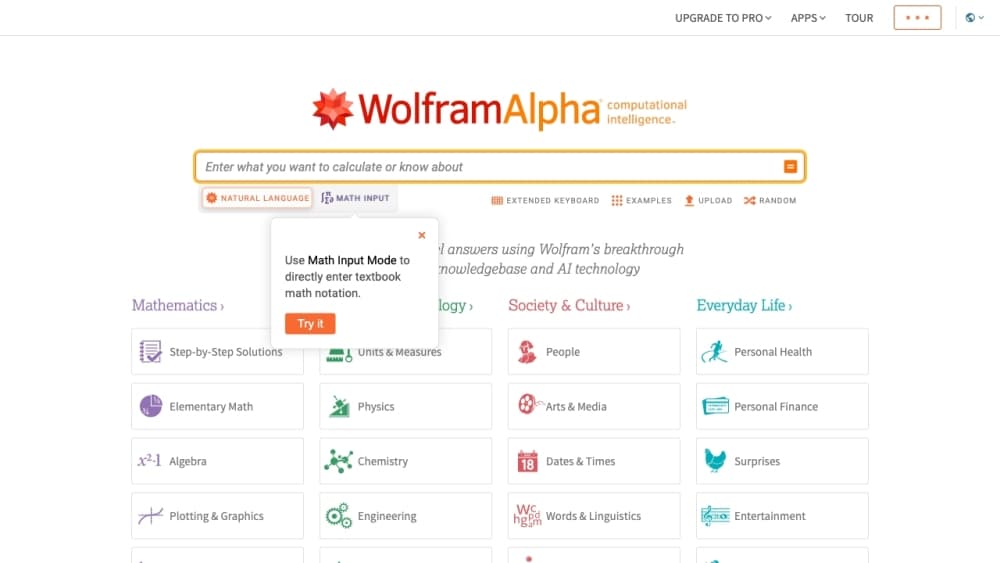
About WolframAlpha Classic
What Is WolframAlpha
WolframAlpha works differently from a search engine. You type a question the way you'd say it out loud, and instead of handing back a list of links, it computes an answer. Ask for the derivative of a function, the distance between two cities, or the GDP of a country, and you get a result page with charts, formulas, and sources behind it.
It runs on Wolfram Language, the system that also powers Mathematica, and pulls from a curated library of data, algorithms, and models built up over more than three decades. That's what lets it handle everything from basic arithmetic to advanced calculus, chemistry, engineering, and finance in one place. The company describes the project as an attempt to make all systematic knowledge computable.
The engine has real limits. It's built for questions with a definite answer, so open-ended writing or opinion tasks are a poor fit. As a math solver it's strong, but it won't write an essay for you. It also returns computed facts rather than a chat, so it won't hold a back-and-forth conversation the way an AI assistant does. And several of its best features, like uploading your own data or downloading results, sit behind the paid WolframAlpha Pro plan.
Getting Started
- Go to wolframalpha.com and type a question into the box, or try the examples page if you're not sure what to ask.
- Read the result page, which breaks the answer into sections like plots, alternate forms, and values.
- Step through the math yourself with step-by-step solutions, available on WolframAlpha Pro and in the mobile apps.
- Upload your own files, images, or data on Pro to run analysis against your numbers instead of Wolfram's.
- Move to Pro or the API when you need more computation time, downloads, or programmatic access.
Product Information
A quick look at WolframAlpha Classic's pricing, supported platforms, and performance.
Best for
The users, tasks, and scenarios where this tool fits best.
Users
- Students
- Engineers and scientists
- Analysts and researchers
Tasks
- Solving math problems
- Checking facts and figures
- Unit and currency conversion
- Generating practice problems
Scenarios
- Homework help
- Quick reference at work
- Building a study plan
Key features
A Compute-First Answer Engine
The core idea is that WolframAlpha calculates rather than searches. Type a question and it parses the input, picks the right algorithms and data, and returns a structured result page. You get plots, alternate forms, and related properties in one view, so a single query often answers several follow-up questions.
Step-by-Step Solutions
On a Pro plan, math and science problems come with a walkthrough that shows how the answer was reached. Each step explains the move being made, which turns the tool from a result checker into something closer to a tutor. The same feature is available inside the free iOS and Android apps for Pro users.
Wolfram Problem Generator
The Problem Generator builds new practice questions on the spot instead of pulling them from a fixed database. It covers topics like arithmetic, algebra, calculus, and statistics across beginner to advanced levels, and Pro subscribers can turn a set into printable worksheets.
Data, Image, and File Input on Pro
Pro lets you bring your own material. Upload spreadsheets, images, or files in more than 60 formats and the engine runs analysis against them, whether that's fitting a curve to your data or reading values off an image. This is what separates the free box from a working analysis tool.
Direct Data Download
Pro users can export computed results as files for spreadsheets, reports, or 3D models, rather than retyping numbers by hand. It's a small feature that matters when a result feeds into another document or a presentation.
Web Apps and Custom Interfaces
WolframAlpha ships a set of form-based Web Apps that sit on top of the engine. They give a simpler, guided front end for common jobs, like a specific calculator or a course-guided input view, which helps people who'd rather click through options than phrase a query.
APIs for Developers
Wolfram Research offers several APIs, including a Full Results API for programmable access, an LLM API tuned for language models, and a Short Answers API for quick replies. Teams use them to wire computation into their own products, and an AppID is required to get started.
Pros and cons
Pros
- Answers come from computation and curated data, so numbers arrive with a method behind them instead of a guess.
- One query covers a lot of ground, returning plots, alternate forms, and related properties in a single result page.
- Step-by-step solutions turn it into a study aid, not just a final-answer machine.
- It spans subjects most tools split apart, from calculus and chemistry to finance and geography.
Cons
- It's built for questions with a definite answer, so open-ended writing or opinion prompts fall flat.
- There's no real conversation. You refine a query instead of chatting back and forth, which feels limited next to AI assistants.
- The strongest features, like your own data upload and downloads, need a Pro plan, so the free tier is a taster.
- The result pages can be dense, and figuring out which section holds your answer takes some getting used to.
Frequently asked questions
WolframAlpha computes answers to factual questions. People use it for math and science problems, unit and currency conversions, and real-world data like populations or prices, all from plain-language queries.
Related content
Explore related tools, skills, and articles for WolframAlpha Classic.
WolframAlpha Classic Alternatives

Base Code
Base44 (Wix) · Coding · ProductivityBase Code is a shared cloud development environment from Base44. Teammates describe changes to an existing GitHub codebase in chat, preview them live and send them back as pull requests.

Google EmbeddingGemma 2
Google DeepMind · Writing · Image · CodingGoogle EmbeddingGemma 2 is a 740M-parameter open model that turns text, code, images, audio, and video frames into vectors in one 768-dimension space, running on phones and laptops.

GitGlow
GitGlow · Coding · ProductivityGitGlow is a local-first desktop Git client that lets independent developers review their own code and their AI agents' changes in one place before shipping.