

WoolyAI Acceleration Service
WoolyAI Inc · Coding
WoolyAI Acceleration Service is a pay-per-use GPU cloud built on the WoolyStack CUDA abstraction layer, so teams run PyTorch work without owning local GPUs.
About WoolyAI Acceleration Service
What Is WoolyAI Acceleration Service
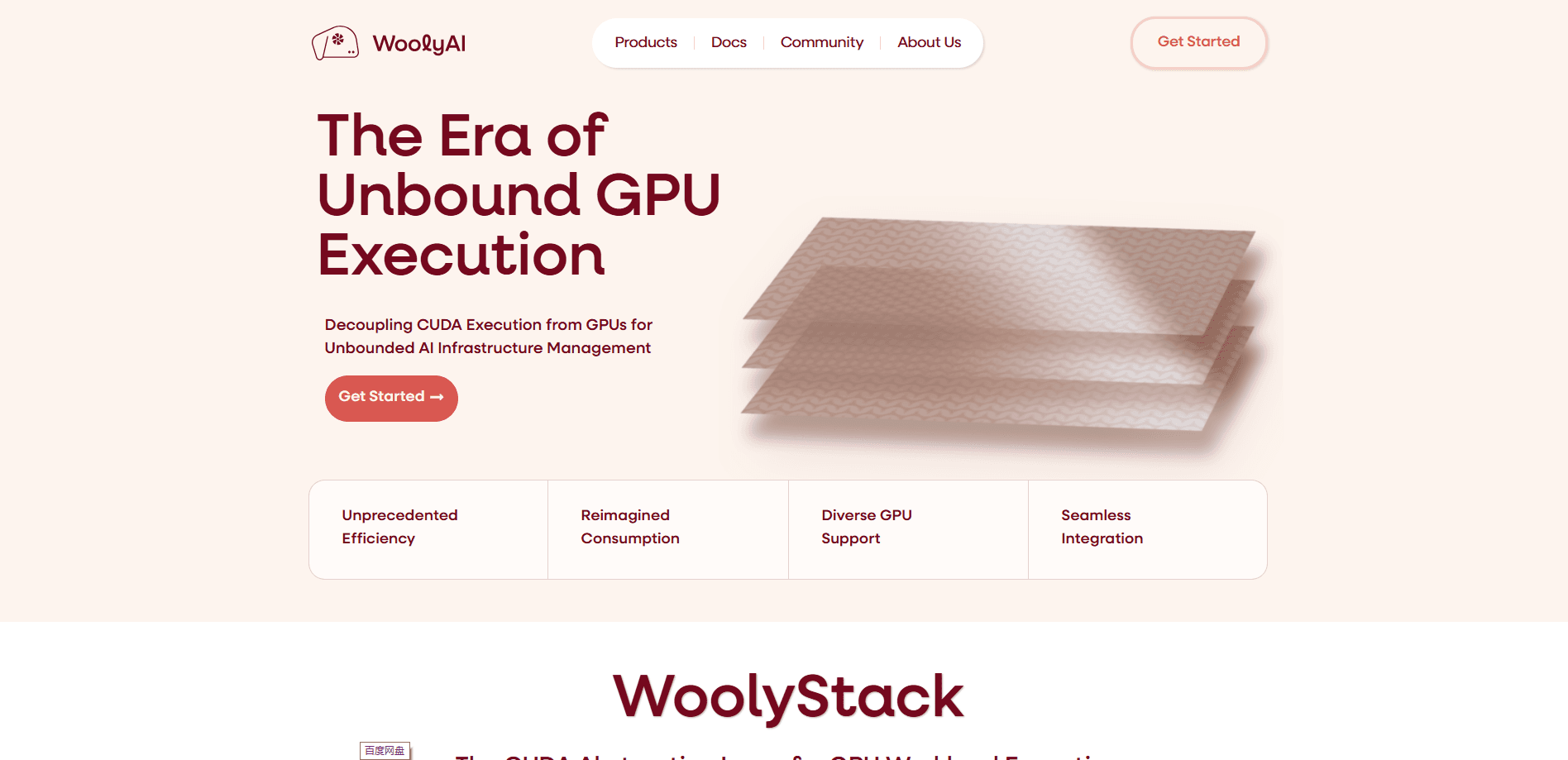
WoolyAI Acceleration Service is a GPU cloud offering from WoolyAI Inc, built on the company's WoolyStack layer. WoolyStack decouples CUDA execution from the GPU itself, which means a program written for a GPU can run on CPU infrastructure and have its compute work sent to remote GPUs instead.
The service targets teams that need GPU capacity but do not want to buy or rent it by the hour. Rather than billing on time used, it charges for the GPU resources a job actually consumes. You describe the work, the platform finds a matching device and runs it, and the meter follows real usage instead of wall-clock time sitting on a reserved card.
WoolyStack also treats GPU hardware as interchangeable. Because compute is abstracted away from any single vendor's stack, the same job can land on different GPU models, and isolated execution environments keep one workload apart from another. The service is still early stage. WoolyAI's own site describes the product as coming soon, so availability, exact pricing and supported hardware should be confirmed with the vendor before you plan a production rollout.
Getting Started
- Contact WoolyAI through the official site or [email protected] to request access, since the service is listed as coming soon
- Set up your environment so CUDA calls route through the WoolyStack abstraction layer
- Run your PyTorch or CUDA workload as usual and let the platform assign remote GPU capacity
- Monitor consumption and billing by actual GPU usage rather than booked time
Product Information
A quick look at WoolyAI Acceleration Service's pricing, supported platforms, and performance.
Best for
The users, tasks, and scenarios where this tool fits best.
Users
- Teams with CPU-heavy fleets
- Startups and labs on tight budgets
- Platform engineers
Tasks
- Running PyTorch training and inference
- Handling spiky GPU demand
- Testing across GPU hardware
Scenarios
- Small teams prototyping AI features
- Cost-sensitive inference
- Locked-in environments
Key features
CUDA Decoupled From the GPU
WoolyStack separates CUDA execution from the physical GPU, which is the core of the offering. A program that expects a GPU can run where no GPU is installed, and the compute portion is dispatched to remote hardware. That split is what lets CPU infrastructure host work that would normally need a local card.
Pay for Consumption, Not Time
The billing model charges for the GPU resources a job actually uses rather than the hours a card is reserved. For workloads that run in bursts, that difference matters: you are not paying for a GPU to sit idle between jobs. Pricing details should be confirmed directly with WoolyAI, since the service is still listed as coming soon.
Hardware-Agnostic Execution
Because execution is abstracted from any single vendor's stack, the service can target GPUs from more than one supplier. Teams avoid tying an application to one card model, and moving a job to different hardware does not require rewriting the code around it.
Isolated Execution Environments
Each workload runs in its own isolated environment. That separation keeps jobs apart from one another, which matters when several teams or tenants share the same pool of underlying GPUs.
Dynamic Resource Allocation
The platform assigns GPU resources on demand rather than through a fixed reservation. Combined with the consumption-based meter, that setup fits variable demand, where the amount of GPU time a project needs changes from week to week.
Usage Profiling
WoolyAI pairs allocation with profiling, so you can see how much GPU a job really consumes. That visibility feeds back into the billing model and helps teams spot workloads that are spending more than expected.
Pros and cons
Pros
- Runs CUDA and PyTorch work on CPU infrastructure, so a local GPU is not required
- Consumption-based billing fits bursty jobs better than hourly reservations
- Hardware-agnostic layer reduces dependence on a single GPU vendor
- Isolated environments keep multi-tenant workloads separate
- Profiling shows real GPU usage, which supports cost control
Cons
- The product is still listed as coming soon, so pricing and availability are not final
- Performance depends on network latency to remote GPUs, which can hurt latency-sensitive jobs
- Teams must route execution through WoolyStack rather than calling local CUDA directly
- Details on supported GPU models and regions are limited while the service is pre-launch
Frequently asked questions
It provides GPU capacity as a cloud service built on the WoolyStack CUDA abstraction layer. You run GPU-oriented code such as PyTorch workloads, and the platform sends the compute portion to remote GPUs while billing by actual consumption rather than time used.
Related content
Explore related tools, skills, and articles for WoolyAI Acceleration Service.
WoolyAI Acceleration Service Alternatives

Base Code
Base44 (Wix) · Coding · ProductivityBase Code is a shared cloud development environment from Base44. Teammates describe changes to an existing GitHub codebase in chat, preview them live and send them back as pull requests.

Google EmbeddingGemma 2
Google DeepMind · Writing · Image · CodingGoogle EmbeddingGemma 2 is a 740M-parameter open model that turns text, code, images, audio, and video frames into vectors in one 768-dimension space, running on phones and laptops.

GitGlow
GitGlow · Coding · ProductivityGitGlow is a local-first desktop Git client that lets independent developers review their own code and their AI agents' changes in one place before shipping.