

Would you pay?
Mustafa Ergisi · Marketing · Business
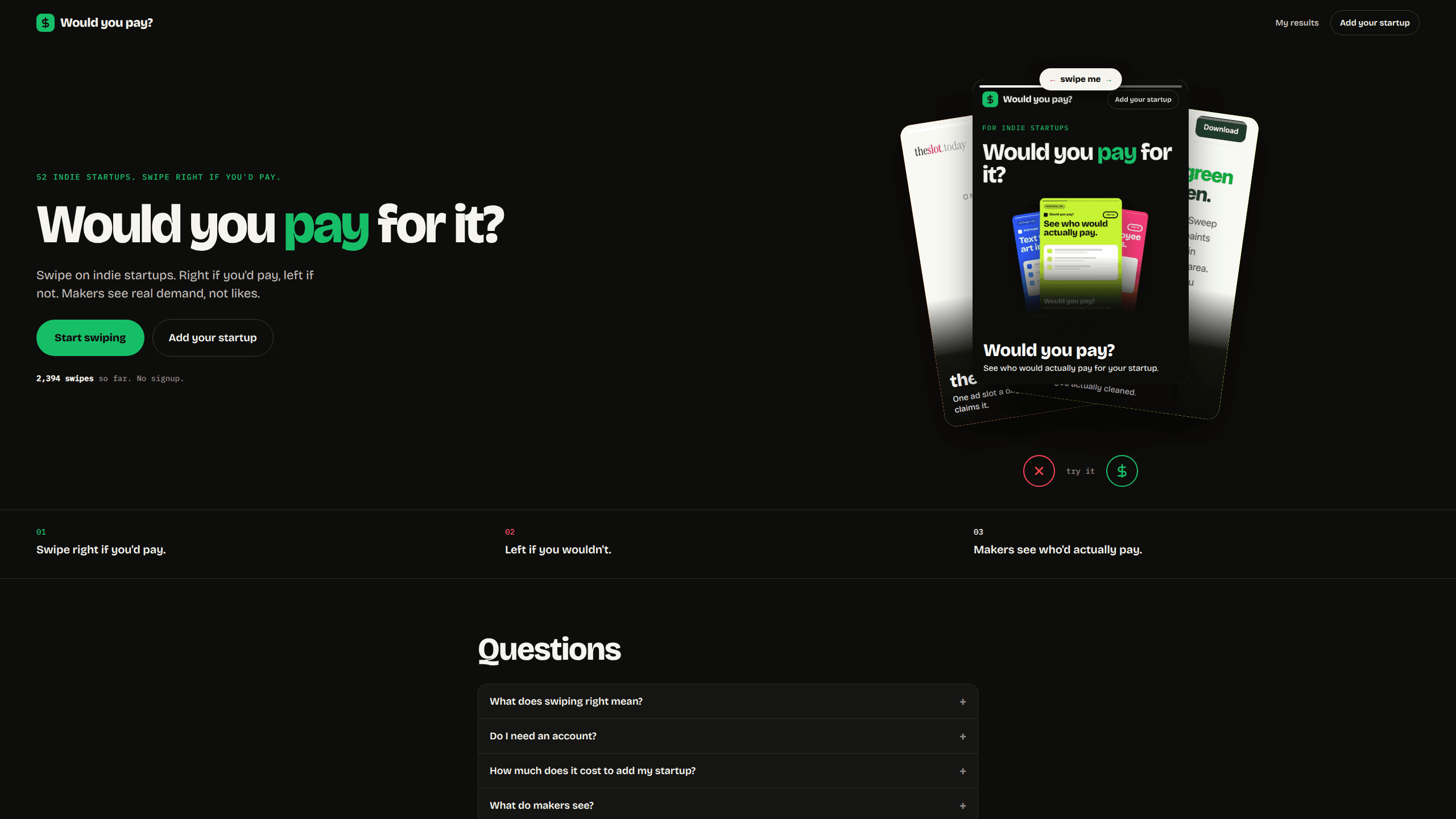
Would you pay? turns indie startups into a swipe deck. Strangers swipe right only if they'd pay, and makers see the yes rate before they build more.
About Would you pay?
What Is Would you pay?
Would you pay? is a web app where people judge indie startups one card at a time. A card shows a product name, a one-line pitch, and a screenshot. Swipe right if you'd pay for it, left if you wouldn't. Nothing is charged, and voting takes no account.
If you've asked would people pay for my app and got polite shrugs, this is the blunter test. Startup idea validation here means one stranger, one card, and one decision about money. Likes and upvotes cost nothing, so they arrive easily and mean little. A yes here is a small claim about spending, which makes it a harder signal to give. The site publishes its own numbers: across 12,491 swipes from 975 people, about 20% were yes. Among 158 startups with at least 20 votes, the best card reached 44%, the middle one 19%, and the weakest 4%.
Makers see the share of people who'd pay, a split by role (developers, founders, marketers), and how many clicked through to their site. The percentage stays hidden until 10 swipes, so two early votes can't set the number. The limits deserve a line too. This is stated intent, not a purchase, and the crowd is made of developers, founders, and marketers. Their yes rate tells you how the pitch lands with peers. It tells you less about a market of clinic managers or restaurant owners.
Getting Started
- Open iwouldpay.dev and hit the swipe deck. The first card loads in about a second, with no signup wall in front of it.
- Swipe right on the startups you'd pay for and left on the rest. After a few yes votes, the site asks one extra question about how much per month you'd accept.
- Makers add a startup at iwouldpay.dev/submit. The listing is free, the card enters the deck right away, and results stay in the maker's own dashboard.
- Log in with a one-time email link to read the breakdown. The headline percentage appears after 10 swipes, and a $9 Boost puts the card at the front of the deck for 24 hours.
Product Information
A quick look at Would you pay?'s pricing, supported platforms, and performance.
Best for
The users, tasks, and scenarios where this tool fits best.
Users
- Indie makers and solo founders
- Product marketers at small software teams
- Community leads and accelerator mentors
Tasks
- Testing a one-line pitch
- Finding a launch number
- Checking a price assumption
Scenarios
- The weekend before a build sprint
- Pre-launch research on a tiny budget
- Choosing between several side projects
Key features
A swipe deck that needs no account
The voting side is open to anyone with a browser. Open the deck, get a card in about a second, and swipe. No email, no profile, no paywall between a visitor and the first vote. That low barrier is the point: honest first impressions are easier to collect when nobody has to sign up to give one.
Results that wait for 10 swipes
A maker's dashboard reports the share of people who'd pay, but the number stays hidden until the card reaches 10 swipes. The delay protects the reading from one enthusiastic friend or one bad morning. Makers also see click-throughs, so a high yes rate with no site visits is easy to spot.
A role split behind every card
Votes are grouped by what the swiper does: developer, founder, or marketer. Since the site says those three groups say yes at about the same overall rate, the useful part is the gap per startup. A card that wins founders and loses developers points to a different buyer, and to a different pitch.
Boost for faster answers
Boost costs $9 at launch and moves a card to the front of the deck for 24 hours, where nearly every new swiper sees it first. Up to five cards can be boosted at once, and they share the front in random order. If a boosted card doesn't reach 100 swipes in a day, the boost continues free until it does. Votes stay honest, since a boost buys attention and not yes votes.
A public share page
Past 10 swipes, each startup gets a share page with the headline percentage on it. That page is built for posting, which means a maker can show a number without screenshotting a private dashboard. The full breakdown, including role split and click-throughs, stays visible only to the owner.
Benchmarks from live votes
The insights page turns the whole deck into a reference point. It shows the average yes rate, the spread between the top and bottom cards, and the willingness to pay bands people pick after a yes: $5 a month takes 49% of answers, $10 takes 27%, and $50 or more takes 11%. A 25% result reads very differently once you know the deck average sits near 20%.
Pros and cons
Pros
- Voting takes seconds and needs no account, so the yes rate comes from people with nothing to gain.
- Listing a startup is free, and the card enters the deck immediately instead of waiting for review.
- The 10-swipe threshold and the role split add context that a raw like count never has.
- A $9 Boost is a small, one-time cost next to paid user research panels.
- Published benchmarks make a single result comparable to the rest of the deck.
Cons
- A yes is stated intent, so the number can't stand in for preorders or a real checkout test.
- The audience is developers, founders, and marketers, which leaves consumer and local businesses thinly covered.
- Small samples stay noisy, and 10 swipes is a low bar for a percentage that looks precise.
- Boost guarantees attention, not votes, so a weak pitch can still collect left swipes in front of a bigger crowd.
Frequently asked questions
It's a swipe deck of indie startups where a right swipe means you'd pay for the product, and makers see the share of people who agree before they invest more time in the build.
Related content
Explore related tools, skills, and articles for Would you pay?.
Would you pay? Alternatives

ngram 2.0
ngram · Video · Marketingngram 2.0 is an AI video generator for teams. It turns a prompt, a screen recording, or a product URL into a narrated explainer, product demo, or AI avatar video, and every scene stays editable.

shippedit.me
Krawlup · Marketing · Businessshippedit.me now redirects to Krawlup, a web platform that audits SEO, AEO and page speed every week, then hands the fixes to AI coding agents over MCP.

MePersona
MePersona, Inc. · Writing · Productivity · MarketingMePersona is an AI unified inbox for creators. It learns your voice, drafts replies to fan messages from 12 platforms, and sends only what you approve.