

WPSummarize
WPSummarize · Writing · Coding
WPSummarize is a WordPress plugin that writes AI summaries for your posts. It runs on your own OpenAI, Gemini, Anthropic, or xAI key, and displays TLDRs in list or narrative form.
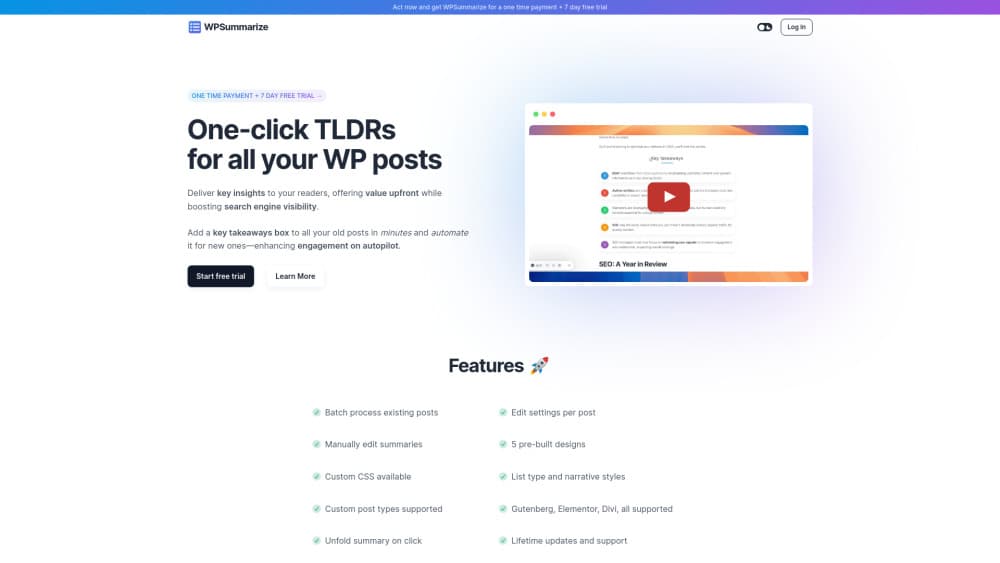
About WPSummarize
What Is WPSummarize
WPSummarize is an AI summary plugin for WordPress that turns long posts into short TLDRs readers can scan in seconds. It plugs into the same AI providers you already use, so you pick a model, paste an API key, and the plugin generates a summary for each article either on publish or in a batch run.
The plugin keeps summaries in your own database as post meta fields. That matters for two reasons. Pages still load from cached text instead of calling an AI service on every visit, and you can edit any summary by hand when a model gets the wording wrong. You control where each summary sits (top of the post, after the first paragraph, or wherever a shortcode lands), how it looks (bullet list or a flowing paragraph), and which post types get one.
Where it asks something of you: WPSummarize is a "bring your own key" plugin. There's no built-in AI credit, so you need an OpenAI, Gemini, Anthropic, or xAI account, and your provider bills you per summary. That setup keeps the plugin price low, but it adds a step before your first summary runs, and it means a sparse key balance stops generation.
Getting Started
- Install WPSummarize from the WordPress plugin repository, or activate the Pro license if you bought one
- Enter your AI provider key in the settings, then pick the model you want to summarize with
- Set where summaries appear, the style (list or narrative), and the item or word count
- Turn on auto-generation so new posts get a summary as they publish
- Run a batch over your archive to fill summaries for existing articles, then edit any that need a human pass
Product Information
A quick look at WPSummarize's pricing, supported platforms, and performance.
Best for
The users, tasks, and scenarios where this tool fits best.
Users
- Blog owners with long archive posts
- News and magazine publishers
- WordPress site managers who avoid coding
- Agencies running several WordPress sites
Tasks
- Add TLDRs to existing posts
- Auto-summarize new posts on publish
- Improve on-page reader experience
- Support search intent
- Match summary tone to your brand
Scenarios
- A news site with thousands of short-lived articles
- A personal blog that publishes weekly
- An Elementor or Divi site with a custom layout
- A site using Advanced Custom Fields
- An agency handing off a build
Key features
Bring-your-own-key AI setup
WPSummarize connects to OpenAI, Google Gemini, Anthropic, and xAI, plus Azure, through an API key you supply. The free tier runs on OpenAI; the Pro tier adds Gemini, Claude, and xAI. Because you pay your provider directly, a summary costs roughly a tenth of a cent, so a thousand summaries run about a dollar.
List and narrative summary styles
You pick the shape of the summary. List format produces bullet points you can set to disc, circle, square, decimal, or no bullets, with a minimum and maximum item count so a summary stays in range. Narrative format writes a flowing paragraph and takes a target word count, useful when a bulleted TLDR would break the rhythm of a long-form piece.
Auto-generation on publish
Turn on auto-generation and new posts get a summary the moment they publish, including scheduled ones. The work runs in the background so publishing stays quick. Automatic summary generation can be switched on or off for the whole site or for a single post, which helps when only some articles suit a TLDR.
Batch processing for the archive
The Pro plan can summarize thousands of existing posts, and you can narrow the run with filters. This is the part that saves the most time for a site with years of back content, since you fill summaries across an archive in one pass instead of opening each article.
Per-post control and manual editing
Every summary sits in your database as a post meta field, and you can edit it by hand. You can also change options for one post without touching the global settings, set a click-to-reveal summary, and cap token use so a long article does not burn through your key budget.
Page builder and theme compatibility
WPSummarize works with Gutenberg, Elementor, and Divi, and it supports custom post types, so summaries are not limited to standard blog posts. You can drop a summary in with a shortcode anywhere the editor allows, or let the plugin place it automatically before the content, after the first paragraph, or ahead of the first heading.
Display themes and custom output
The plugin ships with more than ten responsive designs, and you can restyle a summary from an integrated interface or let AI suggest a look that matches your site. For finer control, custom CSS and HTML sections let you add markup before or after a summary without editing the theme.
Pros and cons
Pros
- Bring-your-own-key pricing keeps the license cheap and puts AI cost on the provider bill, at about $0.001 per summary
- Summaries store as post meta, so pages serve cached text and do not slow down on every visit
- Works across Gutenberg, Elementor, and Divi, and supports custom post types and ACF fields
- Free tier covers 50 summaries a month, enough to test output on real posts before paying
Cons
- No built-in AI credit: without an OpenAI or other provider key, the plugin cannot generate anything
- Free tier is limited to 50 summaries a month and a single design, and it only runs OpenAI
- Batch processing, extra themes, and non-OpenAI providers sit behind the $49 Pro plan, so a large archive needs the paid tier
Frequently asked questions
WPSummarize is a WordPress plugin that writes AI summaries for your posts, showing a short TLDR readers can scan before the full article. It connects to OpenAI, Gemini, Anthropic, or xAI using your own API key and displays the result in list or narrative form.
Related content
Explore related tools, skills, and articles for WPSummarize.
WPSummarize Alternatives

Google EmbeddingGemma 2
Google DeepMind · Writing · Image · CodingGoogle EmbeddingGemma 2 is a 740M-parameter open model that turns text, code, images, audio, and video frames into vectors in one 768-dimension space, running on phones and laptops.

MePersona
MePersona, Inc. · Writing · Productivity · MarketingMePersona is an AI unified inbox for creators. It learns your voice, drafts replies to fan messages from 12 platforms, and sends only what you approve.

Fluence
Yay Software (Yannick Huchard) · Writing · Voice & Language · ProductivityFluence is an Android app that reads PDFs, EPUBs, Word files and web articles aloud, follows each sentence as it speaks, and answers questions about the text on the phone itself.