

xpander.ai
xpander.ai · Coding
xpander.ai is an enterprise AI agent platform that deploys, governs and audits agents on any model or framework, running in your own cloud, VPC or a fully air-gapped setup.
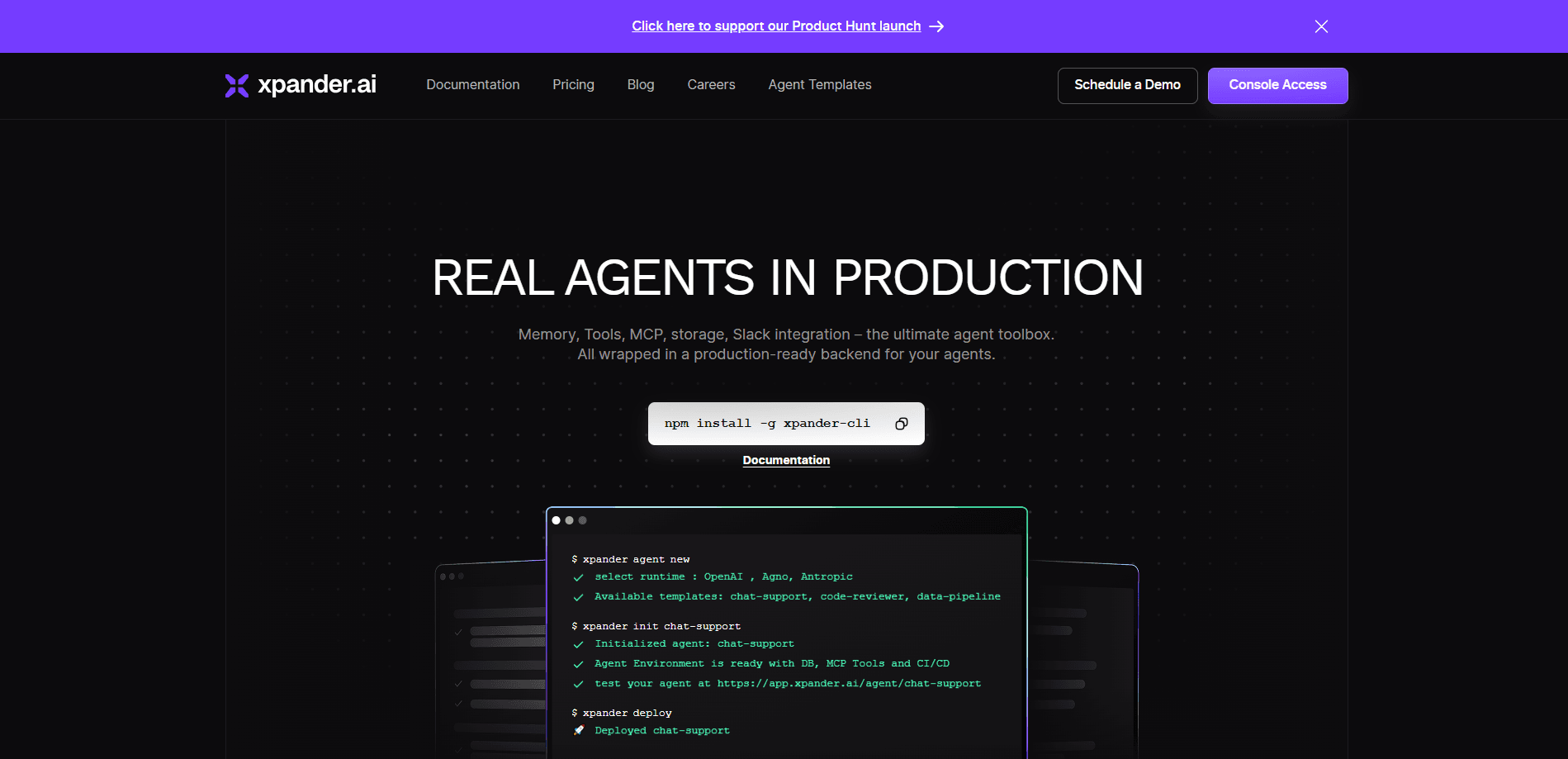
About xpander.ai
What Is xpander.ai
xpander.ai is a control plane for building and running AI agents in production. Instead of locking teams into one model vendor or one framework, it sits above them and manages the full agent lifecycle: who can build an agent, what it can reach, where it runs, how much it can spend and what gets logged.
The company frames the problem as AI agent governance rather than raw capability. Models are strong enough and frameworks are mature, yet many teams still can't say which agents are live, what tools they touch or who approved them, so the work stalls in prototypes. xpander.ai targets that gap by making every agent a registered, permissioned and audited asset that runs where your data already lives.
Two limits define the fit. It's built for organizations, not solo users, so pricing is quote-based and there's no self-serve sign-up. And it asks for real infrastructure: running agents in your own Kubernetes cluster or on-prem means you carry the operational load, which pays off only when control and data residency are the priority.
Getting Started
- Book a demo, since there's no self-serve trial, and describe the systems and models your agents need to reach.
- Let the team set up a pilot and connect your identity provider so agents authenticate as the person who invoked them.
- Build your first agent in Omni, the built-in AI engineer, by describing what you need in plain language.
- Define policies for approved tools, runtime limits, spend caps and human approval steps.
- Run the agent from Slack, Teams, ChatGPT or the Omni UI, and review logs, traces and costs in the platform.
Product Information
A quick look at xpander.ai's pricing, supported platforms, and performance.
Best for
The users, tasks, and scenarios where this tool fits best.
Users
- Platform and IT teams at mid-to-large companies
- Security and compliance officers
- Business application teams publishing a shared service
- Developers who already build agents in Claude Code or Codex
Tasks
- Moving laptop-built agents to a shared cloud environment
- Governing agent access and spend
- Auditing every agent action
- Connecting agents to private systems
Scenarios
- Running agents inside a regulated or air-gapped network
- Automating a background business process
- Embedding AI features in a product
- Sharing one agent across the whole company
Key features
Vendor-neutral, multi-framework AI agents
xpander.ai runs on the model and framework you already chose. It works with Claude, GPT, Gemini, Llama, Qwen, Mistral, Deepseek or your own fine-tuned model, and with runtimes like Claude Code, Codex, OpenCode or a harness you wrote yourself. That neutrality keeps the cost of switching models low, which matters when a better option shows up or a vendor changes its terms.
A governed control plane
The platform gives operators one place to manage the agent lifecycle, from first launch to fleet operations. An agent registry tracks owners, versions, environments and status, while a connector registry holds approved APIs, tools, MCP connectors and private systems. The core promise is that if a control isn't enforced in the runtime, it isn't treated as a control at all.
Deployment of self-hosted AI agents
Agents run in your AWS, GCP or Azure account, your VPC, on-premises or a fully air-gapped network. Self-hosted deployments egress no operational data, and credentials come from a vault at the moment of use so the model never sees a secret. For teams in regulated fields, this is often the deciding factor.
Omni, the built-in AI engineer
Omni is an agentic forward-deployed engineer that builds agents from a plain-language description. You tag it like a teammate inside ChatGPT or Claude, ask for the agent you want, and it wires up the tools and hands back something ready to run. It also optimizes, migrates and fixes agents over time, which trims the setup work that usually eats a project's early weeks.
Multiplayer AI workspace
Agents and the people using them share one conversation. A published agent runs self-serve for any authorized team, and work happens where people already are: Slack, Teams, ChatGPT, Claude and the Omni UI. Approvals and handoffs sit in the same thread, so a human can step in without leaving the context.
Observability, budget controls and identity
Every agent has a named identity, and every action is logged with spend attributed per task. Operators set approved models, routing rules, limits and spend caps, and attach human-in-the-loop approvals to sensitive actions. A run trace shows each tool call and what came back, which is what makes an agent reviewable rather than a black box.
Policy engine and AI agent security
A policy engine defines who can build, run, approve, publish and access agents, and it scopes permissions, secrets and data access per agent. The company reports SOC 2 Type II certification and GDPR compliance, with a full audit trail that can be exported to your SIEM. Security teams usually want that in writing, and this platform publishes it rather than describing it.
Pros and cons
Pros
- Runs agents in your own cloud, VPC, on-prem or air-gapped environment, which keeps data residency under your control.
- Stays vendor-neutral across models and frameworks, so switching a model or runtime doesn't force a rewrite.
- Assesses governance in the runtime itself, with a policy engine, named agent identities and per-task spend attribution.
- Meets teams where they work, with agents living in Slack, Teams, ChatGPT, Claude and the Omni UI.
- Backs its claims with SOC 2 Type II and GDPR compliance and an audit trail you can export.
Cons
- There's no self-serve trial or free plan, so trying it means booking a demo and setting up a pilot with the sales team.
- Pricing is quote-based and the enterprise license starts at 50 agents, which pushes small teams and individual developers out.
- Self-hosted deployment puts the operational load on your own Kubernetes or on-prem team, so it isn't a zero-maintenance option.
- Much of the value sits in enterprise governance features, so a small team that just wants a quick agent may find the platform heavier than it needs.
Frequently asked questions
xpander.ai is used to build, run and govern AI agents in production. It connects agents to your applications, data and cloud through your existing identity setup, then enforces policies on who can run them, what they reach, what they spend and what gets logged. It's built for companies that need agents running under control, not just working in a demo.
Related content
Explore related tools, skills, and articles for xpander.ai.
xpander.ai Alternatives

Base Code
Base44 (Wix) · Coding · ProductivityBase Code is a shared cloud development environment from Base44. Teammates describe changes to an existing GitHub codebase in chat, preview them live and send them back as pull requests.

Google EmbeddingGemma 2
Google DeepMind · Writing · Image · CodingGoogle EmbeddingGemma 2 is a 740M-parameter open model that turns text, code, images, audio, and video frames into vectors in one 768-dimension space, running on phones and laptops.

GitGlow
GitGlow · Coding · ProductivityGitGlow is a local-first desktop Git client that lets independent developers review their own code and their AI agents' changes in one place before shipping.