

Yext
Yext, Inc. · Coding · Marketing
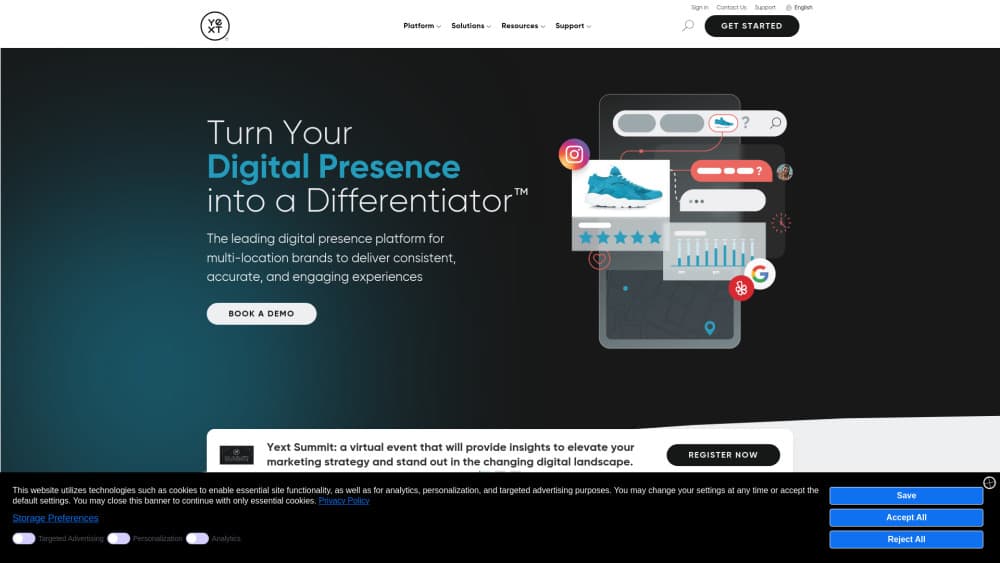
Yext is an AI search visibility platform. It keeps your brand facts in one knowledge graph, pushes them to 200+ publishers and AI assistants, and tracks where you appear in ChatGPT, Gemini and Google.
About Yext
What Is Yext
Yext is a software company based in New York that sells digital presence management to brands with many physical locations. Banks, hospital groups, retailers, restaurant chains and hotel operators use it to keep the same address, opening hours, phone number and service list in sync everywhere a customer might look. That includes Google, Apple Maps, Yelp, Facebook and, increasingly, AI assistants.
The problem it solves is drift. A branch changes its Saturday hours, the update lands on Google but not on Apple, a holiday schedule goes stale, and an AI assistant answers a question with last year's information. Yext treats your business data as a single record and distributes it through direct connections instead of third party aggregators. The company says it manages more than 12 million locations and holds over 200 direct publisher integrations.
The main constraint is the buyer it targets. Yext is built for marketing teams at companies with dozens or thousands of locations, so pricing runs through a sales conversation rather than a checkout page. A single shop or a small clinic will find the setup work and the contract size hard to justify against cheaper listing tools.
Getting Started
- Talk to the sales team and scope the number of locations, the publishers you care about and the modules you need. There is no self-serve signup.
- Import location data from a spreadsheet, a CMS or an existing listing account, then fill in the fields each publisher expects.
- Claim and verify your profiles, connect your Google Business Profile, Apple Business and other accounts, and let the first sync run.
- Open Scout to see baseline visibility across AI and traditional search, then work through the gaps it flags.
Product Information
A quick look at Yext's pricing, supported platforms, and performance.
Best for
The users, tasks, and scenarios where this tool fits best.
Users
- Multi-location marketing teams
- Local SEO and reputation managers
- Agencies running local campaigns for clients
Tasks
- Fixing inconsistent business information
- Tracking brand answers in AI assistants
- Publishing location pages at scale
Scenarios
- A retail chain opens 40 stores in one quarter
- A hospital group needs accurate "open now" data
- A brand notices ChatGPT recommends a competitor
Key features
AI Visibility Tracking Across Answer Engines
Scout monitors how your brand shows up in Google Search, Google Maps, AI Overviews, ChatGPT, Gemini, Claude and Perplexity, then breaks results down by location and competitor. It tracks head-to-head win rates against up to 20 rivals on both brand prompts and high-intent local queries. The useful part is the diagnosis: you see which prompt or location slipped, not just a single falling score.
Direct Publisher Distribution
Yext's local listings management connects straight to publishers rather than routing updates through aggregators, which it says makes changes go live in seconds across more than 200 destinations. Fewer hops means fewer chances for a field to be dropped or overwritten. For a team that has watched a corrected phone number take two weeks to appear, that difference is the reason to pay for this category of tool.
Knowledge Graph
Every location, service, provider, menu and FAQ lives in one structured record that both publishers and AI systems can read. You edit the fact once, and the same value flows to Google, Apple, your website pages and the AI assistants that license the data. Duplicate entries and conflicting values get caught at the source instead of on twelve different profile pages.
Listings Verifier
The verifier pulls what publishers currently show and compares it against your master record, then reports mismatches, duplicates and overwrites. Fixes can be applied in bulk, and the next sync pushes them out. This is the unglamorous work that decides whether a customer calls the right number, and it's where most listing problems actually start.
Action Center Agents
Scout turns its recommendations into tasks that agents can execute across the platform, from correcting a field to responding to reviews or publishing social posts. Your team keeps approval control, so a bad suggestion doesn't reach the public. It's the difference between a report that says "your hours are wrong" and something that changes the hours.
Developer Platform and MCP Access
Yext exposes APIs, a CLI and config-as-code for teams that want listings and content work inside their own pipelines. Internal agents can also plug into the knowledge graph and publisher network over MCP, which matters if your company already runs its own AI tooling and doesn't want a second, disconnected data store.
Pros and cons
Pros
- Direct connections to more than 200 publishers, so a correction lands without an aggregator in the middle.
- One knowledge graph feeds listings, pages, reviews and AI visibility, which removes a lot of duplicate data entry.
- AI visibility tracking covers ChatGPT, Gemini, Claude, Perplexity and Google, not just classic local search.
- Enterprise controls such as role-based approvals, audit trails and encryption suit regulated industries.
- Mobile app handles on-site photo and hours fixes when a store manager spots a problem.
Cons
- No public pricing and no self-serve plan, so you can't test the product before a sales cycle.
- Cost and minimum contract size put it out of reach for single-location businesses.
- Setup depends on clean source data; messy internal records turn the first import into a project.
- Publisher coverage varies by country, and some regional directories still need manual work.
Frequently asked questions
Yext stores your business facts in one place and distributes them to search engines, maps, directories and AI assistants. On top of that it reports how visible your brand is in AI answers and traditional search, then helps you fix the gaps.
Related content
Explore related tools, skills, and articles for Yext.
Yext Alternatives

Base Code
Base44 (Wix) · Coding · ProductivityBase Code is a shared cloud development environment from Base44. Teammates describe changes to an existing GitHub codebase in chat, preview them live and send them back as pull requests.

Google EmbeddingGemma 2
Google DeepMind · Writing · Image · CodingGoogle EmbeddingGemma 2 is a 740M-parameter open model that turns text, code, images, audio, and video frames into vectors in one 768-dimension space, running on phones and laptops.

GitGlow
GitGlow · Coding · ProductivityGitGlow is a local-first desktop Git client that lets independent developers review their own code and their AI agents' changes in one place before shipping.