

ZenMux
ZenMux · Other
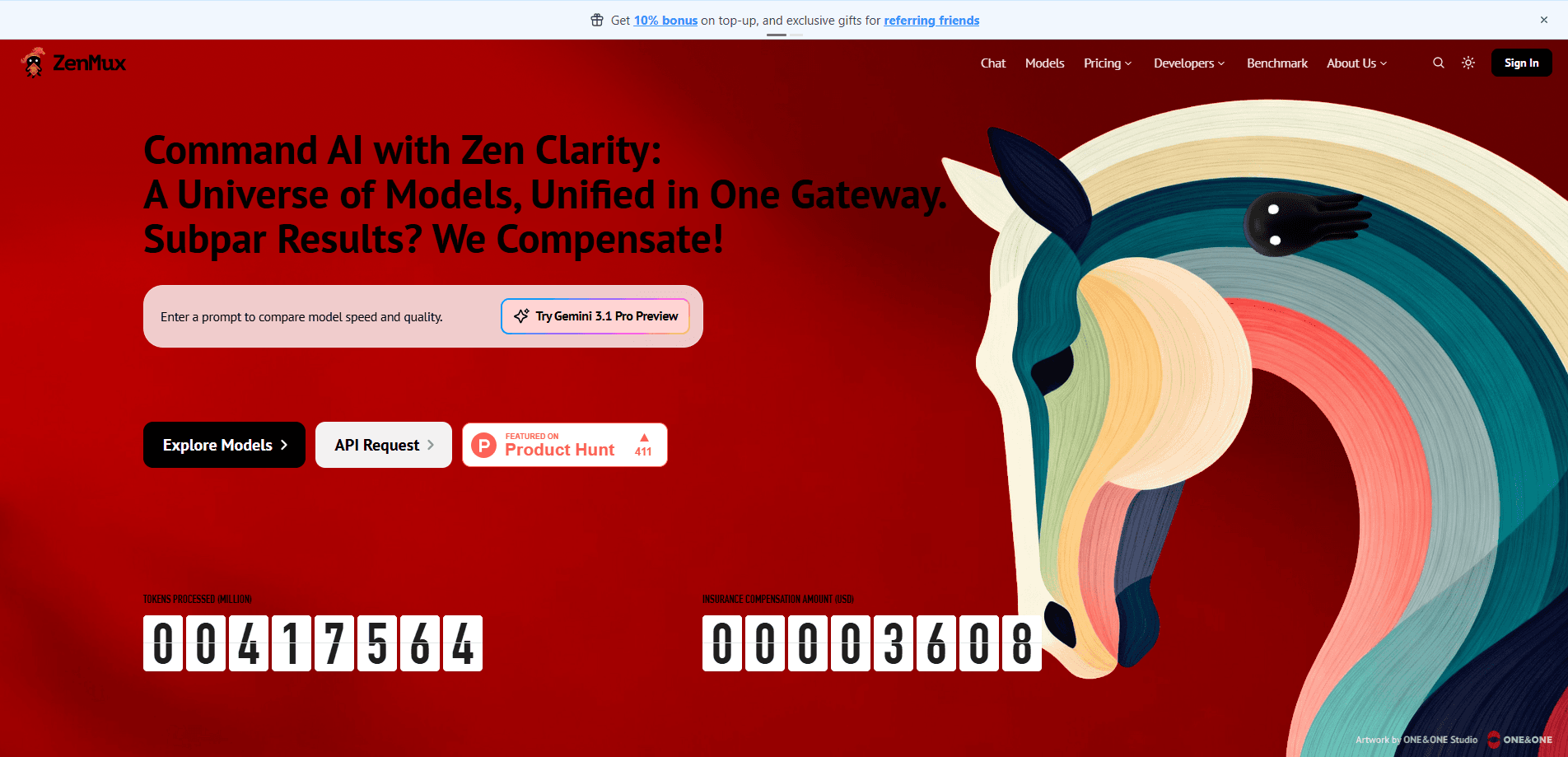
ZenMux is an AI gateway that puts more than 100 models behind a single API key, with built-in insurance that credits your account when output quality or latency drops.
About ZenMux
What Is ZenMux
ZenMux is an LLM API aggregator built around a unified AI API. One account and one key get you Claude, GPT, Gemini, DeepSeek and dozens of other models through a single endpoint, with billing collected in one place. Models come from the vendors themselves or authorized cloud partners, so a request reaches the real model rather than a resold copy.
What separates it from a plain router is AI model insurance. ZenMux checks platform traffic every day and pays compensation credits when a response is judged hallucinated, slow, or short on throughput. Payouts post the next day. Flagged cases also come back to you, anonymized, as bad-case data you can put into your own evaluation set. That data holds real failures.
Two limits matter before you commit. The free plan runs only in the browser Studio chat and has no API access, so an integration starts at $20 per month or on pay-as-you-go credits. Subscription usage is counted in Flows instead of dollars, and the Flow to USD rate is set by the platform and adjusted over time.
Getting Started
- Create a ZenMux account at zenmux.ai and generate an API key from the console.
- Point your OpenAI or Anthropic SDK at the ZenMux base URL and swap in the new key. Most projects touch two lines of config.
- Choose a model from the catalog, or turn on Auto routing and let the gateway pick per prompt.
- Send a test request, then open the Activity page to read token counts, latency and cost for that call.
- Set a budget cap, or move to a Builder Plan once the test traffic looks like real traffic.
Product Information
A quick look at ZenMux's pricing, supported platforms, and performance.
Best for
The users, tasks, and scenarios where this tool fits best.
Users
- Solo developers shipping with several models
- Product teams running model comparisons
- Platform engineers standardizing vendor access
Tasks
- Migrating an OpenAI SDK app
- Tracking AI API pricing per feature
- Holding a demo online through a provider incident
Scenarios
- Launching an AI feature before vendor contracts are signed
- Running a coding assistant in Claude Code or Cursor
- Giving a small team a fixed AI budget
Key features
One Key Across 100+ Models
The multi-model API catalog covers flagship and budget models from OpenAI, Anthropic, Google, DeepSeek and other labs, all reached through the same credential. New releases usually appear within days of launch, and each model page lists the providers behind it. One wallet funds everything. That removes the recharge cycle that comes with juggling vendor accounts.
OpenAI, Anthropic and Vertex Protocols
ZenMux speaks three API dialects. OpenAI compatible endpoints cover most tooling, the Anthropic protocol keeps Claude-native workflows intact, and a Vertex AI route serves Google Cloud setups. Teams already on LangChain, LlamaIndex or the Anthropic SDK can move over by changing the endpoint. The gateway reports cost and latency the same way regardless of which protocol you call.
Insurance That Pays Credits Back
Every call is checked against quality, latency and throughput thresholds, and hits are compensated with account credits the following day. The credit lands in your ZenMux balance, not your bank. Treat it as a discount on future usage. Each flagged response is also returned as an anonymized bad case, which gives evaluation sets a source of real failures instead of synthetic ones.
Auto Routing by Prompt
Turn on Auto and the gateway reads each request, then picks the model it expects to deliver the best result for the lowest price. Routing draws on historical performance across the platform, so a short extraction task can land on a cheap model while a reasoning-heavy prompt goes to a frontier one. Decision logs show what was chosen and why, which keeps the behavior auditable when a result looks off.
Multi-Provider Failover
Most models are served by more than one channel, and ZenMux keeps reserve capacity on hand for the popular ones. If a provider rate-limits, errors out, or drops a region, traffic moves to a backup. No code change on your side. Requests are also handled at Cloudflare edge nodes near the caller, which cuts the network leg of latency for teams outside the United States.
Cost and Latency Dashboards
The console logs every request with prompt tokens, completion tokens, time to first token, throughput and the amount billed. You can group spend by project, model or day, and compare the same prompt across models to see where quality actually differs. Raw metadata also ships in the API response. Cost data can flow into your own reporting instead of staying locked in a dashboard.
Pros and cons
Pros
- One key, one bill and one set of logs for models from five major labs, which cuts a lot of account admin.
- The insurance payout is unusual in this category and turns a vague quality complaint into a credit you can point at.
- Auto routing makes the cheap-model question automatic, and the decision logs keep it from being a black box.
- Protocol coverage means existing OpenAI, Anthropic and Vertex code moves with a base URL change.
- Pay-as-you-go credits sit alongside the flat plans, so testing does not require a monthly commitment.
Cons
- The free plan has no API access at all. Developers who want to test a real integration have to pay $20 or buy credits first.
- Flows are harder to forecast than dollars. The USD value of a Flow floats, so a budget in Flows can shift against your accounting.
- Builder Plan seats are released in limited batches. If the current batch sells out, you wait for the next one regardless of budget.
- Insurance decisions are automated and paid in platform credits, not cash. Disputed cases have no published appeal path, and the thresholds are not public.
Frequently asked questions
ZenMux gives applications one API endpoint for models from several vendors, plus dashboards for cost and latency and an insurance mechanism that credits accounts when output quality drops. Teams use it to avoid managing a separate key, SDK and invoice for every model provider.
Related content
Explore related tools, skills, and articles for ZenMux.
ZenMux Alternatives

Odyssey 3
Odyssey · OtherOdyssey-3 is Odyssey's foundation world model. It simulates physics in real time, turns a prompt into an interactive environment, and adapts to robots, cars and games.

JarvisCore
Prescott Data · Coding · Productivity · OtherJarvisCore is an open source Python runtime where AI agents work as equal peers on an agent mesh, claim tasks from a shared ledger, and reach external services through a zero-trust broker.
Clef
Cloudflare · Business · OtherClef is Cloudflare's open-source decision model for Workers AI. It returns calibrated probabilities for typed questions, not generated text, so agents can classify, route, and act fast.