

ZETIC.ai
ZETIC.ai (Zetic Inc.) · Other
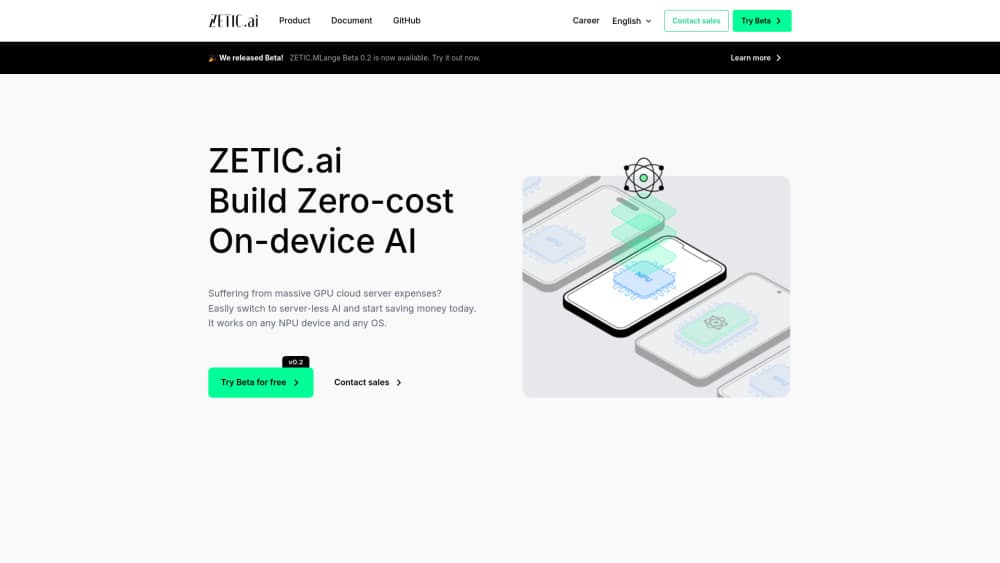
ZETIC.ai puts AI models inside your app's own hardware. Its Melange SDK compiles models for mobile NPUs and edge boards, then picks the fastest chip at runtime, so inference runs offline.
About ZETIC.ai
What Is ZETIC.ai
ZETIC.ai is a Korean edge computing company that sells one thing: getting a trained model to run fast on hardware you already own. Its main product is Melange, an on-device AI platform. You upload a model, the service quantizes and compiles it, and the SDK pulls the compiled binary down to the device.
The pitch is aimed at teams that never wanted to touch C++, OpenCL, or Metal shaders. The SDK exposes a simple model wrapper, and the hard part, which is mapping your graph onto Qualcomm, MediaTek, Samsung, or Apple silicon, happens on ZETIC's side. That is the whole case for NPU acceleration here: you deploy AI models without learning four different vendor toolchains.
Two limits matter before you commit. There is no hosted inference endpoint, so the model ships inside your app rather than behind a URL. And the free path covers Qualcomm, Google Tensor, and Apple Neural Engine, while MediaTek APU and Samsung Exynos DSP sit behind an enterprise agreement.
Getting Started
- Sign up at melange.zetic.ai with a Google or GitHub account. No credit card is needed, and a demo model key works if you only want to test the runtime.
- Upload a trained model in .pt2 or .onnx format, plus sample inputs saved as NumPy .npy files.
- Wait for the background job to finish. Melange analyzes the graph, quantizes weights, and compiles it for each target NPU family.
- Copy the Model Key and your Personal Key from the dashboard, then paste the ready-made snippet into an Android, iOS, or Flutter project.
- Run on a physical phone. Emulators and simulators lack the NPU hardware, so latency numbers there mean nothing.
Product Information
A quick look at ZETIC.ai's pricing, supported platforms, and performance.
Best for
The users, tasks, and scenarios where this tool fits best.
Users
- Mobile developers adding AI features to a shipped app
- Robotics and hardware teams
- Researchers who need device numbers
Tasks
- Running image recognition inside a camera app
- Running a language model without a server
- Checking whether a model fits a phone at all
- Comparing candidate models on identical hardware
Scenarios
- Photo and video apps where uploading user media to a cloud service is a compliance problem
- Products with heavy inference volume and thin margins
- Hardware procurement
Key features
Upload once, get a compiled binary
Melange accepts PyTorch Exported Program (.pt2) and ONNX files. The service analyzes the graph, quantizes it, and compiles it for the target accelerators in the background, then hands back a Model Key that points at that binary. You never build the kernel yourself.
NPU access without driver work
Hardware abstraction covers Qualcomm HTP and DSP, Google Tensor, Apple Neural Engine on A11 and later, plus MediaTek APU and Samsung Exynos DSP under an enterprise agreement. The point is that you write Kotlin, Swift, or Dart, and the platform handles the vendor-specific plumbing that usually eats a quarter of a project.
Backend choice at runtime
Every model is profiled on CPU, GPU, and NPU for each device, and the runtime routes mobile AI inference to whichever is fastest. That matters on phones where the NPU driver lags: on a Galaxy A34 with a MediaTek chip, ZETIC's own numbers put the NPU at 249 ms against 96 ms on GPU, and Melange falls back to GPU there.
One code path for Android, iOS, and Flutter
Android uses Kotlin or Java through Maven, iOS uses Swift through Swift Package Manager, and Flutter has a dedicated package. The wrapper API is the same shape on all three, so the model loading code differs by a few lines rather than a rewrite.
Benchmarks from physical devices
ZETIC measures on a farm of more than 200 real handsets rather than emulators, which surfaces driver fragmentation, thermal throttling, and memory limits. Published numbers include 3.72 ms on a Galaxy S25 NPU and 2.05 ms on an iPhone 15 Pro Max NPU for YOLOv11.
Delivery for robotics stacks
For physical AI work, ZETIC packages the same execution work as a C/C++ library or ROS 2 package and supports Jetson Thor, Orin, and Nano plus Qualcomm QCS and iQ boards. In its π0.5 demo on Jetson AGX Thor, policy inference fell from 253.7 ms to 31.5 ms, roughly 8.1x, measured against a PyTorch eager baseline.
Pros and cons
Pros
- No shader, kernel, or driver work on your side, which is the usual reason on-device AI projects stall.
- Free account with no credit card, and a public demo model key for a first test.
- One model key spans a wide device list, with the runtime picking CPU, GPU, or NPU per handset.
- Benchmarks come from real hardware, so latency estimates survive contact with production.
- Robot and edge board delivery is quoted at two days for supported models, with a C/C++ or ROS 2 package.
Cons
- MediaTek APU and Samsung Exynos DSP require an enterprise agreement, so consumer app teams on those chips get GPU paths only.
- No hosted API. If you wanted a REST endpoint instead of an SDK, this is the wrong shape of product.
- Minimum targets are Android 7.0 and iOS 16.6, and physical hardware is mandatory for any real measurement.
- Pricing is not published, and new model architectures or boards take about a week before delivery.
Frequently asked questions
It moves AI inference onto the device. You bring a trained model and a target phone or board, and ZETIC compiles that model to run on the local NPU, GPU, or CPU.
Related content
Explore related tools, skills, and articles for ZETIC.ai.
ZETIC.ai Alternatives

Odyssey 3
Odyssey · OtherOdyssey-3 is Odyssey's foundation world model. It simulates physics in real time, turns a prompt into an interactive environment, and adapts to robots, cars and games.

JarvisCore
Prescott Data · Coding · Productivity · OtherJarvisCore is an open source Python runtime where AI agents work as equal peers on an agent mesh, claim tasks from a shared ledger, and reach external services through a zero-trust broker.
Clef
Cloudflare · Business · OtherClef is Cloudflare's open-source decision model for Workers AI. It returns calibrated probabilities for typed questions, not generated text, so agents can classify, route, and act fast.