

Zetta
Zetta · Coding · Marketing
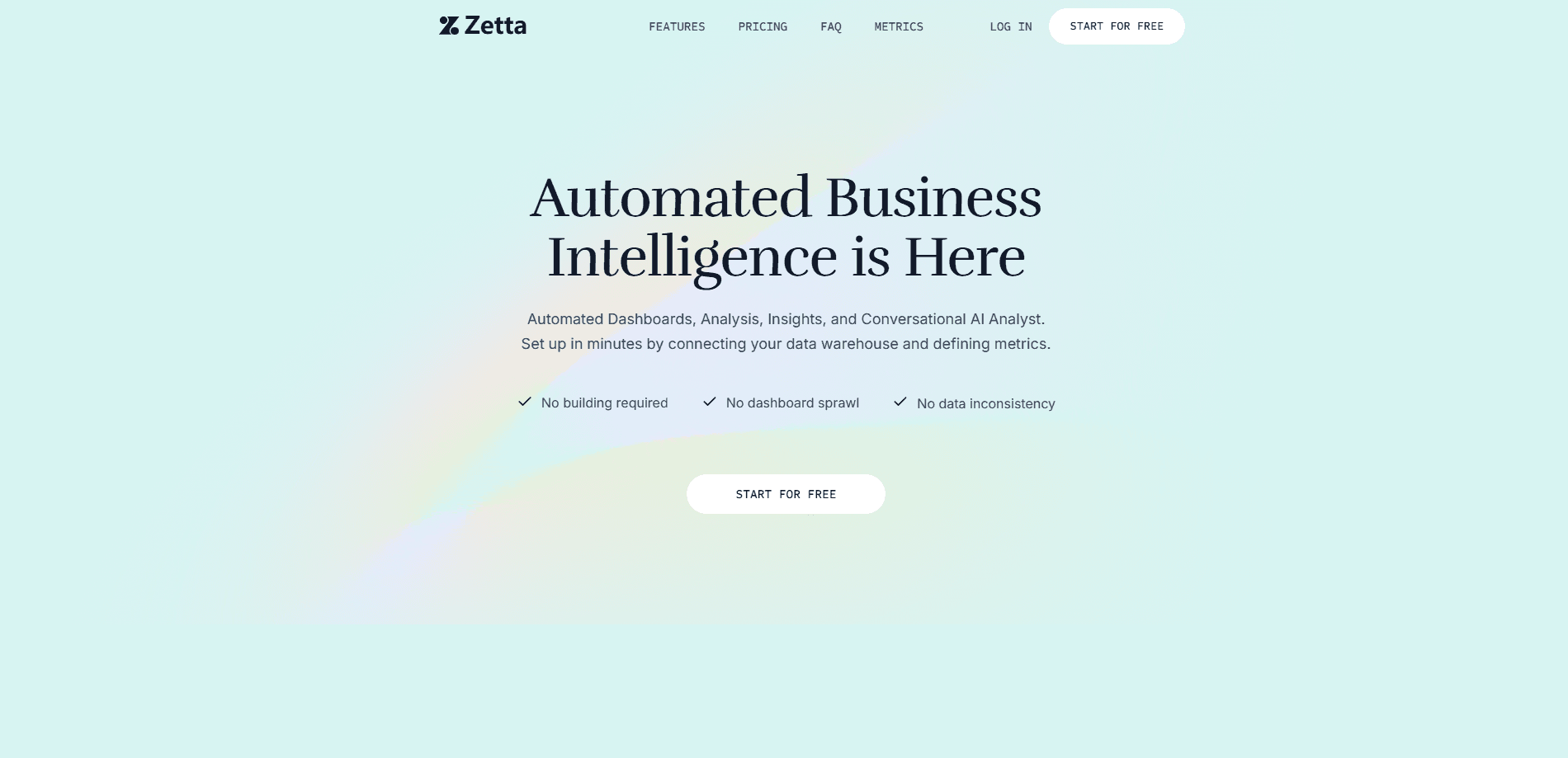
Zetta is an AI data analytics platform that connects to your data warehouse and auto-builds dashboards, metrics and insights, backed by a conversational AI Data Analyst.
About Zetta
What Is Zetta
Zetta is an automated business intelligence platform built around exactly that idea. Instead of hiring a data team to build dashboards by hand, you connect a data warehouse, define your key metrics in one place, and Zetta generates the dashboards, charts and written insights for you. It also ships a conversational AI Data Analyst, so business users can ask a question in plain language and get an answer without filing a ticket with the data team.
The pitch speaks directly to a common frustration. Most startups drown in dashboards that nobody trusts, because the same metric gets defined three different ways in three different spreadsheets. Zetta's answer is a single metrics builder that becomes the source of truth, and dashboards that update themselves from it. The company frames the result as visibility you get in minutes rather than weeks of setup.
There are real limits to weigh. Zetta is a young product from a small team, and the Starter plan caps you at one user and ten metrics, so it suits a founder tracking core numbers more than a large analytics org with dozens of stakeholders. The Enterprise tier is where the wider data connectors, managed warehouse and fractional data experts live, and that runs on custom pricing.
Getting Started
- Request access from the Zetta site and create your workspace
- Connect your data warehouse, currently Snowflake, BigQuery or Redshift on the self-serve plans
- Open the metrics builder and define the KPIs you want to track, each with plain-language documentation
- Let Zetta generate the dashboards and insights, then query them conversationally through the AI Data Analyst
Product Information
A quick look at Zetta's pricing, supported platforms, and performance.
Best for
The users, tasks, and scenarios where this tool fits best.
Users
- Startup founders
- Small data teams
- Business users
- Companies without data infrastructure
Tasks
- Tracking company-wide KPIs
- Ad-hoc data questions
- Building a single source of truth
- Root-cause analysis
- Investor and board reporting
Scenarios
- A founder checks MRR and churn on a Monday morning
- A marketer asks why signups dipped last week
- A small team loses its only analyst
- A company has data in Snowflake but no one to model it
- Preparing for a board meeting
Key features
Automated Dashboards
Point Zetta at your connected warehouse and it builds the dashboards for you, with visualizations that update as your data changes. The company's promise is no dashboard sprawl and no building on your side, which matters most for teams that never got around to setting up BI properly. You still get flexibility in how charts look, but the default path is automatic rather than hand-assembled.
Conversational AI Data Analyst
The AI Data Analyst is a chat interface over your data. You ask a question the way you'd ask a colleague, and it returns an answer, often with a chart. Each self-serve plan includes a monthly question quota, 1,000 on Starter and 10,000 on Growth, which caps how much the analyst gets used. For business users who don't write SQL, this is the feature that decides whether Zetta is worth it.
Centralized Metrics Builder
The metrics builder is where you define what each KPI means, once, with documentation attached. Every dashboard then pulls from that single definition, so two reports can't quietly disagree about what counts as an active customer. This is the part that addresses the data inconsistency problem the company leads with, and it's the reason a metrics-first setup beats ad-hoc dashboards.
AI-Powered Insights
Beyond charts, Zetta generates written insights that explain the root cause and likely direction of a KPI, not just its current value. The company positions this for telling a growth story to investors and a board, where the narrative around a number carries as much weight as the number. It's a step up from a raw dashboard. The quality of any AI insight still depends on how well your metrics are defined upstream.
Data Warehouse Connectivity
On the self-serve plans, Zetta connects to Snowflake, BigQuery and Redshift, the three warehouses most startups already run. That keeps setup to connecting an existing warehouse rather than migrating data. The Enterprise plan widens this to a catalog of 350+ connectors spanning Salesforce, Hubspot and ad platforms, aimed at teams pulling in operational data alongside warehouse tables.
Managed Warehouse and Expert Services
The Enterprise tier wraps the software in a service. Zetta can host and manage the data warehouse, set up your metrics for you, and give you access to a fractional data team plus a prebuilt library of ARR dashboards for Stripe and Chargebee. That's a different proposition from a self-serve BI tool, and it's aimed at companies that want the outcome without building the capability in-house.
Pros and cons
Pros
- Automated dashboards remove the manual building that usually blocks a small team from getting BI set up
- The metrics builder gives every report one shared definition, which cuts the inconsistency that erodes trust in data
- A free Starter plan and a $100 per month Growth plan keep entry costs low for startups
- The conversational AI Data Analyst lets non-technical users get answers without writing SQL
- Enterprise adds a managed warehouse and data experts, so you can buy the outcome rather than the tool alone
Cons
- The Starter plan is capped at one user and ten metrics, too tight for anything but a solo founder
- Self-serve plans connect only to Snowflake, BigQuery and Redshift, so teams on other warehouses have to wait for Enterprise
- Zetta is a young, small company, so there's less of a track record than with an established BI vendor
- There's no public API or self-serve export documentation, which matters if you want to move data or metrics in and out programmatically
Frequently asked questions
Zetta, at zettadata.ai, is an AI-powered data analytics platform that connects to your data warehouse and automatically produces dashboards, insights and metric definitions. It also includes a conversational AI Data Analyst that answers questions about your data in plain language, so teams can get insights without building dashboards by hand.
Related content
Explore related tools, skills, and articles for Zetta.
Zetta Alternatives

Base Code
Base44 (Wix) · Coding · ProductivityBase Code is a shared cloud development environment from Base44. Teammates describe changes to an existing GitHub codebase in chat, preview them live and send them back as pull requests.

Google EmbeddingGemma 2
Google DeepMind · Writing · Image · CodingGoogle EmbeddingGemma 2 is a 740M-parameter open model that turns text, code, images, audio, and video frames into vectors in one 768-dimension space, running on phones and laptops.

GitGlow
GitGlow · Coding · ProductivityGitGlow is a local-first desktop Git client that lets independent developers review their own code and their AI agents' changes in one place before shipping.