

Zilliz Cloud
Zilliz · Coding
Zilliz Cloud is a managed vector database on open-source Milvus, built for teams making AI search and recommendation apps. A fast start for vector search.
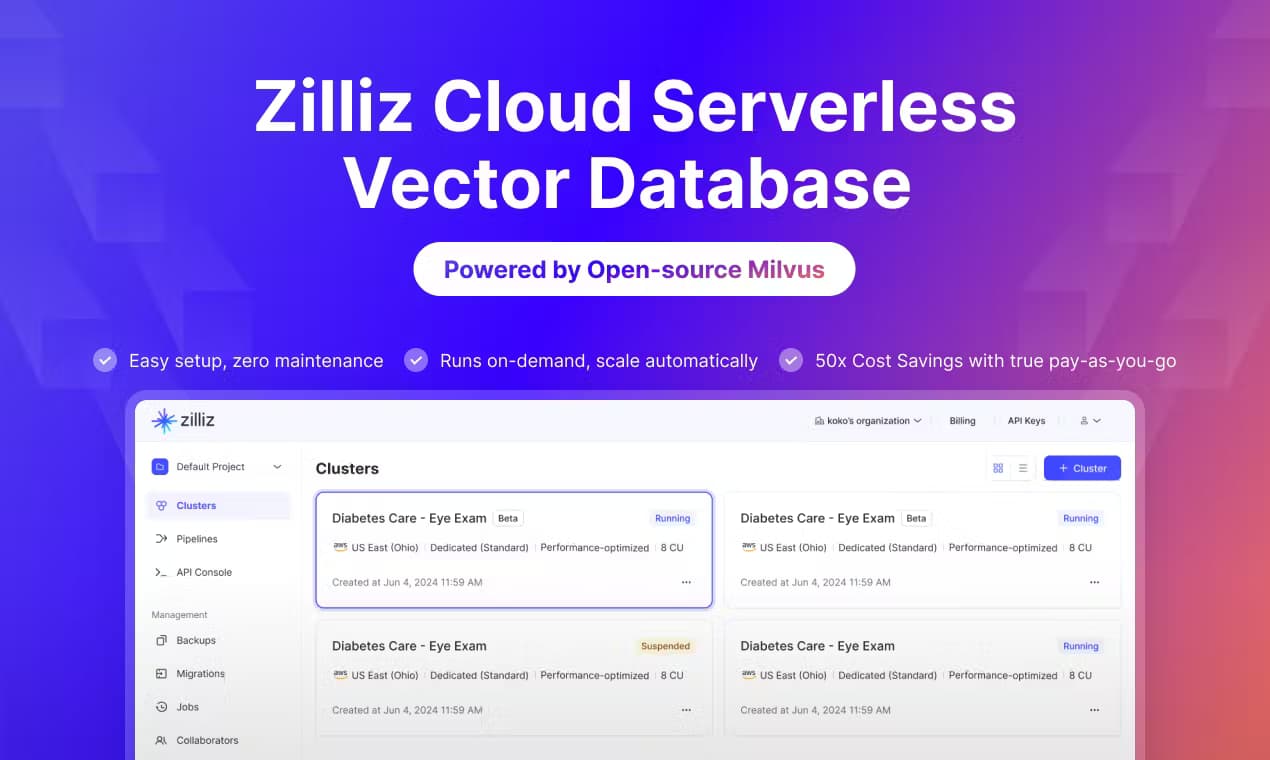
About Zilliz Cloud
What Is Zilliz Cloud
Zilliz Cloud is a fully managed vector database service from Zilliz, the company behind the open-source Milvus project. It stores embeddings, the numeric vectors that AI models produce when they turn text, images, or audio into something a machine can compare. Then it finds the closest matches in milliseconds. If you've ever used a "semantic search" box that understands meaning instead of exact words, a vector database like this is usually what powers it underneath.
The pitch is simple. Milvus is powerful, but running it yourself means hiring engineers to tune indexes, manage clusters, and keep everything online around the clock without letting recall slip. Zilliz Cloud takes that work off your plate while keeping the same core engine underneath. You get managed infrastructure across AWS, Google Cloud, and Azure, plus a free tier to test ideas before you commit.
The catch is cost and lock-in. Dedicated clusters start around $126 per GB per month, which adds up fast for large datasets. And while the product is Milvus-compatible, you're still leaning on Zilliz to run it, so a self-hosted setup remains the escape hatch if you want full control.
Getting Started
- Sign up for a free account at cloud.zilliz.com and create your first project.
- Spin up a cluster: pick the free serverless tier for testing or a dedicated cluster for production.
- Create a collection, then define the vector field and its dimension to match your embedding model.
- Insert your embeddings through the SDK, REST API, or a data import job.
- Run a similarity search query and read back the closest matches with their scores.
Product Information
A quick look at Zilliz Cloud's pricing, supported platforms, and performance.
Best for
The users, tasks, and scenarios where this tool fits best.
Users
- AI developers building RAG pipelines
- Data and ML teams at growing companies
- Startups prototyping a semantic search feature
Tasks
- Storing and querying embeddings from text, image, or audio models
- Hybrid search across dense and sparse vectors
- Powering recommendation engines
Scenarios
- Building a chatbot that answers from your own documents
- Running a large-scale similarity search job over external data
- Meeting compliance requirements in regulated industries
Key features
Managed Milvus Without the Ops Burden
Zilliz Cloud runs the same engine as open-source Milvus but handles upgrades, scaling, and monitoring for you. That matters if your team wants vector search without hiring a specialist to babysit clusters. Automated deployment and built-in tooling replace months of manual setup and tuning.
AI-Powered AutoIndex and Cardinal Search Engine
The platform picks an indexing strategy for each dataset automatically through AutoIndex and its Cardinal search engine. You don't hand-tune parameters to get good recall. For teams without deep vector-search expertise, this removes the hardest part of the job.
Hybrid Search
You can query across multiple vector fields in one request, mixing sparse and dense vectors or combining dense vectors with text. That makes results more accurate than pure semantic search when exact terms matter, like product codes or names. Ever searched for a specific part number and gotten fuzzy nonsense back? Hybrid search fixes that.
Horizontal Scaling
A component-based architecture lets you scale horizontally as your data grows. Performance stays steady across a small prototype or a production workload with fluctuating traffic. You pay for the compute you actually use on the serverless tier.
Enterprise Security and Compliance
The higher tiers add SSO with SAML 2.0, granular role-based access control, audit logs, and private endpoints with VPC peering, giving security teams the controls they expect before signing off on a new data store. The Business Critical plan goes further with customer-managed encryption keys and HIPAA-eligible controls, which matters for healthcare and finance teams.
Multiple Deployment Options
You can run fully managed on Zilliz's cloud, keep it inside your own infrastructure with BYOC, or use dedicated clusters with reserved compute. Each option carries the same core feature set, so you're choosing where it lives, not what it does.
Tunable Consistency and Similarity Metrics
Multiple consistency levels let you decide how fresh your search results need to be, balancing accuracy against speed. You also pick the similarity metric, like cosine or Euclidean distance, to match how your embeddings were trained.
Pros and cons
Pros
- Fully managed, so you skip the engineering work that self-hosted Milvus demands.
- Runs on AWS, Google Cloud, and Azure, with a free tier to start.
- AutoIndex removes manual tuning, which helps teams without vector-search specialists.
- Hybrid search and multiple similarity metrics cover more use cases than plain vector lookup.
Cons
- Dedicated clusters start near $126 per GB per month, so large datasets get expensive quickly.
- The free tier caps you at 5 GB and 5 collections, too small for real production.
- You're depending on Zilliz to run the service, so a self-hosted Milvus setup is the only way to avoid that reliance.
Frequently asked questions
It stores and searches vector embeddings so AI applications can find similar items fast. Common uses include semantic search, retrieval with generation, recommendations, and anomaly detection.### Is Zilliz Cloud free to use? Yes, there's a free tier with 5 GB of storage, 2.5 million vCUs per month, and up to 5 collections. It's meant for learning and personal projects, not production workloads.
Related content
Explore related tools, skills, and articles for Zilliz Cloud.
Zilliz Cloud Alternatives

Base Code
Base44 (Wix) · Coding · ProductivityBase Code is a shared cloud development environment from Base44. Teammates describe changes to an existing GitHub codebase in chat, preview them live and send them back as pull requests.

Google EmbeddingGemma 2
Google DeepMind · Writing · Image · CodingGoogle EmbeddingGemma 2 is a 740M-parameter open model that turns text, code, images, audio, and video frames into vectors in one 768-dimension space, running on phones and laptops.

GitGlow
GitGlow · Coding · ProductivityGitGlow is a local-first desktop Git client that lets independent developers review their own code and their AI agents' changes in one place before shipping.