

zMaticoo
Eclick Tech · Marketing
zMaticoo is a programmatic advertising platform from Eclick Tech that connects app publishers with global ad demand through SDKs, RTB and Prebid.
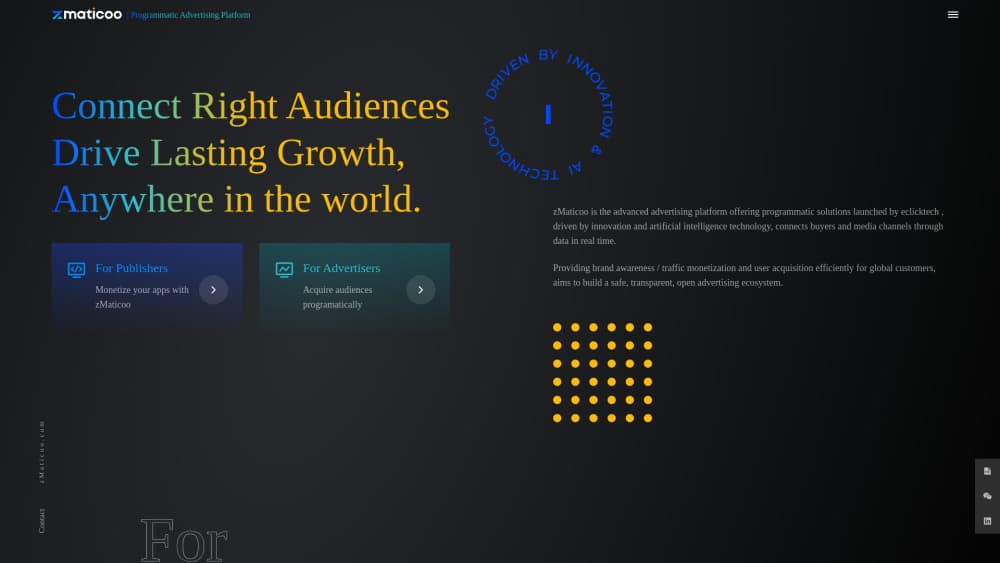
About zMaticoo
What Is zMaticoo
zMaticoo is an ad tech platform for in-app advertising, built for mobile apps that want to sell their ad space and for advertisers that want to buy app users. It runs a supply-side platform, an ad exchange and a demand-side platform under one login. Publishers plug in an SDK or a tag, define placements, and let the platform auction each impression to connected buyers.
The company behind it is Eclick Tech, a marketing technology firm with offices across Asia, Europe and the Americas. zMaticoo is the part of that business aimed at in-app inventory. The platform carries demand from brand and performance campaigns in ecommerce, gaming, retail and travel, and it reports that more than 85 percent of top app developers work with it. That figure comes from the vendor.
Two things shape whether it fits. First, it's built for publishers with real traffic. Signing up asks for company details and payment information, so a hobby project with a few hundred daily users rarely gets far. Second, pricing isn't listed. Revenue share terms come from a sales conversation, which makes comparison shopping harder. For a studio with a live app and a global audience, the mix of SDK, header bidding and managed demand covers most of what a mobile ad monetization stack needs.
Getting Started
- Register on the zMaticoo SSP sign-up page with a work email, company information and payment details. Wire and PayPal are both supported.
- Add your app under Application, then Apps, then Add App. Enter the bundle ID or App Store ID, the store listing URL and your website, which the platform uses to check app-ads.txt.
- Wait for verification. Approved apps switch to Live status, and you get the result by email.
- Create ad placements and choose a format for each one: banner, rewarded video, interstitial, native or interactive. Set the placement size, skip timing and price type.
- Integrate the Android, iOS or Unity SDK, add a test device in the dashboard, and confirm that test ads fill before you push the build live. Revenue then shows up in reports.
Product Information
A quick look at zMaticoo's pricing, supported platforms, and performance.
Best for
The users, tasks, and scenarios where this tool fits best.
Users
- Indie app developers with one live app
- Mid-size publishers with several apps
- Performance advertisers and media buyers
- Agencies running app portfolios for clients
Tasks
- Monetizing a casual or hyper-casual game
- Filling unsold inventory through header bidding
- Launching a user acquisition push for a new app
- Adding ads to a mobile web or H5 game
Scenarios
- An app has passed soft launch and needs global fill
- A regional app wants US revenue without a US sales team
- A publisher is consolidating ad partners
Key features
One Stack for Supply, Exchange and Demand
zMaticoo runs a mobile SSP, an ad exchange and a DSP as connected products. Publishers sell inventory through the SSP, the ad exchange matches those impressions with buyer demand, and advertisers manage campaigns in the DSP. Keeping all three in one company shortens the path between an ad request and a paid impression. It also means reporting lines up across buying and selling, which is useful for studios that both monetize and advertise.
Four Ways to Integrate
There's more than one route into the platform. Mobile apps use the Android, iOS or Unity SDK. Web and H5 publishers use a JSTag or VASTTag. Advertisers and networks connect through RTB, and Prebid covers header bidding setups. Third-party SSPs and ad exchanges can also plug in. That range matters for publishers who run several properties and don't want a different vendor for each one.
Five Ad Formats With Placement Controls
Banner, rewarded video ads, interstitial, native and interactive formats are all supported. Each placement gets its own settings. Banners refresh on a 30 second cycle by default. Interstitials let you set the skip button between 3 and 10 seconds, with 5 as the default. Native units take video and images and can be styled to match the app. Interactive ads need a conversation with the operations team before you create the placement, since they're built around gamified engagement.
AI Bidding and Demand Pacing
The company says machine learning sets bid levels and routes traffic to the demand most likely to pay. In practice, that shows up as automatic price adjustments per placement and region rather than a fixed floor you maintain by hand. Advertisers get the same system from the buy side, where budgets shift toward audiences that convert. You can still set price types manually if you'd rather keep control.
Brand Safety and Traffic Verification
The SDK is listed in the Google Play SDK Index, which means it passed Google's review for scale, security and stability. Impressions are scanned by Human and Pixalate, and ad creative safety is handled by GeoEdge and TMT. For publishers, the practical benefit is fewer low quality ads reaching users, which protects retention. For advertisers, it's a paper trail they can show clients.
Reporting on Revenue and Fill
The dashboard tracks revenue by app and placement, along with fill and request data. Publishers can compare formats and see which placement earns per impression, then adjust floors or swap formats. Automated reports can be scheduled, which saves the weekly export routine. Advertisers see spend, conversions and return on ad spend in the same account structure.
Pros and cons
Pros
- One account covers monetization and user acquisition, so a studio doesn't need separate SSP and DSP vendors.
- SDKs for Android, iOS and Unity, plus RTB, Prebid and JSTag options, cover most app and web setups.
- Five ad formats with per placement controls let you test what fits the app instead of accepting defaults.
- Brand safety checks from Google Play, Pixalate, GeoEdge and TMT give advertisers documentation and publishers cleaner inventory.
- Global support teams and data centers reduce latency for users outside the US and Europe.
Cons
- Pricing isn't published. Revenue share and minimum traffic terms come from sales, so you can't compare costs before a call.
- Sign-up requires company information and payment details, which rules out quick self-serve testing for small projects.
- Demand skews toward US audiences. Apps with traffic concentrated in markets outside the US, APAC and Europe may see lower fill.
- The help center is thin on cross-platform wrappers. React Native and Flutter developers will need to bridge the native SDK themselves.
Frequently asked questions
It sells ad space inside mobile apps and buys app users for advertisers. Publishers integrate an SDK or tag, the platform auctions each impression to connected buyers, and revenue lands in the SSP dashboard. The DSP side runs acquisition campaigns on the same demand pool.
Related content
Explore related tools, skills, and articles for zMaticoo.
zMaticoo Alternatives

ngram 2.0
ngram · Video · Marketingngram 2.0 is an AI video generator for teams. It turns a prompt, a screen recording, or a product URL into a narrated explainer, product demo, or AI avatar video, and every scene stays editable.

shippedit.me
Krawlup · Marketing · Businessshippedit.me now redirects to Krawlup, a web platform that audits SEO, AEO and page speed every week, then hands the fixes to AI coding agents over MCP.

MePersona
MePersona, Inc. · Writing · Productivity · MarketingMePersona is an AI unified inbox for creators. It learns your voice, drafts replies to fan messages from 12 platforms, and sends only what you approve.