

ZooData
ZooData · Coding
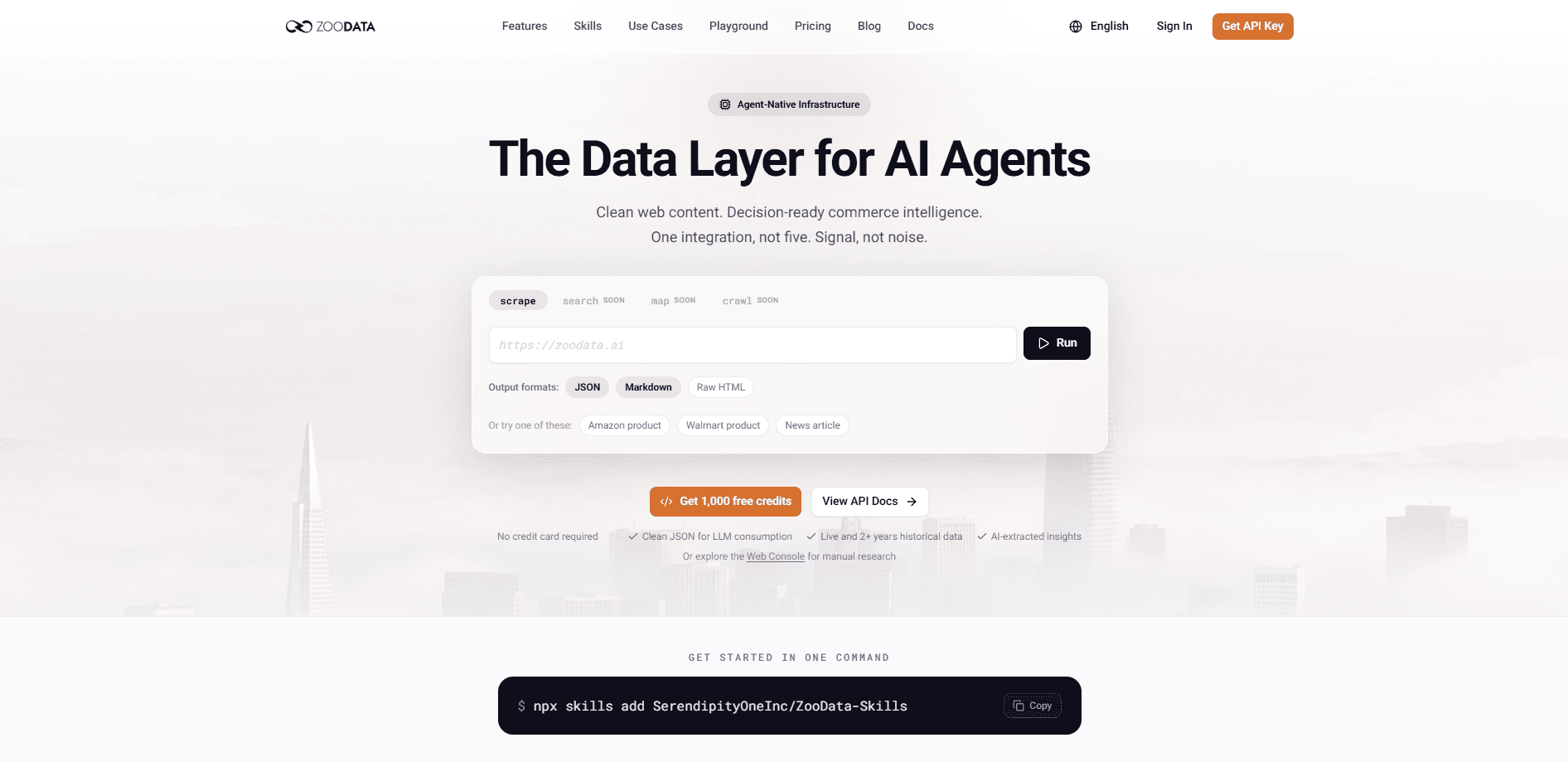
ZooData is an agent-native commerce data layer that turns messy ecommerce signals into clean, structured JSON. It pulls from live and 2+ years of historical Amazon data, then hands the results to AI agents over an API-first OpenAPI v2 interface. Building an agent that reasons about products, prices, or market trends? ZooData is the plumbing that feeds it reliable data instead of scraped junk. That distinction matters more than it sounds.
About ZooData
What Is ZooData
ZooData sits between raw ecommerce data and the agents that need to act on it. Instead of scraping Amazon yourself and cleaning the output by hand, you call the ecommerce data API and get back tidy JSON with the fields already normalized. That saves the part of agent development nobody enjoys: data wrangling. Less glue code, fewer bugs.
The company markets it as "the data layer built for agents," which is a fair description of the problem it targets. Agents break when their inputs are inconsistent, so ZooData's value is consistency as much as coverage. It works as an Amazon product data API and a structured JSON API at once, serving live signals plus more than two years of history. That combo lets you compare today's prices against a real baseline.
The biggest limitation is scope. ZooData centers on Amazon commerce signals, so it won't help if your agent needs data from other marketplaces. Pricing isn't published on the site either, which means you'll need to contact the team before you can budget for it. No public numbers, no free trial.
Getting Started
- Go to zoodata.ai and request API access from the team.
- Read the OpenAPI v2 documentation to see which endpoints cover the data you need.
- Authenticate with your API key and make a test call against a live product.
- Pull historical signals alongside live ones to build your comparison baseline.
- Wire the structured JSON response into your agent's tool or function layer.
Product Information
A quick look at ZooData's pricing, supported platforms, and performance.
Best for
The users, tasks, and scenarios where this tool fits best.
Users
- AI agent developers
- Ecommerce analysts
- Data engineers
Tasks
- Feeding product and pricing context into a shopping agent
- Tracking price movement over time
- Extracting product insights with AI
Scenarios
- Prototyping an agentic shopping assistant
- Researching a product category before launch
- Backfilling a data pipeline with commerce history
Key features
Agent-Native Structured JSON
Every response comes back as clean, structured JSON built for machine consumption. There's no half-parsed HTML to untangle, which means your agent spends its time reasoning instead of cleaning. That's the core promise. Data your code can trust on the first pass, without a cleanup script sitting in the middle.
Live and Historical Amazon Signals
ZooData serves current Amazon signals alongside more than two years of history. Why does that matter? A single snapshot tells you nothing about direction. With history in the same response format, you can build trend logic without bolting on a second data source.
AI-Extracted Insights
Beyond raw fields, ZooData runs AI extraction over the underlying signals and returns insights, which means you receive records plus the interpretation layered on top of them. Think of it as a lightweight analysis layer sitting on top of the data. You still get the structured records, but you also get the interpretation, which shortens the path from data to decision.
API-First OpenAPI v2 Interface
The whole product is designed to be called, not clicked. The OpenAPI v2 interface gives you a predictable contract your tooling can generate clients from, so integration work becomes mechanical rather than exploratory. For teams shipping agents, a stable spec beats a pretty dashboard every time.
Commerce Data Layer Architecture
ZooData positions itself as a layer, not an app. That means it's meant to sit underneath whatever you're building rather than replace it. If your stack already has a front end and a logic layer, ZooData slots in as the data source beneath both, feeding them without forcing a rewrite of either.
Pros and cons
Pros
- Structured JSON output removes the cleaning work that usually follows a scrape, which means your team spends its time building agent logic instead of babysitting a fragile parser that breaks every time a page layout changes.
- Two-plus years of history lets you compare current signals against a real baseline.
- API-first design with OpenAPI v2 makes client generation straightforward.
- AI-extracted insights add an analysis layer without a second vendor.
Cons
- Currently focused on Amazon signals, so multi-marketplace agents need another source.
- Pricing isn't published, so you can't estimate cost without contacting the team first.
- No free tier means there's no way to test the data quality before committing.
Frequently asked questions
It's a commerce data layer that turns live and historical Amazon signals into clean, structured JSON for AI agents to consume. You call the API, and it returns normalized data plus AI-extracted insights. You don't scrape anything yourself.
Related content
Explore related tools, skills, and articles for ZooData.
ZooData Alternatives
Forefront
Forefront · CodingForefront is a web platform for building with open-source AI. It lets you fine-tune leading open-source language models on your own data, evaluate how they perform, and run them through an API or export them to host yourself. Developers who want the convenience of a closed-source platform but insist on owning their models and data are the target audience here.

Startkit
StartKit.AI · CodingStartkit is a boilerplate for building AI SaaS and AI wrapper products. Think of it as an AI startup boilerplate with the boring parts already wired up: authentication, Stripe and Lemon Squeezy payments, usage limits, transactional email, and an AI API starter that talks to OpenAI, Anthropic, Groq, or Llama. You clone the repo, set your price, and start on the part of your product that people actually pay for. It's Next.js under React and Tailwind, so most of the boilerplate code already feels familiar.
Testim
Tricentis · CodingTestim is an AI-powered test automation platform for building and running end-to-end tests across web, mobile, and Salesforce applications. It leans on machine learning to keep tests stable when an interface changes, so teams spend less time fixing broken selectors. Not bad for an automated testing tool you can start using today. You create tests by recording actions in a browser, then optionally add JavaScript when you need more control. It's a solid pick for busy QA teams.