

ZooWork
Serendipity One Inc. · Coding · Business · Chatbot
ZooWork is an AI agent delivery platform for forward-deployed engineers and domain experts. Teams describe a job in chat, connect their systems, and ship agents that run on a managed runtime.
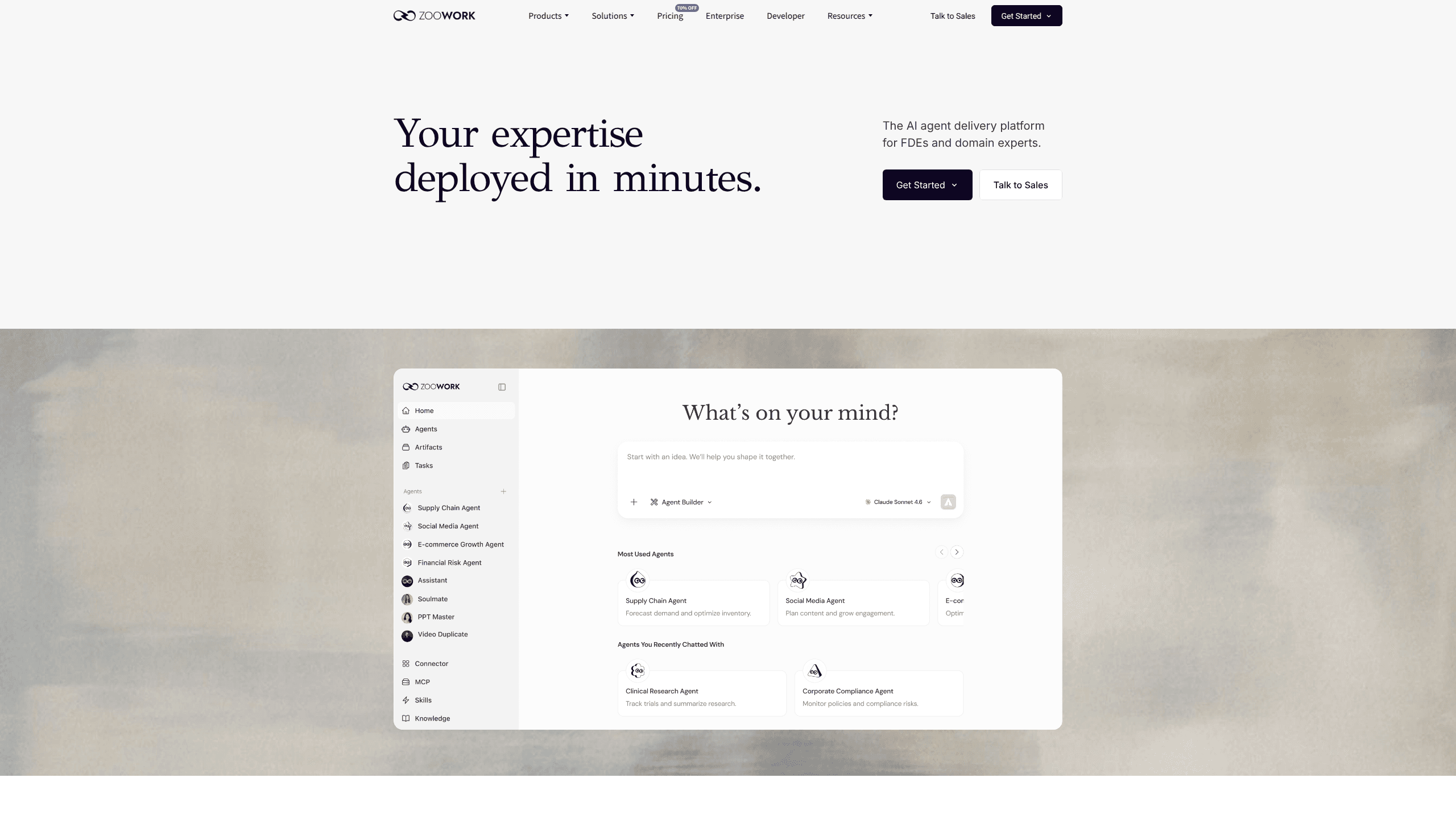
About ZooWork
What Is ZooWork
ZooWork is an agent platform from Serendipity One Inc., a US company founded in 2023. It goes after a specific gap: the people who know a job best usually can't build the software that automates it, and the engineers who can build it don't know the job. ZooWork lets the first group describe their work in plain language, then gives the second group an API to run the result inside their own products. That split explains why so many domain expert AI agents stall after the demo.
The build path is a conversation, and the AI agent builder is where written knowledge turns into a running role. You tell the builder who the agent is, what outcome it owns, which systems it can touch, and what "done" means. That becomes an Agent Skill: a packaged role with company knowledge, working SOPs, delivery standards, and tool permissions. The agent then runs on ZooWork's cloud runtime, which handles planning, tool calls, sandboxes, schedules, and human approval gates.
Two limits matter before you sign up. The Managed Agent API is in developer preview, so endpoints can change. And the product rewards teams that already write down how work gets done. If your best operator keeps the playbook in their head, expect to spend the first week getting it out.
Getting Started
- Create a ZooWork account and open Agent Builder.
- Pick an industry template or start from a blank role, then describe the job, the outcome, and the systems involved.
- Connect tools through Google Workspace, Microsoft 365, Slack, Jira, GitHub, or an MCP server for internal systems.
- Set permissions and approval gates for any action that moves money or writes to a live system.
- Publish the agent to Slack, Microsoft Teams, WhatsApp, or the iOS app, or call it through the Managed Agent API.
Product Information
A quick look at ZooWork's pricing, supported platforms, and performance.
Best for
The users, tasks, and scenarios where this tool fits best.
Users
- Forward-deployed engineers
- Domain experts in operations, marketing, or finance
- Small teams without machine learning staff
- Enterprise IT and security leads
Tasks
- Recurring operations reports
- Research and first drafts
- Turning web pages into structured data
- Building an agent into a customer-facing product
Scenarios
- Retail and e-commerce operations
- Agency production work
- A seven-day enterprise pilot
Key features
Agent Builder turns a chat into a shipped agent
You describe the role, the goal, and the rules in conversation, and the builder produces a configured agent you can preview and publish. A library of industry and role templates means you start from a working playbook rather than a blank page. Changes arrive as follow-up requests, so adding an escalation rule takes one message.
Agent Skills hold the job description
An Agent Skill bundles five things: who the agent is, the company knowledge it can use, the SOPs your best people follow, the standard that defines done, and the tools it may touch. That package is what separates a role from a prompt. It also gives you a single place to update behavior when the process changes.
A managed runtime with sandboxes and approvals
Agents plan before acting, break large jobs into steps you can inspect, and run code in isolated sandboxes with Python, shell, and a browser. Anything that moves money or writes to a system of record can wait behind a human approval gate. The runtime is Kubernetes-native, scales compute and storage as work grows, and keeps a replayable record of every tool call.
Model routing across 20 or more models
ZooWork connects OpenAI, Claude, Gemini, DeepSeek, Kimi, GLM, and others behind one interface. Hard problems can go to the strongest model while routine work goes to a cheaper, faster one. You aren't locked into a single vendor, and the routing decision stays visible in the run log.
Managed Agent API for your own product
The API runs the same agents on ZooWork's infrastructure and hands you session control, event streaming, webhooks, per-user agents, memory, and file handling. TypeScript and Python SDKs cover the common paths. Billing is prepaid and usage-based: model tokens at each provider's list price with no markup, plus tool and compute time.
Agents inside the chat tools your team uses
You can mention an agent in Slack, Microsoft Teams, or WhatsApp and ask it to do something, the same way you would ask a colleague. Threads keep the context, and the agent reports back with links to the work. An iOS app covers the same ground when you're away from a desk.
Pros and cons
Pros
- The build path fits people who know the work but not the code, which is rare among agent platforms.
- One runtime covers planning, sandboxes, schedules, memory, and approvals, so you don't stitch together five services.
- Model choice stays open, and token pricing follows provider list rates with no markup.
- Approval gates and audit trails give security teams a concrete review point before agents write to production.
- The seven-day pilot with a forward-deployed engineer lowers the risk of a first project.
Cons
- The Managed Agent API is still in developer preview, so building it into a customer product means accepting breaking changes.
- Credits make costs hard to predict: the same task can burn very different amounts depending on model and tool use.
- There's no free plan, so evaluating the product costs $30 at minimum, and the API needs prepaid funds on a separate balance.
- Results depend on how well your processes are documented; teams with tribal knowledge will do more setup work before they see value.
Frequently asked questions
ZooWork is used to build and run AI agents that do a defined job, such as checking store inventory, drafting proposals, or extracting product data from web pages. The agent runs on a managed cloud runtime and can report into Slack, Microsoft Teams, WhatsApp, or your own app through the API.
Related content
Explore related tools, skills, and articles for ZooWork.
ZooWork Alternatives

Base Code
Base44 (Wix) · Coding · ProductivityBase Code is a shared cloud development environment from Base44. Teammates describe changes to an existing GitHub codebase in chat, preview them live and send them back as pull requests.

Google EmbeddingGemma 2
Google DeepMind · Writing · Image · CodingGoogle EmbeddingGemma 2 is a 740M-parameter open model that turns text, code, images, audio, and video frames into vectors in one 768-dimension space, running on phones and laptops.

GitGlow
GitGlow · Coding · ProductivityGitGlow is a local-first desktop Git client that lets independent developers review their own code and their AI agents' changes in one place before shipping.